
Ingredients
Delivery Systems in Skincare, Explained
Liposomes, niosomes, cyclodextrins, and nanoemulsions explained — why two products with the same % active can behave completely differently.
Disclosure — This article may contain affiliate links. We earn a small commission at no extra cost to you when you purchase through our links. This supports our ability to create independent, evidence-based skincare content.
Two serums can both say “15% vitamin C” on the label and do completely different things on your face. One brightens visibly in six weeks. The other oxidizes in the bottle before it ever gets the chance. The percentage isn’t lying — it’s just not the whole story.
The part nobody puts on the front of the label is the delivery system: the vehicle that decides whether an ingredient actually reaches a living cell, in an active form, before your skin’s enzymes or the air in your bathroom breaks it down. This is the unglamorous half of formulation chemistry, and it matters more than most ingredient percentages do.
Why the Percentage on the Label Barely Tells You Anything
Concentration tells you how much of an ingredient went into the batch. It does not tell you how much survives to do anything once it’s on your skin.
Vitamin C is the clearest example. L-ascorbic acid is a small, unstable molecule that oxidizes on contact with light, air, and water — we’ve covered why that orange tint shows up in a 15% serum within weeks of opening it. A 10% serum stabilized properly can outperform a 20% serum that’s already half-oxidized by the time you apply it. Same goes for retinol, which degrades in sunlight and loses potency through oxidation before it ever reaches a keratinocyte.
The skin itself adds another layer of difficulty. The stratum corneum is built to keep things out — that’s its job. Most actives are either too large, too water-soluble, or too unstable to cross it in meaningful amounts on their own. A delivery system is the formulator’s answer to that problem: a vehicle designed to protect the active, help it penetrate, and release it where it can actually do something.
This is why two products with identical percentages can produce different results, and why the better question isn’t “how much” but “how much actually gets there.”
Liposomes: The Original Trojan Horse
Liposomes are tiny spheres built from phospholipids — the same fat molecules that make up your cell membranes. Because they’re structurally similar to skin cells, they can fuse with the cell membrane and release their payload inside, rather than just sitting on the surface.
This matters for two reasons. First, protection: an active locked inside a liposome is shielded from oxygen and light, so it degrades slower. Second, penetration: liposomes are small enough (often 50–200 nanometers) to slip between corneocytes in ways a free molecule dissolved in water cannot.
The evidence here is genuinely solid. Liposomal encapsulation has decades of pharmaceutical research behind it, originally developed for drug delivery long before skincare brands picked it up. Studies on liposomal retinol and liposomal vitamin C do show improved stability and, in some cases, better skin penetration compared to free-form versions of the same ingredient.
The catch: liposomes are expensive to manufacture and unstable themselves if the formulation isn’t handled right. A cheap “liposomal” claim on a $14 serum should make you skeptical — proper liposome production requires specific equipment and quality control that doesn’t come free. If you see the word with no explanation of the lipid composition or no mention of a patented delivery name, treat it as marketing until proven otherwise.
Encapsulated retinol is the most common consumer-facing application, and it’s worth understanding on its own terms — we go deeper on how the shell actually changes performance in our guide to encapsulated retinol.
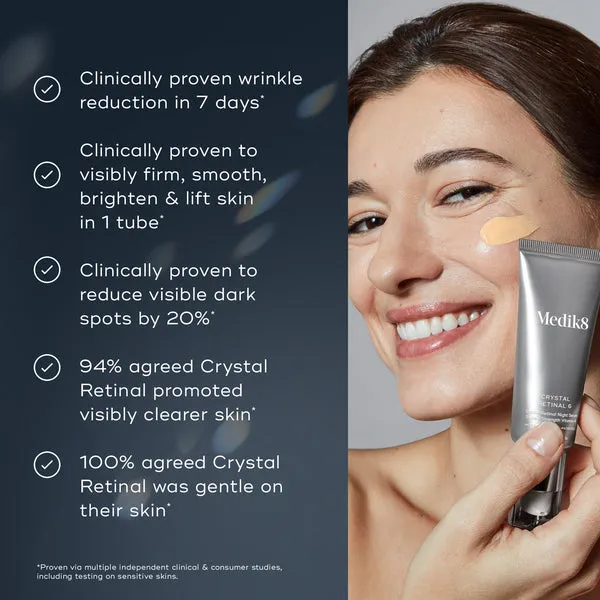
Crystal Retinal 6
Medik8
$76
★★★★½
This one uses a patented encapsulation technology to slow-release retinaldehyde, which is already a faster-converting form of vitamin A than standard retinol. The combination — a quicker-acting molecule paired with a controlled-release shell — is a reasonable argument for why it costs more than a plain retinol cream. Whether it’s worth the price over retinol or tretinoin depends on how your skin tolerates faster-converting actives; it can also mean faster irritation if you move too quickly through the concentrations.
Niosomes: Liposomes’ Cheaper, Sturdier Cousin
Niosomes work on the same principle as liposomes — a bilayer sphere encapsulating an active — but they’re built from non-ionic surfactants instead of phospholipids. That substitution sounds minor. It isn’t.
Non-ionic surfactants are more stable than phospholipids, cheaper to source, and less prone to oxidation. That makes niosomes a practical compromise: you get most of the protective and penetration benefits of liposomal encapsulation at a lower manufacturing cost and with a longer shelf life.
The tradeoff is that niosomes are generally considered slightly less biocompatible than liposomes, since they aren’t built from the same material as your actual cell membranes. In practice, the difference for most consumer products is marginal. If you see “niosome” on an ingredient list or in marketing copy, it’s a legitimate delivery technology — not a watered-down liposome pretending to be the real thing. It’s a different tool for a similar job, and often the more realistic one at drugstore price points.
Cyclodextrins: Molecular Cages, Not Capsules
Cyclodextrins work differently from liposomes and niosomes. Instead of a sphere, picture a ring-shaped sugar molecule with a hydrophobic (water-repelling) cavity in the middle and a hydrophilic (water-loving) exterior. An oil-soluble or unstable active — think retinol, certain essential oil compounds, or fragrance molecules — can sit inside that cavity, protected from oxidation and light, while the water-loving exterior keeps the whole complex dissolved in a water-based formula.
This is less about dramatic skin penetration and more about solving two very specific problems: stability and solubility. Cyclodextrins are a go-to for stabilizing retinol in water-based formulas (since retinol and water don’t naturally mix), and they’re also used to trap and slow-release fragrance, or to neutralize odor compounds — which is why you’ll sometimes see cyclodextrin in “odor-eliminating” products that aren’t skincare at all.
The claims that hold up: improved stability of an otherwise fragile oil-soluble active in a water-based product, and controlled release over time. The claims that don’t: anything implying dramatically deeper penetration than a standard emulsion. Cyclodextrins are a stability tool first, a delivery tool second.
Nanoemulsions: Shrinking the Droplet, Not Changing the Chemistry
A standard emulsion — your typical lotion or cream — suspends oil droplets in water (or vice versa) at a droplet size you could roughly estimate in micrometers. A nanoemulsion shrinks those droplets down to the nanometer range, typically under 200 nm.
Smaller droplets mean a larger total surface area for the same volume of oil, which can improve how evenly an active spreads across the skin and, in some formulations, modestly improve penetration through the lipid matrix between skin cells. Nanoemulsions also tend to feel lighter and absorb faster, which is part of why the format shows up often in “watery” essences and lightweight moisturizers.
What nanoemulsions are not is a guarantee of dramatically increased absorption. The research is mixed and highly dependent on the specific active, the oil phase used, and the surfactant system — there’s no universal “nano = works better” rule. It’s also worth knowing that “nano” has become a loose marketing term. A legitimate nanoemulsion has a measurable, consistent droplet size distribution, usually verified by dynamic light scattering in a lab. A brand simply printing “nano-delivery” on the bottle with no particle size data is making a claim it hasn’t shown its work on.
Which Claims You Can Actually Test (and Which You Can’t)
Here’s the part that matters for your shopping cart.
Testable, with real methodology behind it: stability improvements (does the product stay colorless and odor-free over its stated shelf life?), controlled release (does irritation onset get delayed or reduced compared to the unencapsulated version?), and penetration studies using tape-stripping or skin model data published in peer-reviewed journals. If a brand cites a specific percentage increase in penetration, ask whether that number comes from an in-house test on isolated skin samples or from independent, published research. Those are not the same thing, and brands know most readers won’t ask the difference.
Not testable from the outside, no matter what the label says: vague claims like “goes deeper into skin” or “activates at a cellular level” with no mechanism named. If a brand can’t tell you what the delivery system is made of — lipid-based, surfactant-based, sugar-ring, droplet size — there’s nothing to verify. A delivery system claim without a mechanism is just adjective.
Our guide to reading clinical claims goes deeper into spotting the difference between a real study and a marketing stat dressed up to look like one. It’s worth bookmarking before your next serum purchase.
Where Face Oils Fit Into This Conversation
Oil itself is a delivery system, just a simpler one than liposomes or nanoemulsions. Fat-soluble actives dissolved directly in an oil base don’t need encapsulation to get past the skin’s lipid barrier — they’re already compatible with it. This is part of the logic behind oil-soluble vitamin C derivatives like ascorbyl tetraisopalmitate, which skip the instability problem of L-ascorbic acid by being lipophilic from the start.

Ayurvedic Vitamin C Face Oil
Kerala Botanics
$49
★★★★☆
This one pairs a stabilized vitamin C form with bakuchiol, a plant-derived retinol alternative, in a straight oil base rather than an encapsulated serum. The oil format does the delivery work that liposomes do elsewhere in this article — protecting the active from oxygen and helping it move through the lipid-rich outer layer of skin — without the manufacturing cost of true encapsulation. The honest tradeoffs: it’s less clinically documented than a benchmark like SkinCeuticals C E Ferulic, the texture runs heavier under makeup, and oily skin types may find it sits on top rather than sinking in. For a simplified routine, though, it’s a reasonable argument that delivery doesn’t always require a nanoparticle.
C E Ferulic
SkinCeuticals
$185
★★★★½
Worth naming as the comparison point here because it uses no encapsulation at all — just a specific pH (below 3.5) and a vitamin E and ferulic acid combination to stabilize 15% L-ascorbic acid in water. It’s proof that delivery systems aren’t the only way to solve a stability problem. Sometimes the chemistry of the formula itself does the job. We’ve broken down whether the $185 price tag holds up elsewhere on the site.
Putting It All Together
The percentage on a label tells you the dose. It doesn’t tell you the delivery. Liposomes and niosomes protect fragile actives and help them cross into skin cells using sphere-shaped carriers; cyclodextrins solve solubility and odor problems with a molecular cage rather than a capsule; nanoemulsions improve spreadability and sometimes penetration by shrinking droplet size; and plain oils deliver fat-soluble actives the old-fashioned way, by being chemically similar to the barrier they’re crossing.
None of these technologies are inherently better than the others — they solve different problems. The real skill, as a shopper, isn’t memorizing which system is “best.” It’s learning to ask what problem the delivery system in front of you is actually solving, and whether the brand can name it specifically enough to be checked. If they can’t, you’re paying for a word, not a mechanism.