
Ingredients
Why Vitamin C Serums Oxidize and Turn Orange (and How to Avoid It)
L-ascorbic acid serums go orange fast — here's the chemistry behind it, what to look for, and how to choose a formula that actually lasts.
Disclosure — This article may contain affiliate links. We earn a small commission at no extra cost to you when you purchase through our links. This supports our ability to create independent, evidence-based skincare content.
You buy a vitamin C serum. It’s clear or faintly yellow. You use it for a few weeks, and somewhere around week six you notice it’s turned the color of orange juice. Or worse — you skipped a few days, came back to it, and now it smells vaguely metallic and leaves a faint orange tint on your skin after application.
That’s oxidation. And it’s not a sign of a bad product, necessarily. It’s a sign of what L-ascorbic acid does when it’s exposed to light, heat, and air. The chemistry here is worth understanding, because once you know why it happens, you can make better decisions about which products are worth the money and which are already losing potency before you even open the box.
The Problem With L-Ascorbic Acid
L-ascorbic acid (LAA) is the form of vitamin C with the most clinical research behind it. Studies support its ability to stimulate collagen, fade hyperpigmentation, and neutralize free radicals. It works. The problem is that it’s structurally unstable.
LAA is a small, water-soluble molecule that oxidizes readily when it encounters air, UV light, or heat. The oxidation process converts it first to dehydroascorbic acid, and then to diketogulonic acid — a compound with no skincare benefit and a telltale orange-brown color.
When your serum turns orange, that’s the visual confirmation that the active ingredient has broken down. The serum may still feel like a serum. It may still absorb. But the vitamin C portion is, for practical purposes, gone.
There’s a secondary problem. Oxidized vitamin C doesn’t just stop working — some research suggests that a heavily oxidized formula may actually generate free radicals rather than neutralize them. The evidence isn’t conclusive, but it’s reason enough to stop using a serum that’s gone visibly dark.
Why Some Serums Go Orange Faster Than Others
Not all L-ascorbic acid products degrade at the same rate. Three factors drive how quickly a formula loses stability.
pH. L-ascorbic acid is only effective at a low pH — generally below 3.5. At higher pH levels, it doesn’t penetrate skin well. But low pH formulas are also more reactive and tend to oxidize faster. It’s a genuine tradeoff.
Concentration. Higher concentrations of LAA (15–20%) are more potent but also more unstable. Some brands have moved toward lower-concentration formulas (around 10%) specifically to improve shelf life.
Packaging. This is where most brands cut corners. A clear glass bottle with a dropper exposes every dose to air and light. Airtight pumps, opaque or amber bottles, and vacuum-sealed packaging all extend functional shelf life. The Drunk Elephant C-Firma Fresh takes this seriously — the vitamin C and the carrier are kept in separate chambers and mix at first use precisely because Drunk Elephant knows the formula degrades once combined.
The Three Serums People Complain About Most
SkinCeuticals C E Ferulic is the gold standard. Dermatologists recommend it constantly, and the ferulic acid in the formula does genuinely help stabilize the ascorbic acid. But even CE Ferulic oxidizes if stored in a warm, bright bathroom. The recommendation is to keep it in the refrigerator, which most people don’t do.
Drunk Elephant C-Firma Fresh handles stability better than almost any other LAA serum through its dual-chamber design. The trade-off is that once you start using it, you’re on the clock.
La Roche-Posay’s Pure Vitamin C10 Serum is a solid mid-range option — the lower concentration helps with stability, and the packaging is more protective than most. It’s a reasonable entry point, but it still uses LAA and carries the same underlying risks.
C E Ferulic
SkinCeuticals
$182
★★★★½
C-Firma Fresh Day Serum
Drunk Elephant
$90
★★★★☆
Pure Vitamin C10 Serum
La Roche-Posay
$42
★★★★☆
What the Orange Residue on Your Skin Actually Is
This comes up constantly in online forums. Someone applies their serum, waits for it to dry, and finds an orange stain on their pillowcase or fingertips. A few things can cause this.
The most common reason: the serum was already oxidized before it hit skin. The degraded ascorbic acid leaves a temporary yellow-orange tint that transfers to fabric. If this is happening with a fresh bottle, check your storage situation.
Less commonly, it’s a reaction between the serum and the sunscreen or moisturizer applied over it. Some mineral sunscreen formulations — particularly those with zinc oxide — can cause LAA to oxidize faster on the surface of skin. Applying before the serum has fully absorbed makes this worse. The fix is simple: wait. Give the serum at least two minutes before layering anything on top.
Rarely, it’s the packaging itself. Some brands use components that react with L-ascorbic acid over time, accelerating degradation. If your serum is orange when you first pump it out, the bottle is the problem.
How to Extend the Life of an L-Ascorbic Acid Serum
If you’re already using an LAA serum and want to get more out of it:
- Store it in the refrigerator. Cold temperature slows oxidation significantly.
- Keep it away from the bathroom if you can. Heat and humidity from showers accelerate breakdown.
- Replace the cap tightly and immediately after use. Even a few seconds of air exposure adds up over weeks.
- Check the color before each use. Pale yellow is fine. Deep amber or orange means it’s time to replace it.
If the serum smells off — metallic, slightly sour, or like nothing at all when it used to have a mild scent — that’s also a sign of degradation. Color change is the clearest indicator, but smell is a secondary one.
The Case for Stable Vitamin C Derivatives
L-ascorbic acid isn’t the only option. A category of vitamin C derivatives has been developed specifically to address the stability problem. These include ascorbyl glucoside, sodium ascorbyl phosphate, ascorbyl tetraisopalmitate (ATIP), and 3-O-ethyl ascorbic acid.
The trade-off is that most of these derivatives have less clinical research than LAA. The mechanism is understood — they convert to ascorbic acid once absorbed — but the studies are fewer, smaller, and sometimes funded by the brands selling them. That doesn’t mean they don’t work. It means the evidence base is thinner.
ATIP is the one getting the most attention right now. It’s oil-soluble (unlike LAA, which is water-soluble), meaning it can be formulated into oils and oil-rich products rather than the low-pH water-based serums that LAA requires. It’s also significantly more stable at room temperature and doesn’t require the harsh pH environment that LAA does. For a deeper comparison of how these two forms differ in penetration and delivery, the oil-soluble vs. water-soluble vitamin C breakdown is worth reading.
The stability advantage is real. An ATIP formula stored at room temperature, in normal packaging, will retain its potency far longer than an equivalent LAA serum stored the same way. Whether the skin benefit is equivalent is a more open question — the answer probably varies by individual skin type and the specific formula.
The Oil-Based Option
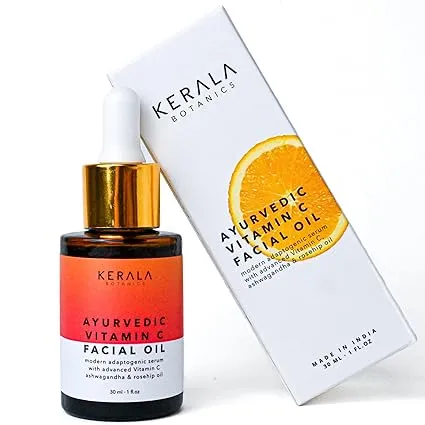
Kerala Botanics’ Ayurvedic Vitamin C Face Oil uses this oil-soluble vitamin C format, combined with bakuchiol — a plant-derived compound that mimics some of retinol’s effects without the irritation. The idea is that a single product covers vitamin C treatment, moisturization, and a retinol alternative in one step.
For someone running a simplified routine, that’s genuinely appealing. The formula is rooted in Ayurvedic tradition, which is interesting context but not itself a reason to buy or skip it — what matters is whether the ingredients work. The ATIP form is stable. Bakuchiol has solid evidence for collagen support and mild brightening (see our bakuchiol vs retinol breakdown for the specifics). The oil format absorbs reasonably well for most skin types.
That said, oily or acne-prone skin may not love a face oil as a vitamin C delivery method. And anyone expecting CE Ferulic-level clinical results will need to calibrate expectations — ATIP has less research behind it than LAA, full stop. It’s a different approach to the same goal, not a proven upgrade.
Ayurvedic Vitamin C Face Oil
Kerala Botanics
$49
★★★★☆
How to Shop for a More Stable Vitamin C Product
When evaluating any vitamin C product, these are the things worth checking:
Packaging. Airless pump, opaque or dark bottle, or a sealed chamber design. If it comes in a clear dropper bottle, assume you’ll need to be diligent about refrigeration.
Ingredient form. If you see L-ascorbic acid, sodium ascorbyl phosphate, ascorbyl glucoside, ATIP, or 3-O-ethyl ascorbic acid — those are the ones to recognize. LAA is the most studied; the derivatives are more stable. Both are legitimate.
Concentration and pH. For LAA serums, most formulas work in the 10–20% range. Below 8% may not deliver meaningful results. The brand usually lists the pH on the packaging or their website — below 3.5 is the target for LAA.
Storage instructions. If the brand recommends refrigeration, that’s not a red flag — it’s honesty about the chemistry.
For a broader look at how vitamin C fits alongside other antioxidants, the antioxidant skincare guide covers the category well. And if oxidation sensitivity has been a recurring problem with serums specifically, there’s more context in the guide on vitamin C and sensitive skin.
Putting It All Together
An orange vitamin C serum has oxidized. That’s chemistry, not a defect in the specific bottle — it’s what L-ascorbic acid does when it’s exposed to air, light, and warmth over time. The fix involves either better storage (refrigeration, airtight packaging), a better-packaged LAA product, or switching to a more stable vitamin C form.
None of this means LAA serums aren’t worth using. CE Ferulic is still the most research-backed vitamin C formula available, and that matters. But if you’re burning through bottles before finishing them, or finding orange residue on your pillow regularly, the chemistry is working against you. A derivative-based formula stored at room temperature in normal packaging might be the more practical choice — even if the clinical trail isn’t as long.
Match the product to how you actually live, not how you intend to live. A $182 serum you store incorrectly doesn’t outperform a stable $42 alternative stored properly.
For reference on where vitamin C fits in the broader routine, how to layer skincare covers sequencing clearly. And if you’re still deciding between formats — serum versus oil — the vitamin C serum vs oil comparison lays out the practical differences.