
Ingredients
Niacinamide + Vitamin C: The 60-Year-Old Myth, Debunked
The idea that niacinamide and vitamin C cancel each other out traces to a single outdated study. Here's what modern research actually shows.
Disclosure — This article may contain affiliate links. We earn a small commission at no extra cost to you when you purchase through our links. This supports our ability to create independent, evidence-based skincare content.
There’s a rule floating around skincare communities that goes something like this: never use niacinamide and vitamin C together, because they cancel each other out. Some versions of the warning go further — they’ll turn your skin yellow, they’ll cause flushing, they’ll make both ingredients useless.
It’s one of the most widely repeated claims in the skincare space. It’s also based on research from the 1960s that has been misread for decades.
Here’s what actually happened, what the current data says, and what a sensible approach to using these two ingredients actually looks like.
Where the Myth Came From
The fear traces to a real chemical reaction. When niacinamide (vitamin B3) and ascorbic acid (the most common form of vitamin C) are combined under certain conditions, they can form a compound called niacin — technically nicotinic acid. Niacin is associated with skin flushing.
Early studies that documented this reaction used high concentrations, high heat, and extended reaction times. We’re talking about conditions that don’t resemble your bathroom vanity in any meaningful way.
The problem is that the conclusion got separated from the context. “They form niacin” became “they cancel each other out” became “never use them together.” Each retelling dropped a little more nuance, and here we are.
What the Research Actually Shows
A few things worth knowing.
The reaction is slow. At room temperature, in the formulations you’re actually using, the conversion of ascorbic acid and niacinamide to niacin takes hours — far longer than product sits on your skin before absorbing or being rinsed away. A 2005 analysis found that in a typical topical formulation at normal skin temperatures, the niacin yield was negligible.
The concentrations matter. Most niacinamide products use 5–10% concentrations. Most vitamin C serums top out at 15–20% L-ascorbic acid. Even at those levels, the amount of niacin that could theoretically form is orders of magnitude below the threshold for causing visible flushing.
Modern formulations account for this. Many products now deliberately combine both ingredients. Several peer-reviewed studies have looked at combined niacinamide and vitamin C formulations specifically for brightening and found them not only compatible but synergistic for addressing hyperpigmentation.
There’s no credible, peer-reviewed evidence published in the last 20 years showing that layering niacinamide and vitamin C at typical skincare concentrations causes meaningful interference, flushing, or reduced efficacy.
If your skin reacted after using these two ingredients together, something else caused it — more likely the pH, the concentration of the vitamin C serum, or a formulation sensitivity. Not the pairing.
Why Niacinamide and Vitamin C Actually Work Well Together
Set aside the myth and look at what each ingredient does. They target a lot of the same problems via completely different mechanisms. That’s what makes them complementary rather than redundant.
Vitamin C is a potent antioxidant that inhibits tyrosinase, the enzyme involved in melanin production. It also supports collagen synthesis and helps neutralize free radicals generated by UV exposure. The evidence is solid, especially for L-ascorbic acid. For a deeper look at how the different forms compare, oil-soluble vs water-soluble vitamin C covers the tradeoffs clearly.
Niacinamide works downstream in the same brightening pathway — it interferes with the transfer of melanosomes (melanin-containing structures) from melanocytes to skin cells. It also strengthens the skin barrier, reduces inflammation, and helps regulate sebum. There’s a reason it shows up in almost every formula designed for uneven tone. The full breakdown lives in our niacinamide complete guide.
Used together, they approach hyperpigmentation from two separate angles simultaneously. The evidence for combined use in treating dark spots and post-inflammatory hyperpigmentation is genuinely good — better than either ingredient alone in several studies. If hyperpigmentation is the primary concern, there’s also a practical guide on the treatments that actually move the needle.
The pH Question (This One Is Legitimate)
Here’s the part of the conversation that actually deserves attention.
L-ascorbic acid is a low-pH ingredient. Effective vitamin C serums typically sit between pH 2.5 and 3.5 — that acidity is part of what keeps the ascorbic acid stable and helps it penetrate. Niacinamide is generally formulated at a higher pH, closer to skin’s natural range of 4.5 to 5.5.
When you apply a very low-pH product directly over a higher-pH one (or vice versa), there can be some buffering effect. The real concern here isn’t the niacin conversion — it’s that pH interference might slightly reduce how well each ingredient absorbs if applied simultaneously.
The practical fix is simple: apply your vitamin C first, let it absorb for a few minutes, then layer niacinamide on top. The same logic applies to using vitamin C with any other product — give it a moment before you continue. There’s more on sequencing in how to layer skincare.
If your skin is sensitive or reactive, that small wait matters. For most skin types, it’s a minor point — but a good habit either way.
Different Forms of Vitamin C Change the Equation
It’s worth noting that most of the original concern involved L-ascorbic acid specifically. That’s not the only form of vitamin C in modern skincare.
Derivatives like ascorbyl glucoside, sodium ascorbyl phosphate, and tetrahexyldecyl ascorbate (THD ascorbate) are more stable, formulated at higher pH levels, and have essentially no documented interaction concern with niacinamide. The pH compatibility is closer to begin with.
Oil-soluble vitamin C formats in particular sit in a different category. A face oil that delivers vitamin C in an oil base rather than a water-based serum sidesteps the pH compatibility question almost entirely, since the formulation logic is different.
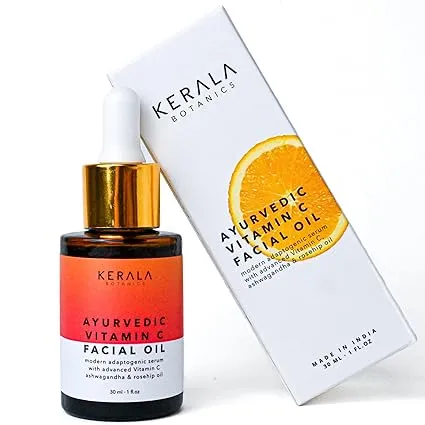
Ayurvedic Vitamin C Face Oil
Kerala Botanics
$49
★★★★☆
The Kerala Botanics Ayurvedic Vitamin C Face Oil is one example of this format. It uses a stabilized, advanced vitamin C alongside bakuchiol (a plant-based retinol alternative) in an oil base — no low-pH environment, and the layering compatibility with niacinamide is essentially a non-issue. The trade-off is that oil formats don’t suit everyone. Oily or acne-prone skin may find it heavy, and it can feel like too much under makeup. But for anyone already using a facial oil as part of their routine, the combination of vitamin C and niacinamide becomes noticeably more straightforward. A full look at this product lives in the Kerala Botanics vitamin C face oil review.
How to Actually Use These Two Ingredients Together
No complicated protocols needed. Here’s what works.
Morning Routine
- Cleanse
- Vitamin C serum (L-ascorbic acid, or your preferred derivative) — let it sit for 2–3 minutes
- Niacinamide serum or moisturizer
- SPF
That’s the whole routine. Niacinamide plays well with almost everything that comes after vitamin C. There’s no need to alternate days, use one only at night, or build up to using them together.
Evening Routine
Niacinamide works equally well in the evening. If you’re using a retinoid at night, niacinamide pairs well there too — it helps buffer some of the irritation that comes with stronger actives. Vitamin C is usually better saved for the morning, where it can also support UV defense alongside your SPF.
For more on building an evening routine that doesn’t conflict with itself, the complete evening skincare routine covers sequencing in full.
Products Worth Considering
If you’re pairing these ingredients deliberately, here are reliable options at different price points.
For niacinamide, The Ordinary’s 10% + Zinc formula is the straightforward entry point. At $6, it’s almost unfairly cheap for what it delivers. The zinc addition makes it particularly useful for oily or breakout-prone skin.
Niacinamide 10% + Zinc 1%
The Ordinary
$6
★★★★½
Paula’s Choice 10% Niacinamide Booster is a more refined option — a lightweight, fragrance-free formula that layers cleanly under most serums and moisturizers without pilling.
10% Niacinamide Booster
Paula's Choice
$44
★★★★½
For vitamin C, SkinCeuticals C E Ferulic remains the clinical benchmark — genuinely well-studied, effective, and genuinely expensive. It works at a low pH (around 3.0–3.5), so the brief absorption window before applying niacinamide is relevant here. If the price is an obstacle, there are real alternatives covered in the best SkinCeuticals C E Ferulic alternatives.
C E Ferulic
SkinCeuticals
$185
★★★★½
Putting It All Together
The niacinamide-and-vitamin-C incompatibility myth originates in chemistry that doesn’t apply to real-world skincare use. The reaction exists on paper; it doesn’t happen meaningfully on skin, at typical concentrations, under normal conditions.
The only legitimate consideration is pH — and the fix takes two minutes. Apply vitamin C first, let it absorb, layer niacinamide on top. That’s it.
Used together, these two ingredients address hyperpigmentation, uneven tone, and early signs of aging through genuinely different pathways. There’s a reasonable case that pairing them is more effective than using either alone.
Stop separating them. Use both.