
Ingredients
Kerala Botanics Ayurvedic Vitamin C Face Oil Review
Is this Ayurvedic vitamin C face oil worth $49? We break down ingredients, texture, performance, and who it's actually for.
Disclosure — This article may contain affiliate links. We earn a small commission at no extra cost to you when you purchase through our links. This supports our ability to create independent, evidence-based skincare content.
Quick Verdict
Most vitamin C products fall into the same format: a watery serum, a pump bottle, a race against oxidation. Kerala Botanics does something different. It delivers vitamin C in a face oil, pairs it with bakuchiol, and positions the whole thing as a routine replacement. At $49, it’s asking you to trust that a single bottle can sub in for two or three steps. For the right skin type, it mostly earns that trust.
Rating: 4.4/5
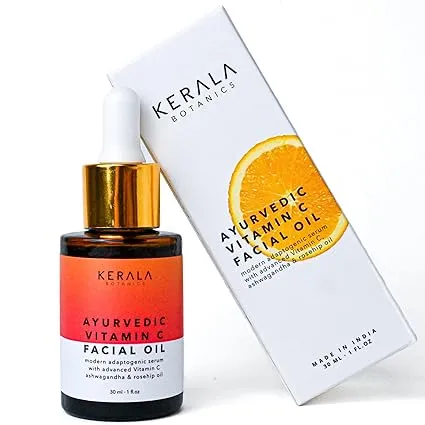
Ayurvedic Vitamin C Face Oil
Kerala Botanics
$49
★★★★☆
What we liked
- + Oil-based vitamin C format resists oxidation better than most L-ascorbic acid serums
- + Bakuchiol adds a gentle retinol-alternative benefit in one step
- + Replaces multiple routine steps — serum, oil, and light moisturizer
- + Earthy, herbal scent reads as genuinely botanical rather than synthetic
- + Good value for a multi-functional product at this price point
Worth noting
- - Oil format is not ideal for oily or acne-prone skin
- - Less clinical data behind the vitamin C derivative than L-ascorbic acid
- - Can feel heavy under makeup without a full absorption window
- - The 'up to 4x more effective' claim needs more independent research
A thoughtfully formulated oil that delivers real brightening and smoothing — best for dry to normal skin that wants to simplify without sacrificing actives.
What It Is
Kerala Botanics is a small brand rooted in Ayurvedic tradition, drawing on plant-based ingredients that have been used in Indian skincare for centuries. This oil is their flagship product — a face oil that combines a stabilized, oil-soluble vitamin C derivative with bakuchiol, ashwagandha, and a carrier blend of botanical oils.
The vitamin C here is not L-ascorbic acid, the form most commonly cited in dermatology research. Kerala Botanics uses an advanced derivative that they describe as staying active in skin cells up to 80 times longer than standard L-ascorbic acid formulas. The mechanism behind oil-soluble vitamin C derivatives is real — forms like ascorbyl tetraisopalmitate and 3-O-ethyl ascorbic acid do convert to active ascorbic acid in the skin, and their oil solubility does confer better stability. The specific derivative Kerala Botanics uses and the exact efficacy data behind their claims are less transparent than we’d like. That’s worth acknowledging. The underlying chemistry is sound; the brand-specific numbers are harder to verify independently.
Bakuchiol (the seed extract of Psoralea corylifolia) is included at what appears to be a functional level, though the concentration isn’t disclosed. The evidence for bakuchiol as a retinol alternative is reasonable — a 2018 study in the British Journal of Dermatology found comparable reductions in wrinkle depth and pigmentation to retinol over 12 weeks, with less irritation. If you want the full comparison, we covered it in depth in our bakuchiol vs retinol piece.
The supporting cast includes ashwagandha (an adaptogen with some evidence for antioxidant activity at the skin level — more on that here), amla (a traditional Ayurvedic source of vitamin C activity — see our amla explainer), and a carrier blend that includes rosehip, sea buckthorn, and jojoba.
Texture and Application
The oil is a warm golden color — vivid, almost amber. That comes largely from the sea buckthorn and the botanical extracts. It’s lighter than it looks. A few drops spread easily and don’t drag.
The consistency sits between a dry oil and a richer face oil. Not as fast-absorbing as squalane, not as heavy as marula. There’s a slight residue if you use too much; two to three drops is the right amount for the face and neck. Give it a minute. Rushing it and applying SPF or makeup directly on top is how you end up with pilling or a sheen you didn’t want.
Skin compatibility with face oils is genuinely variable. We have a full breakdown of how to use facial oils properly and, separately, whether face oils work for oily and acne-prone skin. Short answer: if you’re congestion-prone, this is not the place to experiment.
Scent
Herbal, slightly earthy, faintly citrus-adjacent. The ashwagandha and the botanical extracts are present. It’s not unpleasant — if you appreciate botanical fragrance, you’ll probably like it. If you’re sensitive to fragrance or prefer entirely neutral products, it’s worth knowing before you buy.
There’s no synthetic perfume listed in the ingredient deck. The scent is functional, coming from the actives themselves rather than added fragrance compounds. That’s a meaningful distinction for most users, even if the result is still detectable.
Performance
We used this over six weeks, morning and evening, on dry-to-normal skin, as a replacement for a separate vitamin C serum and facial oil step.
Brightening: Visible. Not dramatic over the first two weeks, but by week four there was a noticeable improvement in evenness and a reduction in the dullness that accumulates from sleeping badly and staring at a screen all day. Whether this is primarily the vitamin C derivative, the amla, or the combination is hard to isolate. The result is real enough to matter.
Texture improvement: This is where the bakuchiol contribution shows up. After six weeks, fine lines around the eyes looked marginally softened. Not a retinoid-level change — nobody should expect that — but consistent with what the bakuchiol evidence would predict. If you’re managing expectations correctly, you won’t be disappointed.
Hydration: The oil blend does provide genuine moisture. On dry skin, it was sufficient as a standalone moisturizer in moderate temperatures. In winter or in very dry climates, you’d likely want something occlusive on top, at least on the driest areas.
Oxidation: One of the practical advantages of oil-soluble vitamin C formats is stability. We kept this bottle for the full six weeks and saw no color change, no rancid smell, no obvious degradation. That’s a legitimate functional win over a lot of L-ascorbic acid serums, which can start turning orange-brown within weeks of opening. For more on why that happens, here’s the explainer.
Ingredients We’d Flag
Nothing alarming in the ingredient list. Sea buckthorn at higher concentrations can be comedogenic for some — if you’ve had issues with it in other products, note that it’s in here. The rosehip oil is high in linoleic acid, which is generally well-tolerated and actually beneficial for acne-prone skin, but the oil-based format overall still warrants caution for anyone who breaks out easily.
The fragrance question is worth repeating: there’s no “fragrance” or “parfum” listed, but the botanical ingredients themselves are aromatic. For most users that’s fine. For anyone with known botanical sensitivities or rosacea, do a patch test.
Who It’s For
Good fit:
- Dry to normal skin that wants to simplify a multi-step routine
- Anyone interested in Ayurvedic or botanical formulations with actual functional ingredients
- People who’ve had oxidation or stability issues with L-ascorbic acid serums
- Those who want a retinol alternative without building a separate bakuchiol step
- Vitamin C beginners who find high-concentration L-ascorbic acid irritating — this is a real issue for a meaningful portion of users
Not a great fit:
- Oily or acne-prone skin — the oil base is a real concern
- Anyone who needs maximum-evidence vitamin C (that’s still L-ascorbic acid in the right formula)
- Makeup wearers in a rush — it needs time to absorb
- Fragrance-sensitive individuals
Value
$49 for a product that genuinely replaces a vitamin C serum ($30–$185 depending on what you’re buying), a face oil ($25–$60), and potentially a light moisturizer — the math works. If you’re spending $60 on a standalone serum that’s oxidizing by week three and another $30 on a facial oil, Kerala Botanics is actually a cost-effective consolidation.
It won’t outperform a clinical-grade L-ascorbic acid formula in a controlled trial. SkinCeuticals CE Ferulic at $185 has 20 years of third-party research behind it. That’s a legitimate gap. But for a simplified routine at this price, the trade-off is reasonable. We wrote about exactly this category of CE Ferulic alternatives if you want to see where it stacks up in a broader field.
Comparison to Competitors
| Product | Format | Vitamin C Type | Bakuchiol | Price | Best For |
|---|---|---|---|---|---|
| Kerala Botanics Ayurvedic Vitamin C Face Oil | Face oil | Oil-soluble derivative | Yes | $49 | Routine simplification, dry skin, natural formulas |
| Sunday Riley C.E.O. Glow Vitamin C + Turmeric Face Oil | Face oil | THD Ascorbate | No | $85 | Luxury oil, brightening focus |
| SkinCeuticals C E Ferulic | Water serum | L-Ascorbic Acid (15%) | No | $185 | Maximum clinical evidence |
| The Ordinary Ascorbyl Tetraisopalmitate Solution 20% | Oil serum | Ascorbyl Tetraisopalmitate | No | $10 | Budget oil-soluble vitamin C |
Sunday Riley CEO Glow is a reasonable comparison point — also an oil, also uses an oil-soluble vitamin C derivative, also targets brightening. At $85 versus $49, Kerala Botanics is the stronger value, and the bakuchiol inclusion is a genuine differentiator. We covered CEO Glow alternatives in more depth here if you’re deciding between them.
The Ordinary’s ascorbyl tetraisopalmitate option at $10 is the obvious budget comparison. It works, but the formula is minimal — no bakuchiol, no botanical support ingredients, and the overall experience is closer to an ingredient delivery vehicle than a complete product. For pure cost efficiency, it holds up. For a holistic oil experience, Kerala Botanics is doing more.
CE Ferulic is a different conversation entirely. If you want the most clinically validated vitamin C formula available, that’s the one. It’s also $185, comes in a water base, and will start oxidizing within weeks of opening. Kerala Botanics isn’t competing with that — it’s offering something different.
Final Rating
| Criteria | Score |
|---|---|
| Ingredient quality | 4.5/5 |
| Texture and application | 4.3/5 |
| Brightening performance | 4.2/5 |
| Stability and shelf life | 4.7/5 |
| Value for money | 4.5/5 |
| Scent | 4.0/5 |
| Overall | 4.4/5 |
The Bottom Line
Kerala Botanics has built a product that’s harder to dismiss than the “Ayurvedic skincare” category sometimes suggests. The oil-soluble vitamin C derivative is a real formulation choice that solves real stability problems. The bakuchiol is there for a reason. The price is honest.
The caveats are also real: the clinical evidence behind the specific vitamin C derivative is thinner than we’d like, the oil format excludes a significant chunk of skin types, and the scent is detectable enough to matter for some users.
For dry to normal skin that wants to cut steps without cutting actives, this is a solid option. If you’re also curious about the broader comparison between oil and serum formats for vitamin C, we broke that down here. And if simplified, multi-functional routines appeal to you more broadly, our guide on three-in-one oil routines covers the format in more depth.
The product works. It’s not for everyone. Those two things can both be true.