
Ingredients
Amla: The Ayurvedic Vitamin C, Explained
Amla (Indian gooseberry) is one of the most polyphenol-rich botanicals on earth. Here's what the science says about its skin benefits.
Disclosure — This article may contain affiliate links. We earn a small commission at no extra cost to you when you purchase through our links. This supports our ability to create independent, evidence-based skincare content.
Vitamin C didn’t start in a lab. Long before L-ascorbic acid got a patent and a $90 price tag, Ayurvedic practitioners were using amla — the small, tart fruit of Phyllanthus emblica — as a foundational ingredient for skin, hair, and overall health. They didn’t call it vitamin C. They called it a rasayana: a rejuvenating substance.
They weren’t wrong about the mechanism. They just didn’t have the vocabulary yet.
Amla is now showing up in modern formulations, particularly oil-based products and natural skincare lines. The question worth asking is whether that crossover is genuinely justified by chemistry, or whether it’s just a botanical name lending credibility to what is essentially marketing. The answer is more interesting than either option.
What Amla Actually Is
Indian gooseberry (Phyllanthus emblica, also called Emblica officinalis) is a small yellowish-green fruit that grows across South and Southeast Asia. It’s been a cornerstone of Ayurvedic medicine for thousands of years — used in everything from Chyawanprash (an herbal jam that tastes like no jam you’ve ever wanted) to hair oils to topical skin preparations.
The fruit itself is intensely sour. Anyone who has eaten one fresh knows it leaves a distinctive astringent feeling in the mouth that takes a minute to place. That sensation is partly tannins, partly organic acids. Both matter for the skin story.
The Polyphenol Profile
Here’s what separates amla from a lot of “natural vitamin C” claims: the ascorbic acid content is real, but it’s not the whole story.
Amla contains ascorbic acid, yes. But it also contains a dense matrix of polyphenols — ellagic acid, gallic acid, emblicanin A and B, punigluconin, and various tannins — that appear to stabilize and extend the activity of that ascorbic acid. This is relevant because isolated L-ascorbic acid is notoriously unstable. It oxidizes quickly in water-based formulas, often before you’ve used half the bottle. If you’ve ever watched a serum turn orange, you know what we mean. (We’ve written about why vitamin C oxidizes if you want the full chemistry.)
The tannin and polyphenol matrix in whole amla extract appears to slow that oxidation. Some research suggests the galloyl glucose compounds in amla are partly responsible — they act as a kind of internal preservative system. This isn’t magic. It’s basic chemistry: antioxidants protect other antioxidants.
Whether this stability translates cleanly into finished formulations is a separate question, and we’ll get to that.
How Much Vitamin C Does Amla Actually Contain?
This one gets inflated a lot. You’ll see claims that amla has “20 times more vitamin C than oranges.” The range in the literature is wide — from around 500 mg per 100g of fresh fruit up to 900 mg in some analyses, depending on variety, growing conditions, and processing. Oranges sit around 50 mg per 100g.
So yes, amla is genuinely high in ascorbic acid. The caveat is that this is the raw fruit, and the ascorbic acid content of any extract depends entirely on how it’s processed. Heat degrades ascorbic acid. Drying degrades it. Solvent extraction can either preserve or destroy it depending on conditions. When you’re buying a product that lists “amla extract,” you often have no idea what you’re actually getting in terms of active ascorbic acid content.
The polyphenols are generally more stable through processing than the ascorbic acid. So a well-made amla extract may retain its antioxidant capacity even when the ascorbic acid number has dropped. That distinction matters.
What the Research Says About Amla and Skin
The clinical research is thinner than the traditional use history suggests it should be. Most studies are in vitro (cell cultures) or animal models, with fewer well-controlled human trials. That’s frustrating, but it’s not unusual for botanical ingredients — they’re expensive to run trials on, and the profit motive for funding them is weaker than for patentable molecules.
Here’s what the evidence actually supports:
Antioxidant activity. This is the strongest case. Multiple studies confirm that amla extract has significant free-radical scavenging capacity. The DPPH assay (a standard antioxidant test) consistently places amla extracts at or above comparable plant extracts. The polyphenol matrix deserves credit here, not just the ascorbic acid.
Tyrosinase inhibition. Tyrosinase is the enzyme that drives melanin production. Inhibiting it is one pathway to reducing hyperpigmentation. Ellagic acid — one of amla’s major polyphenols — has demonstrated tyrosinase-inhibiting activity in laboratory studies. Whether this translates to visible brightening in human skin, at real-world concentrations, is harder to confirm. But the mechanism is there.
Collagen support. Ascorbic acid is a required cofactor for collagen synthesis. No vitamin C, no collagen. Amla’s ascorbic acid content means it can, in theory, support this pathway. The relevant question is whether enough stable, bioavailable ascorbic acid survives from source to skin — which circles back to formulation.
Anti-inflammatory activity. Several amla polyphenols show anti-inflammatory effects in cell studies, which is relevant for skin barrier function and for calming reactive skin.
For a broader look at how botanical antioxidants stack up, our antioxidants in skincare guide covers the territory well.
Amla vs. Synthetic L-Ascorbic Acid: An Honest Comparison
Standard vitamin C serums use pure L-ascorbic acid, usually at concentrations between 10–20%. The research base for L-ascorbic acid is extensive. We know the effective concentration range. We know the pH requirements (below 3.5 for good skin penetration). We know what formulas tend to oxidize faster.
Amla doesn’t have that same depth of clinical documentation. What it has instead is:
- A more complex antioxidant profile (multiple active compounds vs. one)
- Better inherent stability, due to the polyphenol protective matrix
- Compatibility with oil-based formulations, which don’t require the low-pH environment that water-based vitamin C does
- A gentler profile for those who find high-concentration L-ascorbic acid irritating
That last point is underappreciated. If you have reactive or sensitive skin, a 15% L-ascorbic acid serum at pH 2.8 is genuinely harsh. Amla-based formulations tend to be gentler, particularly when delivered in an oil base.
The honest trade-off: if you want the most clinically validated, highest-concentration vitamin C for aggressive brightening or photoaging reversal, synthetic L-ascorbic acid has the stronger evidence base. If you want a gentler, more complex antioxidant experience — particularly in an oil format — amla is a legitimate choice. These are different tools.
We’ve covered the oil-soluble vs. water-soluble vitamin C question in more detail, which is worth reading if you’re trying to decide between formats.
Amla in Modern Formulations
The format question is where amla gets genuinely interesting for skincare. L-ascorbic acid is water-soluble, which is why it’s almost always in serum form. An oil-based product can’t use it effectively. Amla extract — and particularly certain stabilized vitamin C derivatives derived or inspired by amla’s chemistry — can work in oil-based formats.
This opens up a different category of product entirely. An oil that delivers antioxidant activity, supports brightness, and doesn’t require the stringent pH conditions of a traditional vitamin C serum is a meaningful formulation achievement.
Kerala Botanics’ Ayurvedic Vitamin C Face Oil leans into exactly this. It uses a stabilized vitamin C form alongside amla and bakuchiol (a plant-based retinol alternative — we’ve covered bakuchiol vs. retinol in depth). The formula is rooted in Ayurvedic tradition in both ingredient sourcing and approach. The amla connection here isn’t decorative — it’s central to how the formula handles antioxidant delivery in an oil medium.
Worth noting: the oil format means it’s not for everyone. Oily or acne-prone skin may find it too rich as a standalone moisturizer. It’s more natural territory for dry, normal, or mature skin types. And if you’re someone who layers heavily under SPF and makeup in the morning, a face oil can interfere with that — it requires its own application discipline. But as an all-in-one step that replaces serum, facial oil, and moisturizer, it’s a solid, honest product.
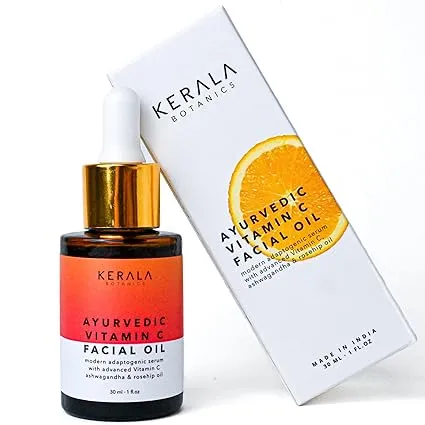
Ayurvedic Vitamin C Face Oil
Kerala Botanics
$49
★★★★☆
If you’re exploring how to use a facial oil effectively in your routine, our guide on how to use facial oils is a reasonable starting point.
What to Look for in Amla Products
Reading an ingredient label that includes amla requires some calibration. Here’s what actually matters:
Extract type. “Amla fruit extract” can mean almost anything depending on the solvent and process. Water-based extracts will carry different compounds than oil-soluble ones. In oil formulations, look for lipophilic extracts or specified active compounds.
Position on the ingredient list. If amla appears near the bottom of a 30-ingredient list, between fragrance and a preservative, you’re likely getting a trace amount. Meaningful concentrations show up in the top third.
Paired antioxidants. Amla works well in combination with other antioxidants — vitamin E (tocopherol), ferulic acid, and rosehip are all reasonable companions that can support and extend activity. A formula that isolates amla as a single hero tends to underperform one that treats it as part of a system.
Packaging. Like all antioxidant-rich ingredients, amla extracts degrade with light and air exposure. Opaque, airless packaging isn’t mandatory, but it helps. Dark glass or opaque pumps are better than clear bottles with open tops.
For a broader breakdown of ingredient labels in general, our guide to reading ingredient labels is useful context.
Putting It Together
Amla is a legitimate ingredient with a real mechanism. It’s not folk medicine rebranded for a wellness trend. The ascorbic acid content is documented, the polyphenol profile is interesting and probably underexplored, and the stability advantages over isolated L-ascorbic acid are real.
The honest ceiling: the clinical human trial data is thin. We’re largely working from cell studies, animal models, and the extrapolated logic of individual compounds. That’s enough to justify using amla-containing products, but not enough to claim it performs identically to a well-formulated 15% L-ascorbic acid serum in clinical outcomes.
What amla offers is a different approach to vitamin C delivery — gentler, more complex, compatible with oil-based formats, and native to a formulation tradition (Ayurvedic medicine) that has been selecting for skin-active botanicals for a very long time. There’s something worth taking seriously in that. Not uncritically, but seriously.
If the modern Ayurvedic skincare tradition is something you’re curious about more broadly, we’ve pulled together the evidence there too.
Use it for what it is. Don’t expect it to do what it isn’t. That’s the framework for every ingredient, and amla is no exception.