
Ingredients
Ashwagandha for Skin: What the Topical Adaptogen Actually Does
Withanolides, cortisol, and inflammation — here's what the evidence actually says about ashwagandha as a topical skincare ingredient.
Disclosure — This article may contain affiliate links. We earn a small commission at no extra cost to you when you purchase through our links. This supports our ability to create independent, evidence-based skincare content.
Ashwagandha has a reputation problem. Spend five minutes in a wellness subreddit and you’ll find it credited with curing anxiety, boosting testosterone, reversing gray hair, and probably doing your taxes. That kind of hype makes it easy to dismiss the ingredient entirely — which would be a mistake, at least topically.
The oral supplement research is genuinely interesting but also genuinely messy. Topical ashwagandha is a different conversation. The mechanisms are more localized, the relevant compounds are more specific, and the case for including it in a skincare formula is more plausible than most “adaptogen” marketing would have you believe.
Here’s what we actually know.
What Ashwagandha Is (and Why It Matters for Skin)
Ashwagandha (Withania somnifera) is a small shrub native to India and North Africa. It’s been used in Ayurvedic medicine for over 3,000 years, primarily as a rasayana — a class of herbs considered restorative and longevity-promoting. The root extract is what shows up in skincare.
The bioactive compounds responsible for most of its studied effects are called withanolides — a group of naturally occurring steroidal lactones. They’re not unique to ashwagandha, but ashwagandha root contains them in notably high concentrations. Withaferin A is the most researched withanolide, and it’s the one most often cited in anti-inflammatory and antioxidant contexts.
Understanding what withanolides do is the whole point. “Ashwagandha extract” on an ingredient label tells you very little without knowing whether the product standardized for withanolide content — and most don’t disclose that.
The Antioxidant Angle
Withanolides are free radical scavengers. In cell culture studies, they’ve shown the ability to neutralize reactive oxygen species (ROS) — the unstable molecules that accumulate from UV exposure, pollution, and normal metabolic activity and that contribute to collagen degradation and uneven pigmentation over time.
The mechanism here is reasonably well understood. Withaferin A in particular appears to upregulate the Nrf2 pathway, which is a master regulator of the body’s own antioxidant enzyme systems (including superoxide dismutase and catalase). In plain terms: it may help skin cells produce their own protective enzymes, not just neutralize damage directly.
That’s a meaningful distinction. Most topical antioxidants — vitamin C, vitamin E, resveratrol — work by donating electrons to neutralize free radicals. An ingredient that also activates endogenous antioxidant pathways is doing something different. Whether that translates to visible results in a cosmetic formula, at realistic concentrations, applied through real skin — that’s where the evidence gets thin. We have mechanism. We don’t have large, randomized human trials.
For a deeper look at how antioxidants work as a category, the antioxidants in skincare guide covers the full picture.
The Anti-Inflammatory Case
This is where ashwagandha’s topical story gets more interesting.
Chronic low-grade inflammation is behind a lot of what we see as “aging” skin — barrier degradation, collagen loss, hyperpigmentation. It’s also what drives redness, sensitivity, and certain patterns of breakouts. Ingredients that genuinely calm inflammatory signaling at the cellular level are worth paying attention to.
Withanolides appear to inhibit NF-κB, a transcription factor that acts as an on-switch for pro-inflammatory cytokines like interleukin-6 (IL-6) and tumor necrosis factor-alpha (TNF-α). When NF-κB is less active, the inflammatory cascade gets quieter. This has been demonstrated in vitro and in some animal models. Human skin-specific topical trials are limited, but the mechanism is consistent with what we see from other well-established anti-inflammatory actives.
The comparison to centella asiatica is useful here. Cica became a staple ingredient partly because its active compounds (asiaticoside, madecassoside) showed credible anti-inflammatory action and were eventually validated in more clinical work. Ashwagandha is earlier in that arc. The mechanism is plausible. The clinical validation still needs to catch up.
The Cortisol Connection
This is the angle you’ll see in most marketing copy, and it’s worth examining carefully.
The “stress-skin connection” is real. Elevated cortisol — the primary glucocorticoid released during stress — disrupts the skin barrier, impairs wound healing, increases sebum production in some skin types, and can accelerate the inflammatory processes that contribute to acne and accelerated aging. Anyone who’s noticed their skin gets worse during a difficult month is not imagining it.
Oral ashwagandha has shown statistically significant reductions in salivary cortisol in several human trials, including a well-cited 2012 study in the Indian Journal of Psychological Medicine. The effect appears to be real, though effect sizes vary and most studies are industry-funded.
Here’s the part most articles skip: when ashwagandha is applied topically, it does not meaningfully reduce systemic cortisol. The skin isn’t a reliable route for systemic hormone modulation at cosmetic use concentrations. Claiming a topical cream will “lower your cortisol levels” is a stretch.
What’s more defensible is that withanolides, applied to skin, may reduce local inflammatory signaling — some of which overlaps with the same pathways that cortisol dysregulates. That’s a narrower, more honest claim. And it’s still interesting.
Skin Barrier Support
There’s emerging evidence that ashwagandha root extract supports ceramide synthesis, which would have direct implications for barrier function. Ceramides are the lipids that hold the outer layers of skin together — depleted ceramides mean increased transepidermal water loss, sensitivity, and vulnerability to irritants. (More on why ceramides matter here.)
The data on this is preliminary. A small number of in vitro studies show withanolides may stimulate certain lipid synthesis pathways, but this hasn’t been widely replicated or confirmed in controlled human trials. Promising. Not proven.
Where Ashwagandha Actually Shows Up in Formulas
Most topical ashwagandha comes as a root extract, standardized or not. You’ll find it in:
- Face oils (oil-soluble actives pair naturally with it)
- Serums, usually as part of a multi-ingredient “adaptogen complex”
- Creams and moisturizers
- Occasional cleansers, where it’s probably decorative
Concentration matters enormously, and most brands don’t disclose it. If ashwagandha is listed in the last three ingredients, it’s almost certainly there for label appeal, not efficacy. Look for formulas where it appears mid-list or where the brand explicitly standardizes for withanolide content.
The oil format is particularly relevant. Withanolides are lipophilic — they have better affinity for oil-based carriers than water-based ones. That’s one reason you see ashwagandha showing up in face oils more than in watery serums.
Kerala Botanics’ Ayurvedic Vitamin C Face Oil is one of the more thoughtfully constructed examples of this. It combines an oil-stable vitamin C derivative with bakuchiol (the plant-based retinol alternative — full comparison here) and ashwagandha root extract in a carrier oil base. The formula is rooted in Ayurvedic tradition and positions the ashwagandha as a functional anti-inflammatory complement to the antioxidant and retinol-alternative work the other ingredients are doing. It replaces serum, facial oil, and moisturizer in one step, which is either a genuine simplification or a compromise depending on how complex your needs are.
Honest caveats: the oil format won’t work for everyone. If your skin runs oily, this may feel like too much. It can also feel heavy under makeup if you don’t give it enough time to absorb. And the clinical evidence behind the formula as a whole is not on par with something like Skinceuticals CE Ferulic. But as a multitasking, Ayurvedic-formulated oil for those who want fewer products and a retinol alternative, it’s a reasonable choice.
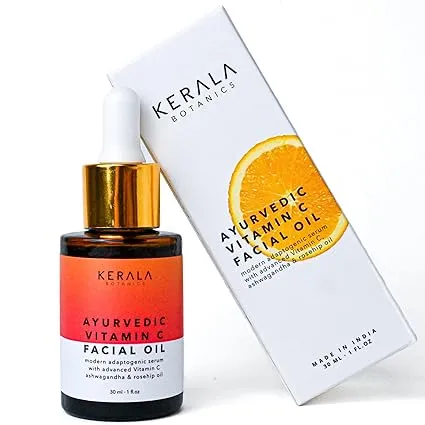
Ayurvedic Vitamin C Face Oil
Kerala Botanics
$49
★★★★☆
How to Use Ashwagandha Topically
A few practical notes.
Pair it with other anti-inflammatories thoughtfully. Ashwagandha stacks reasonably well with centella asiatica, niacinamide, and beta-glucan — all of which calm inflammation through partly different mechanisms. Stacking multiple calming ingredients isn’t redundant; it’s additive. Just watch the overall formula richness if you have oily or acne-prone skin.
Morning or evening works. Unlike vitamin C (which benefits from morning application for daytime antioxidant defense) or retinoids (which are strictly PM), ashwagandha has no photosensitivity concerns and no particular time-of-day advantage. Use it when it fits your routine.
Don’t skip sunscreen because you’re using an antioxidant. Antioxidants reduce oxidative damage; they don’t block UV. Still wear SPF. Every day.
Patch test if your skin is reactive. Ashwagandha is generally well-tolerated, but botanical extracts can cause contact sensitization in rare cases. A 48-hour patch test on the inner arm before first use is always worthwhile.
If you’re building a complete morning routine or an evening routine around calming and antioxidant ingredients, ashwagandha fits into either without complicating layering. It’s not an exfoliant, doesn’t interact negatively with most other actives, and doesn’t require any particular pH environment to function.
What We Don’t Know
The honest version of this guide has to include this section.
There are no large, double-blind, placebo-controlled clinical trials specifically measuring the topical efficacy of ashwagandha on human skin outcomes. What exists is: mechanism studies in cell culture, animal model data, a small number of industry-sponsored pilot studies, and a long tradition of use in Ayurvedic medicine that predates modern trial methodology.
The mechanism is credible. The traditional use is consistent with the proposed mechanism. But “this makes biological sense and has been used for millennia” is not the same as “we have strong clinical proof.”
That’s not a reason to dismiss ashwagandha. It’s a reason to calibrate expectations. You’re probably not going to see dramatic results from one ashwagandha-containing product. Used consistently as part of a well-formulated routine, the anti-inflammatory and antioxidant contributions are plausibly useful. Just don’t expect a single ingredient to fix stressed skin on its own.
Putting It All Together
Ashwagandha is a genuine ingredient with a plausible topical mechanism — not just a wellness buzzword that found its way onto a label. Withanolides, the active compounds in the root extract, show real antioxidant and anti-inflammatory activity in the research that exists. The NF-κB inhibition pathway and the Nrf2 upregulation story are both coherent and relevant to skin aging and sensitivity.
The cortisol angle is more complicated. Topical application won’t lower systemic cortisol — but it may help modulate some of the local inflammatory effects that stress hormones amplify in skin tissue. That’s a narrower claim. It’s also a more honest one.
For best results: look for formulas where ashwagandha appears mid-list or higher, paired with complementary antioxidants, in an oil-based or lipid-rich carrier that suits the ingredient’s chemistry. Use it consistently. And keep sunscreen in the routine regardless.
The evidence will likely catch up to the tradition. That’s generally how it goes with Ayurvedic ingredients that survive long enough to get studied properly — amla being a recent example. Ashwagandha for skin is worth watching, and depending on your routine, probably worth using now.