
Ingredients
Sunday Riley CEO Glow Review (With a Real-Cost Breakdown)
Sunday Riley CEO Glow reviewed honestly — texture, scent, performance, and whether the $85 price tag actually holds up against the competition.
Disclosure — This article may contain affiliate links. We earn a small commission at no extra cost to you when you purchase through our links. This supports our ability to create independent, evidence-based skincare content.
Quick verdict: 3.9/5. CEO Glow is a well-made face oil with genuine brightening appeal. But at $85 for 15ml, you’re paying a lot for sensory experience. The performance is solid — not extraordinary.
CEO Glow Vitamin C + Turmeric Face Oil
Sunday Riley
$85
★★★½☆
What we liked
- + Genuinely pleasant texture — absorbs faster than most oils
- + Turmeric and sea buckthorn give a real warmth to dull skin
- + Smells good, if you like fragrance in your skincare
Worth noting
- - Vitamin C form (THD ascorbate) lacks the clinical depth of L-ascorbic acid studies
- - Heavy fragrance isn't for everyone — or every skin type
- - 15ml size runs out fast; cost-per-use is steep
A sensory-first face oil with real brightening appeal, but the price-to-performance math only works if you already know oils are your format.
What CEO Glow Actually Is
Sunday Riley’s CEO Glow is a vitamin C face oil. Not a serum. Not a hybrid. A face oil — which already tells you something about who it’s built for and who it probably isn’t.
The active doing most of the work is THD ascorbate (tetrahexyldecyl ascorbate), an oil-soluble vitamin C derivative. It’s stable, doesn’t oxidize the way L-ascorbic acid does, and works well in oil-based formulas. The trade-off: there’s less clinical literature behind it than behind the water-soluble forms that dominate the brightening serum category. If you want to understand that distinction in full, our breakdown of oil-soluble vs. water-soluble vitamin C covers it properly.
Alongside the vitamin C, you get sea buckthorn (a rich orange oil with a reputation for warmth and glow), turmeric extract, and a blend of carrier oils that includes rosehip and jojoba. The formula is meant to feel indulgent. It does.
Texture and Application
This is where CEO Glow earns its reputation. The texture is genuinely nice — lighter than you’d expect from an oil, more of a dry-oil feel that absorbs in 60 to 90 seconds without leaving a greasy film. It works well pressed into skin while it’s still slightly damp after serum.
The color is a deep golden-orange from the sea buckthorn and turmeric. On lighter skin, there can be a slight warmth left behind immediately after application, but it fades. On deeper skin tones, it tends to just look like a glow, which tracks with why it’s popular across complexions.
Then there’s the scent. CEO Glow is fragrant. Noticeably, deliberately fragrant — there’s a floral-meets-citrus quality that’s pleasant in the bottle and pleasant on the skin for about ten minutes. After that it fades. But if you’re fragrance-sensitive, this is not the product. Sunday Riley leans heavily on scent across their line, and CEO Glow is no exception. People who love it really love it. People who don’t tolerate fragrance will be irritated — literally.
For routine placement: apply after water-based serums, before sunscreen in the morning. A few drops is enough. Three is plenty for a full face.
Performance: The Honest Version
Here’s where we have to slow down.
CEO Glow brightens. After two to three weeks of consistent use, skin looks warmer, more even. The sea buckthorn and turmeric do something — that orange-toned warmth translates to a visible glow that’s hard to pin entirely on the THD ascorbate. Whether it’s the vitamin C working or the general effect of a well-formulated oil on skin texture is genuinely hard to separate.
What it doesn’t do especially better than cheaper oils: fade hyperpigmentation at clinical speed. If dark spots are your main concern, a dedicated brightening serum will move faster. CEO Glow is more of a maintenance-and-glow product than a corrective one.
The THD ascorbate is real vitamin C. It penetrates the skin barrier effectively and does deliver antioxidant activity. But if you’ve been reading about the alternatives to SkinCeuticals CE Ferulic, you already know that the vitamin C category is competitive, and “works” isn’t the same as “works best for the price.”
The Real Cost Breakdown
This is the part that matters. At $85 for 15ml, CEO Glow is expensive. Let’s be concrete about what that means in practice.
A standard dropper application — three to four drops — uses roughly 0.3ml. That puts you at approximately 50 uses per bottle. Used once daily, that’s about seven weeks. The per-use cost works out to around $1.70 per day, or roughly $88 a month if you use it every morning.
That’s not nothing. For comparison:
| Product | Size | Price | Approx. Days Supply | Cost/Day |
|---|---|---|---|---|
| Sunday Riley CEO Glow | 15ml | $85 | ~50 days | ~$1.70 |
| Kerala Botanics Vitamin C Face Oil | 30ml | $49 | ~100 days | ~$0.49 |
| SkinCeuticals C E Ferulic | 30ml | $185 | ~100 days | ~$1.85 |
| Drunk Elephant C-Firma Fresh | 30ml | $90 | ~100 days | ~$0.90 |
CEO Glow is cheaper than CE Ferulic per day, barely. It’s significantly pricier than most of the oil-format competition. The 15ml size is the real issue — it just runs out. If Sunday Riley offered a 30ml at a proportional price, the value conversation would look different.
Who It’s Actually For
CEO Glow works for a specific person: someone who already knows they like face oils, doesn’t have reactive or acne-prone skin, wants a glow product rather than a corrective one, and genuinely enjoys a scented skincare moment. That’s a real audience.
It’s not for:
- Fragrance-sensitive skin
- Oily or acne-prone skin (the oil weight and fragrance can both cause problems)
- Anyone primarily chasing clinical pigmentation correction
- People who find the 15ml size anxiety-inducing
If you’re still figuring out whether face oils are even right for your skin type, this guide covers the basics before you spend $85 testing the format.
Compared to the Competition
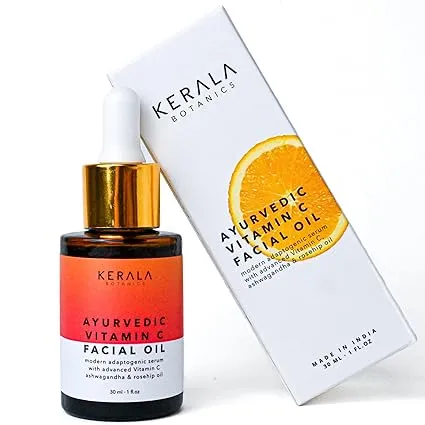
Ayurvedic Vitamin C Face Oil
Kerala Botanics
$49
★★★★☆
What we liked
- + Advanced vitamin C form stays active in skin cells significantly longer than L-ascorbic acid
- + Includes bakuchiol — a retinol alternative that pulls double duty
- + Replaces serum, moisturizer, and oil in one step
- + No synthetic fragrance
Worth noting
- - Oil format won't suit everyone, especially oily skin types
- - Less brand recognition than Sunday Riley or SkinCeuticals
- - May feel heavy under a full face of makeup
A genuinely multi-functional oil that delivers vitamin C and a retinol alternative in one unfussy step — better value, less flash.
Kerala Botanics’ Ayurvedic Vitamin C Face Oil is the most direct comparison worth making here — same format, lower price, different philosophy. At $49 for a bottle that lasts roughly twice as long, the cost-per-use difference is significant. The formula uses an advanced vitamin C compound with different stability and retention characteristics than THD ascorbate, alongside bakuchiol, which means it’s doing double duty as a retinol alternative in the same step. For anyone considering bakuchiol as a gentler option, that inclusion matters.
It doesn’t have the sensory theater of CEO Glow — no signature scent, no warm golden color story. If you buy skincare partly for the ritual, Kerala Botanics won’t scratch that itch. But if you’re after performance and simplicity, the math is clearly in its favor.
C E Ferulic
SkinCeuticals
$185
★★★★½
What we liked
- + The most clinically studied vitamin C serum available
- + L-ascorbic acid at proven pH and concentration
- + Long-lasting antioxidant protection
Worth noting
- - Oxidizes if stored poorly
- - Stings on sensitized skin
- - Very expensive
The benchmark — clinically bulletproof, but hard to justify the price for most people when alternatives are this close.
SkinCeuticals CE Ferulic isn’t a face oil, but it belongs in this comparison because it’s the standard the category gets measured against. It’s a water-based serum with L-ascorbic acid at clinical concentration — more aggressive, more studied, and more expensive. If you’re choosing between CEO Glow and CE Ferulic, you’re essentially choosing between a sensory oil experience and the most evidence-backed vitamin C on the market. Different products, different roles. We’ve covered whether CE Ferulic is actually worth $185 elsewhere — the short answer is: for some people, yes.
Final Ratings
| Category | Score |
|---|---|
| Texture & Application | 4.5 / 5 |
| Scent | 3.5 / 5 (love-it-or-leave-it) |
| Brightening Performance | 3.8 / 5 |
| Value for Money | 3.2 / 5 |
| Formula Transparency | 3.5 / 5 |
| Overall | 3.9 / 5 |
Putting It Together
CEO Glow is not a bad product. The texture is excellent, the glow is real, and the oil format genuinely suits people who’ve already found their way to that step. The issue is purely the price-to-size ratio and the fact that the formula’s vitamin C form, while effective, doesn’t come with the clinical weight to justify the premium over less expensive oils doing similar things.
Buy it if you want the ritual and you know face oils work for your skin. Skip it if your primary goal is corrective brightening or you’re working with a budget that should be going toward a longer-lasting option. The vitamin C oil category has gotten genuinely competitive in the last two years, and CEO Glow doesn’t dominate it the way it might have when it launched.
It’s a good oil. Just not obviously the best one at this price.