
Routines
The 3-in-1 Routine: One Oil Replacing Serum, Moisturizer, and Treatment
Can one face oil genuinely replace your serum, moisturizer, and treatment? Here's how to evaluate 3-in-1 claims and build a smarter minimal routine.
Disclosure — This article may contain affiliate links. We earn a small commission at no extra cost to you when you purchase through our links. This supports our ability to create independent, evidence-based skincare content.
Most routines have three to five products doing one job each. A vitamin C serum. A moisturizer. Maybe a treatment on top. The logic is sound — each step has a purpose. But when you’re standing at the sink at 6 AM, it can feel like running a small lab.
The appeal of consolidation isn’t laziness. It’s clarity. Fewer products means fewer chances for interactions, less money, less waste, and a routine you’ll actually follow every morning. The question isn’t whether simplifying is a good idea. It almost always is. The question is whether a single product can do three things well enough to justify replacing all three.
This guide is about how to answer that honestly — for face oils specifically, where the 3-in-1 claim gets made most often.
What “3-in-1” Actually Means
Before evaluating any product, it helps to be clear about what the three roles are.
Serum: Delivers active ingredients — vitamin C, bakuchiol, niacinamide, retinoids — in a form that penetrates the skin. Typically water-based, though oil-soluble actives can be suspended in oil.
Moisturizer: Replenishes and seals. A good moisturizer does both — it adds water (or draws it in) and creates a barrier to slow transepidermal water loss. Oils handle the second part well. The first part less so, unless the formula includes humectants.
Treatment: Addresses a specific concern. Brightening, firming, barrier repair, reducing breakouts. The same active ingredients from the serum step often carry this role too.
An oil that genuinely fills all three functions needs real active ingredients, meaningful occlusive properties, and a delivery mechanism that works. “Nourishing” and “luxurious” don’t count.
If a product checks those boxes, consolidation makes sense. If it’s mostly carrier oil with a few botanicals, it’s a moisturizer at best — not a treatment.
Why Oils Are the Best Candidate for Consolidation
Water-based serums don’t moisturize particularly well. Moisturizers rarely contain meaningful concentrations of actives. But a well-formulated oil occupies a middle ground that makes real multi-tasking possible.
Here’s why:
- Oil-soluble actives are stable. L-ascorbic acid, the vitamin C in most serums, oxidizes quickly in water-based formulas. Oil-soluble vitamin C derivatives last longer and can be delivered at meaningful concentrations without destabilizing the formula. Here’s a deeper look at how the two forms compare.
- Oils seal without clogging (the right ones). Squalane, rosehip, marula — these absorb well and provide the barrier function that locks in hydration. They don’t fully replace a humectant, but for most skin types, they’re sufficient.
- Oils layer well. Applied as the last step over slightly damp skin, a face oil seals in whatever hydration is already there. No additional moisturizer needed.
That said, oils are not universal. Oily and acne-prone skin tends to push back against oil-heavy routines. If that’s you, read through the caveats section before committing. We also have a full breakdown of how facial oils work for oily and acne-prone skin if you want to go deeper.
What to Look for in a Legitimate 3-in-1 Oil
Not every face oil earns the multi-tasker label. Here’s the short version of what separates a real one from a marketing claim.
Active ingredients at effective concentrations. The label should list the active by name, and ideally give you some indication of concentration or potency. Vague “vitamin C complex” language without any supporting data is a yellow flag.
A carrier oil suited to your skin type. Rosehip and squalane are lightweight and broadly compatible. Argan and marula are mid-weight. Heavier oils — coconut, olive — can be problematic for breakout-prone skin.
Evidence of barrier support. Fatty acids, ceramide-adjacent lipids, or ingredients known to support the skin barrier. A good oil should leave skin feeling protected, not stripped or tacky.
No fragrance in the top five ingredients. Fragrance as a secondary ingredient is a judgment call. High up the list, it starts competing with the actives.
A Product That Makes the Case: Kerala Botanics Ayurvedic Vitamin C Face Oil
The consolidation concept works best when there’s a real example to look at. The Kerala Botanics Ayurvedic Vitamin C Face Oil is worth examining because it’s one of the few that explicitly builds the case for replacing multiple steps — and the formula actually backs it up.
The vitamin C here is an oil-soluble, modified form that the brand claims stays active in skin cells significantly longer than standard L-ascorbic acid serums. That’s a meaningful differentiator. Standard vitamin C serums oxidize; this format doesn’t have that problem. The formula also includes bakuchiol, which functions as a plant-based alternative to retinol — relevant for anyone who wants a gentle treatment without the adjustment period that comes with actual retinoids. More on that comparison over at our bakuchiol vs. retinol breakdown.
The Ayurvedic angle isn’t just branding. The formula draws on ingredients like amla — a natural source of vitamin C used in traditional Indian medicine — which we’ve covered separately if you’re curious about what amla actually contributes to skincare.
At $49, it replaces what would otherwise be a serum, a moisturizer, and potentially a separate facial oil. For a lot of routines, that math works.
The honest caveats: the oil format won’t suit everyone. Oily or combination skin types may find it heavy, especially in humid weather. There’s less clinical data behind this formula than there is for something like SkinCeuticals CE Ferulic. And under full-coverage makeup, oils can cause pilling if they haven’t fully absorbed. Give it two to three minutes before anything goes on top.
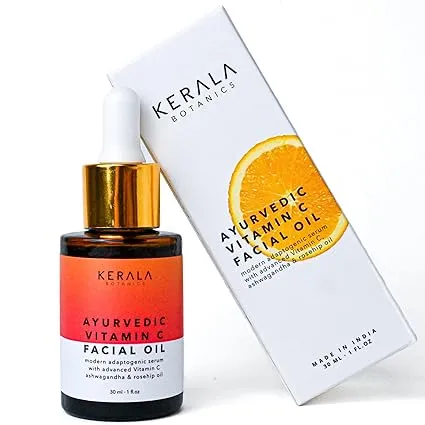
Ayurvedic Vitamin C Face Oil
Kerala Botanics
$49
★★★★☆
Two Other Oils Worth Considering
Kerala Botanics isn’t the only option. Two others have genuinely multi-functional formulas.
Biossance Squalane + Vitamin C Rose Oil pairs stabilized vitamin C with squalane — one of the most universally tolerated carrier oils. It’s lighter than most vitamin C oils, which makes it a reasonable entry point for oily skin dipping into this format. The vitamin C concentration is modest, so manage expectations on the treatment side, but the moisturizing performance is solid.
Squalane + Vitamin C Rose Oil
Biossance
$58
★★★★☆
Pai Skincare Rosehip BioRegenerate Oil takes a different angle — no vitamin C, but the rosehip seed and fruit oil naturally contain trans-retinoic acid precursors that support cell turnover over time. It works as both a treatment and an occlusive finish. Best for dry or sensitive skin that responds poorly to actives but still wants some long-term benefit built into the routine.
Rosehip BioRegenerate Oil
Pai Skincare
$52
★★★★☆
How to Actually Build the Routine
The 3-in-1 routine isn’t just swapping one product in. It’s restructuring. Here’s what a realistic morning version looks like.
Morning
- Cleanser. A gentle, non-stripping wash. Micellar water works if your night routine is minimal.
- Mist or toner (optional). Slightly damp skin helps the oil absorb and means you’re not relying entirely on the oil for hydration.
- The oil. Two to four drops, pressed in rather than rubbed. Let it sit.
- SPF. Non-negotiable. The oil replaces serum, moisturizer, and treatment — not sunscreen.
That’s four steps, and one of them is sunscreen which was always there. Many people find they can cut it to three by skipping the toner and applying the oil to freshly washed skin. Works fine for normal to dry skin. Less reliable if you live somewhere dry and cold.
Evening
The evening version has a little more flexibility. If you’re using bakuchiol — either in the oil or separately — this is the time for it. Bakuchiol doesn’t increase photosensitivity the way retinol does, so morning use is technically fine too, but evening gives it more time to work undisturbed.
If you want to keep a separate exfoliation step, one or two nights a week, that fits cleanly into a routine like this. The oil becomes your finish after the exfoliant. More on how layering order affects outcomes in our skincare layering guide.
When This Approach Doesn’t Work
Consolidation isn’t for every skin concern or every season.
Active acne. If your skin is actively breaking out, a multi-purpose oil is probably not the core of your routine. Salicylic acid, benzoyl peroxide, or a targeted treatment belongs there instead.
High-humidity climates. Oil-based routines can feel suffocating in humidity. Not a dealbreaker, but worth testing.
Very specific concerns. If you’re treating hyperpigmentation aggressively, managing rosacea, or working with a dermatologist on a prescription regimen — a 3-in-1 oil is probably a complement to that work, not a replacement for it.
The maximalist’s mindset. Some people genuinely enjoy a longer routine. There’s nothing wrong with that. The goal here is effectiveness, not minimalism for its own sake. If your complete morning skincare routine is working, there’s no reason to change it.
Putting It All Together
The case for a 3-in-1 oil routine is simple: fewer products, maintained results, less friction. The case against it is just as simple — it only works if the product you choose is actually doing three things, not just claiming to.
Look for oil-soluble actives with real evidence behind them. Make sure the carrier oil suits your skin type. Keep SPF in the lineup. And give the routine four to six weeks before evaluating — consolidation works, but skin takes time to adjust to any change.
The routine itself is the same one we’ve always been drawn to: cleanser, treatment, SPF. The difference is that the middle step is doing significantly more work than it used to.
That’s not cutting corners. That’s editing.