
Routines
Scent as Skincare: Why Aromatherapy Makes a Routine Stick
The secret to a skincare routine you'll actually keep? Scent. Here's the behavioral science behind why aromatherapy makes habits last.
Disclosure — This article may contain affiliate links. We earn a small commission at no extra cost to you when you purchase through our links. This supports our ability to create independent, evidence-based skincare content.
There’s a reason the candle industry is worth billions of dollars. People aren’t just buying wax and fragrance. They’re buying the feeling of walking into a clean house, or a spa, or their grandmother’s kitchen. Scent isn’t decoration. It’s a shortcut to the brain.
Your skincare routine works the same way — and most people have never thought about it like this.
I used to blow through expensive serums without noticing much difference, then stick with a cheap drug store oil for six straight months. The difference wasn’t the price or even the formula. The cheap oil smelled incredible. Every single night, twisting that cap open felt like a tiny reward. I looked forward to it. That’s not a small thing.
The behavioral science here is genuinely interesting, and once you understand it, you’ll probably rethink how you choose products — or at least add a new filter to the process.
Why Your Brain Associates Scent With Ritual
Scent is the only sense with a direct line to the limbic system, the part of your brain that handles memory and emotion. Everything else — touch, taste, sound, sight — gets routed through the thalamus first. Smell skips the middleman. That’s why one whiff of something can pull you back to a specific afternoon fifteen years ago before you’ve even consciously registered what you’re smelling.
For habits, this matters enormously.
Habit formation research consistently points to three components: a cue, a routine, and a reward. Most skincare advice focuses entirely on the routine part — the products, the order, the ingredients. But the cue and the reward are what actually make a behavior stick. Scent can serve both functions at once. The moment you smell your cleanser, your brain knows what’s coming. And the pleasant smell of your oil is the micro-reward that makes the whole thing feel worth doing.
This isn’t woo. It’s basic behavioral conditioning. The scent becomes the cue and the reward simultaneously, which means the habit loop reinforces itself every single time you complete it.
If you’ve ever wondered why your evening skincare routine feels more indulgent than your morning one, scent is a big part of the answer. Most morning routines are SPF and go — functional, efficient, neutral-smelling. Night routines tend to involve richer products with more complex scent profiles. Your brain has been trained to associate those smells with winding down. That’s a feature, not a coincidence.
The Problem With “Fragrance-Free” as a Default Rule
Here’s something the skincare community gets tangled up about. “Fragrance-free” has become a blanket recommendation, especially for sensitive skin, and there are real reasons for that. Synthetic fragrance is a top skin sensitizer. Certain fragrance components — linalool, limonene, eugenol — can trigger contact dermatitis in people who are prone to it. None of that is wrong.
But there’s a difference between synthetic fragrance cocktails and the naturally occurring aromatic compounds in plant-based ingredients. The rose hip oil that smells faintly floral isn’t the same thing as “parfum” sitting at the bottom of an ingredient list. Citrus-forward oils contain natural terpenes that carry mild brightening and antimicrobial properties. The same compounds that make certain Ayurvedic formulations smell the way they do are often active ingredients, not just decoration.
The blanket “fragrance is bad” position erases this distinction. For most people without diagnosed fragrance sensitivities, naturally scented products aren’t a risk — they’re an advantage. For more on how to actually read what’s in your products, learning to decode ingredient labels is genuinely worth your time.
How Scent Works as a Ritual Anchor
An anchor is a cue that reliably triggers a behavior or a state. Cold brew smells like “time to start working.” The sound of a gym locker is the anchor for “I’m doing this.” In the same way, a distinctive product scent can become the anchor for your entire routine.
The key word is distinctive. A smell that blends into the background doesn’t do this. You need something specific enough that your brain flags it as a signal. This is where a lot of minimal, clinical skincare actually works against consistency — not because of the formulas, but because there’s nothing for your brain to grab onto. You finish your routine and your nervous system barely registered that anything happened.
Contrast that with something that actually has a scent profile. Citrus and rose, for example, are two notes with meaningful psychological associations. Citrus tends to read as energizing and clarifying — good for morning routines. Rose has a slight sedative quality in aromatherapy research, which maps well onto an evening wind-down. When a product happens to combine both, you get something that works across contexts.
The Kerala Botanics Ayurvedic Vitamin C Face Oil is worth mentioning here specifically because its scent profile — a warm citrus with faint floral — is genuinely distinctive. That’s partly a product of the Ayurvedic botanical blend, and partly the natural aroma of the vitamin C derivative and bakuchiol it’s built around. It’s not perfumed. It just smells like what it is. And that specificity is exactly what makes it a good ritual anchor.
The formula is also doing real work on your skin. The vitamin C form used here is designed to stay active in skin cells significantly longer than standard L-ascorbic acid — which, as anyone who’s dealt with oxidized serums knows, has a notoriously short shelf life. It’s paired with bakuchiol, a plant-based retinol alternative that handles the cell-turnover side of things. If you want more on how bakuchiol stacks up, we’ve broken down the bakuchiol vs retinol question in full elsewhere.
The oil format means it doubles as a moisturizer, so for anyone trying to simplify their routine, this is three steps in one. That’s a real practical advantage. The honest downsides: it’s not ideal if your skin runs very oily, and it can feel heavy under makeup if you apply too much. A few drops go a long way.
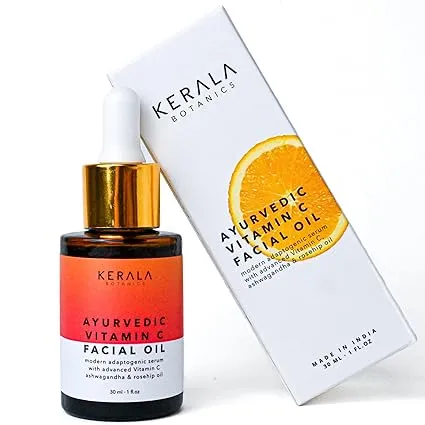
Ayurvedic Vitamin C Face Oil
Kerala Botanics
$49
★★★★☆
Building a Routine That Your Brain Actually Wants to Do
The practical application of all this is pretty simple. When you’re evaluating a new product, smell matters as a selection criterion. Not in a frivolous way. In a “will I actually use this for longer than two weeks” way.
A few principles that actually hold up:
Match the scent to the time of day. Citrus, green tea, and lighter botanicals work well in the morning — they feel clean and alert without being overwhelming. Warmer, heavier scents like rosehip, jasmine, or sandalwood work better at night. Your brain will start to use these associations automatically.
Consistency beats variety. The ritual-anchor effect only kicks in if the scent is predictable. Switching products constantly, which the skincare community absolutely encourages, actually works against habit formation. Pick a few core products and stick with them long enough for the associations to build. Your minimalist routine probably has more going for it than you realized.
Let the application itself be slow. Part of why massage tools like gua sha have their devoted followings isn’t just the physical effect — it’s the sensory pause they create. Taking thirty seconds to press a face oil into your skin with your palms, breathing in the scent, is a meaningfully different experience than slapping it on and walking away. The skin benefits of slow application are real. The psychological ones might be more important. Gua sha’s long-term effects are debated, but as a ritual enforcer, the argument is solid.
Use scent as a category anchor, not just a product preference. If your vitamin C smells like something you associate with morning brightness, you’re less likely to skip it. If your retinol smells clinical and weird, you’ll find reasons to skip. This sounds shallow. It isn’t.
A Few Other Products Worth Knowing About
If you’re building or rethinking your routine through this lens, a couple of options are worth having on your radar.
The Sunday Riley C.E.O. Glow Vitamin C + Turmeric Face Oil has a warm, slightly earthy citrus smell from the turmeric and vitamin C combination. It works well as an evening oil and the scent is distinctive enough to function as an anchor. It’s a bit pricier and not quite as multifunctional as a three-step replacement, but the texture is beautiful and it absorbs faster — better under makeup if morning application is your thing.
C.E.O. Glow Vitamin C + Turmeric Face Oil
Sunday Riley
$44
★★★★☆
The Drunk Elephant B-Goldi Bright Drops are technically a serum, not an oil, and the scent is very light — almost neutral. It doesn’t anchor well as a ritual product, but it’s excellent if you have oily skin and the face oil format doesn’t work for you. Performance on brightening is solid. Just don’t expect it to do the behavioral heavy lifting.
B-Goldi Bright Drops
Drunk Elephant
$38
★★★★☆
For the full picture on how vitamin C products compare across formats — oils versus serums, oil-soluble versus water-soluble derivatives — the breakdown in Vitamin C Serum vs Vitamin C Oil covers the functional differences clearly.
The Ayurvedic Angle
It’s worth noting that this entire idea — scent as an integral part of a therapeutic practice, not just an aesthetic byproduct — is foundational to Ayurveda. The tradition has used aromatic botanical ingredients for thousands of years not despite their smell but because of it. Aroma is considered part of how a preparation acts on the nervous system, not separate from it.
Modern skincare is slowly catching up to this framing. The Ayurvedic skincare guide on this site goes deeper into which traditional concepts have held up under scrutiny. The short version: a lot of them have, and the botanical complexity of Ayurvedic formulations often produces scent profiles that Western clinical skincare simply doesn’t replicate.
This is partly why brands rooted in that tradition tend to have a built-in moat when it comes to ritual products. The scent isn’t an afterthought — it’s baked into the philosophy.
Putting It All Together
A skincare routine isn’t just about what you put on your skin. It’s about what you’ll actually do, consistently, over months and years. Ingredients only work if you use them. And you’ll use them more reliably if the experience is something your brain looks forward to.
Scent is the fastest and most underrated way to make that happen. It ties into how habits are wired, how the brain processes sensory cues, and how Ayurvedic traditions have approached therapeutic self-care for centuries. None of this means buying products purely based on how they smell. Formulas still matter. But scent is a real factor in consistency — and consistency is what actually changes your skin.
Next time you’re evaluating a new addition to your routine, smell it. Deliberately. Ask whether it’s distinctive enough to be a signal. Ask whether it matches the time of day you’ll use it. Ask whether opening that bottle will ever feel like a micro-reward.
If the answer is yes, that’s worth more than you’d think.