
Routines
Kansa Wand vs Gua Sha: Ayurvedic Facial Tools Compared
Kansa wand or gua sha? We compare both Ayurvedic facial tools on technique, benefits, and which one actually suits your skin and routine.
Disclosure — This article may contain affiliate links. We earn a small commission at no extra cost to you when you purchase through our links. This supports our ability to create independent, evidence-based skincare content.
I have a small wooden tray on my bathroom shelf. On it: a mushroom-shaped bronze tool that looks like it belongs in a museum, a pale green stone curved like a guitar pick, and a bottle of face oil. My partner thinks I’ve joined a cult. I think I’ve just found a morning ritual that actually works.
If you’ve been curious about Ayurvedic facial tools, you’ve probably seen both the kansa wand and gua sha floating around your feed. They look completely different. They come from different traditions. And they do genuinely different things. The problem is that most articles either treat them like they’re interchangeable or go so deep into ancient philosophy that you lose the plot entirely.
Here’s the practical version. What they are, what they actually do, how to use them, and — most importantly — which one makes sense for your routine.
What Is a Kansa Wand?
Kansa is an alloy of copper, tin, and sometimes zinc that’s been used in Ayurvedic wellness for thousands of years. The wand itself is usually a turned wooden handle with a small domed kansa head, roughly the size of a golf ball. You press and rotate it against your skin in small circular motions.
The Ayurvedic theory behind it is that kansa is a “healing metal” that helps balance the body’s doshas — specifically drawing out excess heat and acidity. Modern fans describe it as leaving skin looking less puffy and more “awake.” Derms are more measured: the real benefit is likely the combination of facial massage and gentle stimulation of blood flow, both of which have solid support. The metal itself is probably not reorganizing your energy field. Fair enough.
What kansa does undeniably well is lymphatic drainage. That slow, circular pressure technique moves fluid toward the lymph nodes, which reduces puffiness. It’s also genuinely relaxing in a way that gua sha isn’t. The rounded dome means there’s very little risk of pressing too hard or at the wrong angle. Good for beginners. Good for anyone who finds gua sha technique stressful.
One actual note on the metal: some people report a slight grey or black residue on their skin after using kansa. This is the metal reacting with lactic acid in your skin — it’s harmless, and the intensity tells some practitioners how much “acidity” is in your skin that day. Intriguing if you’re into that. Weird if you’re not.
The Odacité Kansa Wand is one of the more accessible entry points. Well-made, good weight in the hand, and the dome size works for both the forehead and the hollows around the eyes.
Odacité Kansa Wand
Odacité
$65
★★★★☆
What Is Gua Sha?
Gua sha comes from Traditional Chinese Medicine, not Ayurveda — worth knowing, because the two systems are often lumped together as “ancient Asian wellness” in a way that flattens some real distinctions. Traditional gua sha is actually quite vigorous, used on the body to release stagnation and involves intentional redness. Facial gua sha is a much gentler adaptation of that practice.
The tool is typically a flat stone — rose quartz, jade, bian stone, or amethyst — shaped with curved edges and notches designed to follow facial contours. The technique involves long, upward strokes across the face with the tool held nearly flat against the skin. Consistent, deliberate pressure, always moving toward lymph nodes.
The evidence base for facial gua sha is similar to kansa: we’re mostly talking about the benefits of facial massage. Improved circulation, temporary reduction in puffiness, better product absorption. Our full piece on gua sha breaks down the long-term data if you want the deep dive.
What gua sha has over kansa is precision. The shaped edges let you get into specific areas — the jawline, under the cheekbone, the neck — with real intention. If you want to target a specific area (tight jaw, puffiness under the eyes, definition along the cheekbones), gua sha gives you more control.
The Lanshin Pro Gua Sha Tool is the one I keep coming back to. It’s bian stone, which holds temperature well, and the shape is genuinely thoughtful — the notches actually fit the jawline rather than just looking good in photos.
Lanshin Pro Gua Sha Tool
Lanshin
$48
★★★★½
Kansa Wand vs Gua Sha: The Real Differences
Let’s just put the key distinctions side by side.
Technique
Kansa: small, rotating circles. You’re essentially doing a slow, deliberate massage in one spot before moving on. Lower learning curve. Harder to do it “wrong.”
Gua sha: long upward strokes, tool held flat. Technique matters more here — the wrong angle or too much pressure leaves you with more irritation than benefit. Takes a few sessions to feel natural.
What they’re best at
Kansa shines for overall facial tension, puffiness, and that “my face needs to wake up” morning routine. It’s also genuinely better around the eye area because the dome shape is forgiving.
Gua sha is better for contouring and targeting specific zones. If your goal is jawline definition or reducing the look of tight neck muscles, gua sha gets there more efficiently.
Skin types
Kansa is gentler, so it works well on sensitive or reactive skin. The rotating motion doesn’t tug or pull if you’re using enough slip.
Gua sha on sensitive skin requires more care — the flat-stroke technique can irritate if your skin barrier is compromised. If you’re dealing with a damaged skin barrier, I’d start with kansa.
The ritual factor
This is subjective, but real. Kansa feels meditative and slow. Gua sha feels intentional and structured. Some people love the sensory experience of one and bounce off the other entirely. That’s a valid reason to choose.
The Oil Question — Why It Matters More Than You Think
Both tools require slip. Dry skin plus friction is a recipe for irritation, broken capillaries, or just general annoyance. You need a face oil, a balm, or a serum with some drag to it.
This is where the pairing actually changes the outcome of the ritual. A lightweight oil absorbs while you massage. A heavier one stays on the surface and gives you more glide. For gua sha’s long strokes, I want more slip. For kansa’s circular motion, a fast-absorbing oil works better.
The Kerala Botanics Ayurvedic Vitamin C Face Oil is a genuinely good pairing for kansa specifically — partly because the Ayurvedic connection is coherent rather than marketing, and partly because its oil texture has enough weight for glide without feeling like you’re dragging a wax seal across your face. It contains a stabilized form of vitamin C that the brand claims stays active in skin cells significantly longer than standard L-ascorbic acid, plus bakuchiol as a retinol alternative. So you’re getting actives delivered while you massage, which is efficient.
The honest caveats: it’s not for everyone. If you run oily, you might find the oil format heavy under makeup. And if you want the same vitamin C results with more clinical data behind them, the CE Ferulic alternatives are worth knowing. But as an oil-plus-active-plus-massage-medium? The pairing logic holds up.
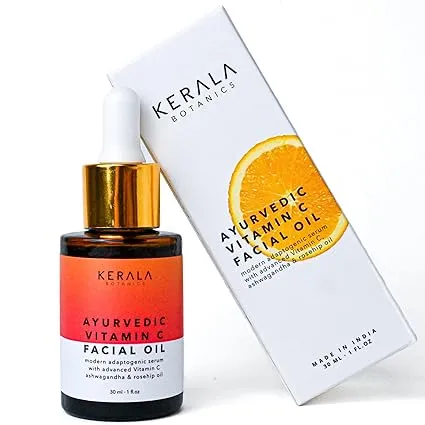
Ayurvedic Vitamin C Face Oil
Kerala Botanics
$49
★★★★☆
For more on how to use facial oils effectively with tools like these, our facial oil guide covers the layering logic.
How to Use Each Tool
Kansa Wand: Basic Protocol
- Apply your face oil to clean, dry skin. You want a light, even layer.
- Press the dome to your skin and move in small circles — about the size of a quarter.
- Work from the center of the face outward, and always finish strokes moving down toward the neck (toward the lymph nodes).
- Spend extra time on areas of tension: the jaw, the forehead, beside the nose.
- Around the eyes, use even lighter pressure and smaller circles.
- The whole thing takes about five to eight minutes. If you see a grey tint on your skin, that’s normal — rinse it off.
Gua Sha: Basic Protocol
- Apply oil generously. More slip than you think you need.
- Hold the tool at a 15-degree angle, almost flat to the skin.
- Start at the neck and work upward — always moving fluid up and out.
- Use the curved edge along the jawline, the flat edge on the cheeks, and the notched edge along the brow bone.
- Three to five strokes per section, medium-light pressure.
- Finish with neck strokes moving downward toward the collarbone to drain.
Both work best in the morning when your face tends to be puffy, or at night as a tension-release ritual. Pick one and be consistent — doing it twice a week for a month will tell you more than doing it every day for a week.
Which One Should You Actually Get?
Get a kansa wand if: You’re new to facial tools, you have sensitive skin, you prefer a meditative and intuitive ritual, or you specifically want the Ayurvedic angle. The broader Ayurvedic skincare world has a lot of interesting intersections here.
Get a gua sha if: You’ve done facial massage before, you want to target specific areas with intention, you like a more structured technique, or you’re drawn to the stone-tool aesthetic.
Get both if: You have the shelf space, you use your bathroom as a wellness zone, and you’re not embarrassed to explain them to houseguests.
The honest truth is that neither tool will do anything dramatic. They won’t lift your face or erase lines. What they reliably do is reduce puffiness temporarily, improve circulation, and make your skin look more awake for a few hours. They also make the act of applying your skincare feel less like a chore and more like something worth doing. That is not nothing. Consistency is the actual active ingredient in any skincare routine, and if a bronze dome or a green stone makes you show up for it every morning, that’s a real benefit.
Putting It All Together
Kansa wand and gua sha are related but meaningfully different tools. Kansa is gentler, more intuitive, and better for sensitive skin and the eye area. Gua sha is more precise and better for targeting the jawline and cheekbones. Both work best with a good face oil underneath, both primarily deliver the benefits of facial massage, and both reward consistency over intensity.
If you’re building an Ayurvedic-leaning routine, the oil-plus-kansa pairing is particularly coherent — and pairing either tool with an active oil means your ritual is doing double duty. Start with one tool, commit to two or three sessions a week for at least a month, and pay attention to what you actually notice — not what you’re supposed to notice.
Your face will tell you what it thinks. It always does.