
Acne
Can a Face Oil Work on Oily, Acne-Prone Skin? The Linoleic-Acid Case
Yes, face oils can work on oily, acne-prone skin — if you pick the right ones. Here's the linoleic acid science that changes everything.
Disclosure — This article may contain affiliate links. We earn a small commission at no extra cost to you when you purchase through our links. This supports our ability to create independent, evidence-based skincare content.
I used to avoid face oils like they had personally wronged me. Oily skin, closed comedones on my chin, the occasional cystic breakout — the last thing I was putting on my face was oil. That felt like pouring gasoline on a fire.
Then a facialist looked at my skin under magnification and told me my pores were full of thick, waxy sebum. “Your skin is congested because your sebum is the wrong consistency,” she said. “It’s too oleic. You need more linoleic acid.”
I had no idea what that meant. But two months after adding a rosehip oil to my routine, my skin was clearer than it had been in years. No new closed comedones. Less texture. I felt genuinely betrayed by every “no oils on oily skin” piece of advice I’d followed.
Here’s the science behind why that happened — and how to pick the right oil if your skin sounds anything like mine.
The Oily Skin Oil Paradox (And Why It Makes Sense)
Oily skin isn’t one thing. Your skin produces sebum, which is made up of several types of fatty acids. The ratio of those fatty acids matters enormously for how your skin behaves — and whether your pores stay clear or get clogged.
Research has consistently found that people with acne-prone skin tend to have sebum that’s relatively low in linoleic acid and high in oleic acid. That imbalance makes the sebum thicker, stickier, and more likely to plug pores and oxidize into the stuff that causes blackheads and inflammatory breakouts.
Here’s where it gets counterintuitive. When you apply an oil that’s rich in linoleic acid to your skin, you’re essentially topping up a deficit. Some research suggests this can help normalize sebum composition over time, making it less congested and less prone to the oxidation cascade that triggers acne.
Oleic-acid-heavy oils — think coconut oil, marula oil, olive oil — are a different story entirely. They’re more likely to worsen that ratio and contribute to clogged pores. That’s the real distinction. Not “oil vs. no oil.” It’s linoleic-rich vs. oleic-rich.
So when someone with oily skin breaks out from an oil, nine times out of ten, it was an oleic oil. And when someone with oily skin clears up after adding an oil, it was almost certainly linoleic.
What Makes an Oil Non-Comedogenic
The term “non-comedogenic” gets thrown around a lot, and frankly it gets oversimplified. There’s no universal certification. It’s mostly based on the comedogenicity rating system developed decades ago — a 0-to-5 scale where 0 means no pore-clogging risk and 5 means very high risk.
Rosehip oil sits at 1. Hemp seed oil, 0. Sunflower oil, 0-2. Compare that to coconut oil (4) or wheat germ oil (5), and you start to see why “just avoid all oils” is bad advice — it lumps totally different molecules into the same category.
The fatty acid profile is the shortcut to predicting comedogenicity:
- High linoleic acid → generally low comedogenicity. Rosehip, hemp seed, sunflower, sea buckthorn (in the flesh oil fraction).
- High oleic acid → generally higher comedogenicity. Coconut, marula, olive, argan (argan is mid-range but still oleic-dominant).
This doesn’t mean oleic oils are bad for everyone. Dry skin types often love them precisely because oleic acid has a richer, more occlusive feel. But if you’re oily and acne-prone, linoleic-dominant oils are your lane.
You can read more about how to evaluate ingredients before you commit to a product in our guide on how to read skincare ingredient labels.
Rosehip Oil: The Case Study
Rosehip seed oil is roughly 35–45% linoleic acid and 14–20% alpha-linolenic acid (an omega-3). It’s one of the most linoleic-rich oils available in standard skincare. It also contains trans-retinoic acid naturally — a precursor to vitamin A — which is part of why it has a decent track record for fading post-acne marks and improving texture over time.
Cold-pressed rosehip is the version you want. The heat-pressed alternative loses some of that fatty acid integrity and most of the retinoic acid content. Look for “cold-pressed” or “cold-processed” on the label.
A few things worth knowing before you start:
It does oxidize. Linoleic-rich oils are more prone to going rancid than oleic ones. Keep it in the fridge, buy small bottles, and if it smells crayon-like or sharp, it’s gone off. Using oxidized oil on acne-prone skin is asking for trouble.
The texture is lighter than you’d expect. Rosehip absorbs pretty quickly. It’s not the same as slathering on a rich face balm.
Results take time. We’re talking four to eight weeks before you see a real change in congestion. This isn’t a spot treatment.
The Ordinary Rosehip Oil
The most accessible entry point. $12, cold-pressed, no fragrance, minimal packaging. If you want to test whether your skin gets along with linoleic oils before spending more, start here.
100% Organic Cold-Pressed Rose Hip Seed Oil
The Ordinary
$12
★★★★☆
Trilogy Certified Organic Rosehip Oil
The one I keep coming back to. It’s organic, cold-pressed, and the bottle design actually minimizes oxidation. A bit pricier but you’re getting a product that’s been third-party certified and has a longer shelf stability track record than most. If you’re committing to rosehip long-term, this is the one to graduate to.
Certified Organic Rosehip Oil
Trilogy
$29
★★★★½
What About Oils That Go Beyond Rosehip
Rosehip is the classic choice, but it’s not the only linoleic-rich option worth knowing.
Hemp seed oil has one of the most balanced omega-6 to omega-3 ratios of any carrier oil, and a comedogenicity rating of essentially zero. It’s less studied in clinical contexts but has a solid following among people with reactive, acne-prone skin. The texture is slightly greener and earthier than rosehip.
Sunflower seed oil is cheap, widely available, and well-studied. One older but frequently cited study found it significantly better than olive oil for maintaining skin barrier integrity — relevant because a damaged barrier and oily skin often coexist. (More on that in our damaged skin barrier repair guide.)
Blue tansy oil (or products formulated with it) is worth mentioning because it contains azulene, which has anti-inflammatory properties. Herbivore’s Lapis Facial Oil uses it as a hero ingredient alongside squalane, and it’s specifically positioned for oily and acne-prone skin. The blue color is striking, the texture is light, and some people with reactive skin swear by it. The price is not for everyone.
Lapis Facial Oil
Herbivore
$72
★★★★☆
The Kerala Botanics Option: When You Want More Than Just Oil
If you want linoleic-acid benefits without using a straight carrier oil, there’s a middle ground worth knowing about.
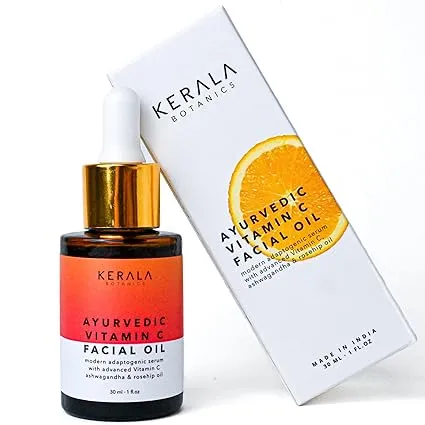
Kerala Botanics’ Ayurvedic Vitamin C Face Oil is built on a rosehip-rich base, which is where the linoleic story connects. But it layers a few things on top: an advanced, stabilized form of vitamin C that the brand claims stays active in skin cells significantly longer than standard L-ascorbic acid, plus bakuchiol — a plant-based compound with a decent body of evidence behind it for improving skin texture and tone without the irritation profile of retinol. (We’ve gone deep on that ingredient if you want to read the bakuchiol vs retinol breakdown.)
The pitch is essentially: one oil that replaces your serum, your facial oil, and your vitamin C step. Rooted in Ayurvedic formulation principles, which have their own long tradition of using botanical oils therapeutically — something we get into in our modern Ayurvedic skincare guide.
Honest pros: The oil-based vitamin C format solves the oxidation problem that plagues water-based serums. The rosehip base makes it more appropriate for oily skin than most face oils. Bakuchiol is a smart inclusion if you want retinol-like effects without the peeling. The routine simplification argument is real.
Honest cons: This is still an oil, which means it will feel like one. If you run very oily — like visibly shiny before noon — you might find it too much in summer or in humid climates. There’s also less long-term clinical data on this specific formulation compared to something like SkinCeuticals CE Ferulic. And if you prefer to control your actives individually rather than in a blend, a multi-ingredient oil might not suit how you like to work.
Worth it for: people who want vitamin C and bakuchiol without juggling four products, and whose skin is combination-to-oily rather than truly oil-slick.
Ayurvedic Vitamin C Face Oil
Kerala Botanics
$49
★★★★☆
How to Actually Use a Face Oil on Oily Skin
The application method matters more than most people realize. Slapping oil on damp skin before it absorbs? That’s how you end up greasy and questioning all your choices.
Start at night. Not because face oil is dangerous in the daytime, but because it gives you a controlled environment to see how your skin responds. Apply SPF over oil in the morning can affect texture and SPF performance, so it’s cleaner to troubleshoot at night first.
Apply to mostly-dry skin, last step in your routine. After serums and before nothing. Two to three drops, warmed between your palms, pressed gently into skin. No rubbing. Give it five minutes before you hit the pillow.
Less is genuinely more. If you’re new to facial oils and you’re oily, start with two drops every other night. Your skin doesn’t need a lot. More oil doesn’t equal more benefit.
Don’t mix it into your moisturizer. This is a common one, and it dilutes both products. If you want to use both, apply them separately.
Watch for the purge vs. breakout distinction. New closed comedones appearing in the first two weeks might be existing congestion surfacing, not your pores being newly clogged. Give it four weeks before you make a verdict. Actual new inflamed pimples in week one are a different signal — stop and reassess.
For a more complete picture of how oils slot into a full routine, check out our guide on how to use facial oils and how to layer skincare.
Who Should Probably Still Skip Face Oils
Even with the linoleic argument on the table, there are situations where oil isn’t the right call.
If you’re actively dealing with inflammatory acne — pustules, cysts, actively red and angry skin — adding any new oil is a risk. Get the inflammation under control first with salicylic acid or benzoyl peroxide, then reassess.
Fungal acne (malassezia folliculitis) is a category that often looks like regular acne but responds very differently. Most plant-derived oils feed malassezia yeast. If you’ve got itchy, uniform little bumps that don’t respond to standard acne treatments, read our fungal acne guide before adding any oil to your routine.
If your skin is extremely oily and you’re already struggling with routine compliance, adding an oil step might just be one more thing to skip. A niacinamide serum — which has good evidence for regulating sebum production — might be a better first move. We have a full breakdown in the niacinamide complete guide.
Putting It All Together
The “don’t put oil on oily skin” rule was always too blunt. The real rule is: don’t put oleic-dominant, high-comedogenicity oils on oily, acne-prone skin. Linoleic-rich oils — particularly cold-pressed rosehip — are in a different category entirely.
If your skin is congested, breaks out around your chin and cheeks, and has that thick, waxy quality to the sebum, it’s worth experimenting with linoleic supplementation through a well-formulated face oil. Start simple: The Ordinary’s rosehip oil is $12 and a perfectly good test case. Trilogy is the upgrade if you stick with it.
If you want vitamin C and bakuchiol in the same step and you’re open to an oil-based format, Kerala Botanics is worth a look — just be realistic about whether a face oil fits your skin on its oiliest days.
The goal isn’t to become a face-oil person. It’s to find out whether your skin actually needs what linoleic acid offers. Given how many people with oily skin are unknowingly running a linoleic deficit, the answer is more often yes than you’d expect.
Four to six weeks. Start at night. Two drops. See what happens.