
Body Care
Stretch Marks: What the Evidence Says Works
Striae rubra vs alba, tretinoin, centella, microneedling, laser — an honest breakdown of what actually reduces stretch marks.
Disclosure — This article may contain affiliate links. We earn a small commission at no extra cost to you when you purchase through our links. This supports our ability to create independent, evidence-based skincare content.
Stretch marks are not a damage problem. They’re a structural one. The dermis — the middle layer of skin — has torn under rapid mechanical stress, and the body has filled that tear with scar tissue. Understanding that distinction is what separates treatments that can actually help from the ones that just moisturize the surface and call it done.
Most of the creams sold for stretch marks work at the level of the epidermis. Stretch marks live deeper than that. So the first honest thing to say is this: topical products alone will not erase them. What the evidence does support is a more specific story — one that depends heavily on when you treat, what you use, and whether you’re willing to go beyond a jar of cream.
Striae Rubra vs Striae Alba: The Timing Gap That Changes Everything
New stretch marks look red or purple. That’s striae rubra. The discoloration means the dermal wound is still active — there’s vascularization, inflammation, some ongoing remodeling. This window, which can last anywhere from a few weeks to several months, is when topical treatments have the best chance of doing something real.
Older stretch marks are white or silver. That’s striae alba. The vessels have regressed, the tissue has matured, the remodeling has stopped. What’s left is essentially an atrophic scar — pale, soft, and significantly harder to shift.
This isn’t a reason to give up on older marks. It does mean the intervention needs to be more aggressive — and realistic expectations matter.
What Topical Treatments Can (and Can’t) Do
Tretinoin: The Best Evidence in Topicals
Tretinoin is the one topical with real clinical backing for striae rubra. A frequently cited 1996 study by Kang et al. found that 0.1% tretinoin applied daily over 24 weeks produced measurable improvements in early stretch marks — shorter length, narrower width, histological changes in collagen organization. The mechanism is the same as it is for photoaging: tretinoin increases dermal collagen synthesis and normalizes epidermal turnover.
The catch is that this works primarily on red marks. By the time striae alba has set in, the collagen-stimulating signal has less active tissue to work with. Studies in mature marks show minimal improvement with tretinoin alone.
Practical notes: tretinoin on body skin tends to be tolerated better than on the face — it’s thicker, less reactive — but irritation is still common early on. Pregnant or breastfeeding? Skip it. Tretinoin beginners should read this before starting.
Tretinoin 0.05% Cream
Obagi
$45
★★★★½
Centella Asiatica: Prevention More Than Correction
Centella’s record on stretch marks is interesting and often overstated. The strongest data isn’t in treatment — it’s in prevention. A randomized controlled trial found that a centella-containing cream used during pregnancy significantly reduced the number and severity of new stretch marks compared to placebo. The proposed mechanism involves madecassoside and asiaticoside stimulating fibroblast activity and improving elastic fiber organization before the dermis tears.
For existing marks, centella helps the surface — it’s anti-inflammatory, soothing, supports the barrier — but it won’t reorganize established scar tissue. Think of it as useful maintenance rather than a correction tool. It’s a better choice for someone trying to prevent marks from forming or from worsening, not for someone looking at five-year-old alba.
Full ingredient breakdown here: centella asiatica guide.

Centella Asiatica 100 Cream
Skin1004
$18
★★★★☆

Cicaplast Baume B5+
La Roche-Posay
$22
★★★★½
What Doesn’t Have Evidence
Cocoa butter. Shea butter. Bio-Oil. Vitamin E. Coconut oil. All widely sold for stretch marks. The evidence for any of them specifically preventing or improving striae is thin to nonexistent. They work as moisturizers — they keep the skin supple, which may reduce itching during rapid growth, and that’s a legitimate benefit. But they don’t affect the dermis, and there’s no mechanism by which they would.
If a product’s marketing relies on anecdotes and before-and-afters without controlled trial data, that’s the signal. We’re not saying skip moisturizer. Just don’t expect it to restructure scar tissue.
Procedures That Have Actual Evidence
If topicals have a ceiling, procedures are where the ceiling gets higher — particularly for striae alba.
Microneedling
Microneedling creates controlled micro-injuries in the dermis, triggering a wound-healing response that produces new collagen. For stretch marks, this is the point. Multiple studies show meaningful improvement with a series of sessions — typically three to six, spaced four to six weeks apart. A 2017 study in the Journal of Cosmetic Dermatology found significant improvements in texture and appearance of striae alba after four microneedling sessions, with histological evidence of new collagen deposition.
At-home dermarollers are a different conversation. The needle depth available over the counter (usually under 0.5mm) is significantly shallower than in-office microneedling (1.5–3mm). That doesn’t make them useless, but the stimulus is weaker. For stretch marks specifically — which sit deep — in-office treatment is more appropriate.
More on at-home devices vs professional treatments.
Fractional Laser
Fractional ablative and non-ablative lasers — the most studied being fractional CO2 and 1550nm erbium — show strong results in striae, including mature white marks. The mechanism is similar to microneedling but deeper and more precise. A 2018 systematic review found fractional laser produced significant improvement in texture, pigmentation, and patient satisfaction across multiple stretch mark types.
The tradeoff: cost (multiple sessions can run into thousands), downtime with ablative options, and higher risk of post-inflammatory hyperpigmentation in deeper skin tones. Non-ablative fractional is gentler and more appropriate for darker skin, though results accumulate more slowly.
Combination Protocols
The most consistent outcomes in recent literature come from combining modalities. Microneedling plus topical tretinoin. Fractional laser plus platelet-rich plasma. The logic is sound: each intervention works through a different mechanism, and the effects add up. Dermatologists specializing in body procedures are increasingly using combination approaches rather than any single treatment alone.
This is worth knowing before booking anything. Ask what the protocol is, not just what device they own.
A Note on Bakuchiol and Oil-Based Alternatives
For people who can’t use tretinoin — during pregnancy, or for those with skin that simply won’t tolerate retinoids — the question of alternatives comes up. Bakuchiol has shown some retinol-like effects on collagen and skin texture in facial studies, though the data on stretch marks specifically is limited. It’s a reasonable option if tretinoin is off the table, with the expectation that results will be more modest.
Kerala Botanics’ Ayurvedic Vitamin C Face Oil combines bakuchiol with a stabilized vitamin C derivative in an oil format. It’s primarily designed as a facial treatment, but the bakuchiol and antioxidant content make it worth knowing about for anyone building a body-care protocol around retinoid alternatives. The oil format is nourishing and absorbs reasonably well on body skin. Oily skin types may find it heavy. It won’t deliver the collagen-stimulating signal that prescription tretinoin does, but for a prevention or maintenance role — especially during pregnancy when options are limited — it’s a solid, well-formulated choice.
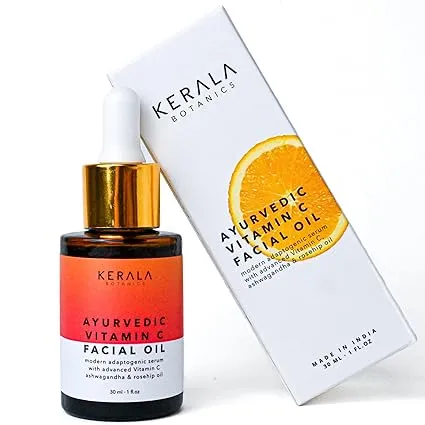
Ayurvedic Vitamin C Face Oil
Kerala Botanics
$49
★★★★☆
Full bakuchiol vs retinol breakdown here.
Putting It Together
The honest picture looks like this:
- Red, new marks: Tretinoin is the best topical option. Start early, be consistent, don’t skip SPF on exposed skin. Centella-based products can complement this.
- White, established marks: Topicals have limited reach. Microneedling or fractional laser — ideally in a combination protocol — are where real improvement happens. Find a practitioner who treats body skin specifically.
- Prevention (pregnancy, rapid growth): Centella-containing creams have the best evidence. Keep skin moisturized and elastic. This won’t guarantee anything, but the data is there.
- Maintenance and skin health: Moisturize, support the barrier, protect from UV. None of this will erase marks, but it keeps the surrounding skin in better condition.
What won’t work regardless of timing: the $40 cream that doesn’t name its mechanism, the oil that “penetrates deeply,” the supplement that “rebuilds collagen from within.” Stretch marks are a structural issue. The treatments that help are the ones that work structurally too.
Expect slow progress. A series of microneedling sessions over six months is a commitment. Tretinoin takes twelve weeks to show early changes. If that timeline sounds frustrating, it’s worth sitting with the fact that these are scars — and scars change slowly, if at all. The evidence gives us real tools. It just doesn’t give us fast ones.