
Sunscreen
Zinc Oxide vs Titanium Dioxide: Which Mineral Filter
Zinc oxide vs titanium dioxide compared: UVA1 coverage, white cast, the nano particle debate, and how to pick a mineral sunscreen that works for your skin.
Disclosure — This article may contain affiliate links. We earn a small commission at no extra cost to you when you purchase through our links. This supports our ability to create independent, evidence-based skincare content.
“Mineral sunscreen” is treated as one category. It isn’t. Two different ingredients sit behind that label, zinc oxide and titanium dioxide, and they don’t protect you in the same way.
The short version: zinc oxide covers more of the UV spectrum, especially long-wave UVA1. Titanium dioxide is better at the shorter wavelengths and is easier to make cosmetically elegant. Most good mineral sunscreens use both. This guide explains where each one is strong, why the white cast happens, what the nano debate actually involves, and how to read a label so you buy the right one.
What Zinc Oxide and Titanium Dioxide Actually Do
Both are inorganic filters. They’re finely milled mineral powders suspended in a cream or lotion, and they sit on top of the skin rather than soaking in.
The old explanation was that they “reflect” UV like tiny mirrors. That’s only partly true. Both minerals absorb a large share of UV radiation and scatter the rest, along with some visible light. Researchers have argued for years about the exact split, and the answer depends on particle size, coating, and formula. For your purposes, the takeaway is that they work immediately on application, with no waiting period, and they don’t break down quickly in sunlight.
That stability is the selling point. Chemical filters like avobenzone degrade as they absorb UV unless the formula stabilizes them. Zinc oxide is far more photostable, which is why it holds up for long days outdoors (provided you apply enough of it, more on that later).
UVA1 Coverage: Where Zinc Oxide Pulls Ahead
This is the biggest functional difference, and it gets the least attention.
UV light splits into three bands that matter for skin:
- UVB (280-315 nm): the main cause of sunburn.
- UVA2 (315-340 nm): shorter-wave UVA, also burning and damaging.
- UVA1 (340-400 nm): long-wave UVA. It penetrates deepest, drives photoaging and pigmentation, and doesn’t cause the pink warning of a burn.
Titanium dioxide is strong across UVB and UVA2. Its protection falls off as you move into UVA1. Zinc oxide stays effective much further into that long-wave range, which is why it’s the only common mineral filter regarded as truly broad-spectrum on its own. Zinc oxide alone can hit a critical wavelength (the measure regulators use for UVA coverage) in the mid-370s nm or beyond, depending on the formula.
Why does this matter in practice? UVA1 passes through window glass and shows up on cloudy days. It’s a major contributor to the dark spots and collagen breakdown people spend money on later. If you’re prone to pigmentation, UVA1 coverage deserves real weight. Our melasma treatment guide goes into why sun discipline matters more than any serum.
Titanium dioxide isn’t useless here. It contributes. But if you have to choose one filter for UVA protection, it’s zinc.
Why Most Formulas Use Both
Zinc oxide is less efficient than titanium dioxide at absorbing UVB, per percentage point of the ingredient. Titanium dioxide fills that gap. Pair them and you get a sunscreen with strong UVB protection and wide UVA coverage, at a lower total mineral load than you’d need with zinc alone.
That lower load matters for feel and look. A formula with only zinc oxide at 20 to 25 percent tends to be thick. A blend at, say, 9 percent zinc and 7 percent titanium dioxide can spread more easily and still deliver SPF 40ish. That’s roughly what you’ll see in many dermatologist-favorite mineral products.
In the US, the FDA’s current framework lists both ingredients as generally recognized as safe and effective, with a cap of 25 percent each. Neither requires special justification. That’s different from newer filters that are still working through approval, like those covered in our bemotrizinol explainer.
White Cast: Why It Happens and What Fixes It
White cast comes from visible-light scattering. Particles that are big enough and bright enough scatter visible light, and your skin looks chalky.
Titanium dioxide has a higher refractive index than zinc oxide. It’s the pigment that makes white paint white. So on a per-particle basis, titanium dioxide is the more opaque of the two, and poorly engineered titanium formulas can look like you smeared on drywall compound. Zinc oxide is more translucent, which is one reason it sits better on many skin tones when the particle size is right.
But formulation beats ingredient choice here. Three things determine how much cast you see:
- Particle size. Smaller particles scatter less visible light, so the cast fades. (This is where the nano question comes in, below.)
- Coating and dispersion. Silica, alumina, or silicone coatings help the particles spread evenly instead of clumping into white patches.
- Tint. Iron oxides add pigment that offsets the pale look. They also block visible light, which helps with melasma and other pigment conditions.
If you have a deeper skin tone, the tint matters more than the filter ratio. Our roundups of mineral sunscreens with no white cast and sunscreens for dark skin tones focus on formulas that handle this well.
One practical tip: apply mineral sunscreen to bare skin, let it set for a few minutes, then check it in daylight. Bathroom lighting lies.
Particle Size and the Nano Debate
“Nano” means particles with at least one dimension under 100 nanometers. Shrinking the particles makes them more transparent on skin. It also made some shoppers nervous, and the anxiety deserves a straight look.
What the concern is
The worry has two parts. First, could nanoparticles get through the skin and into the body? Second, could they harm the environment, especially coral?
What the evidence shows
On skin penetration, the research is fairly consistent. In studies on intact skin, zinc oxide and titanium dioxide particles, nano or not, stay in the outer layers (the stratum corneum and upper follicle openings). They don’t reach living tissue in meaningful amounts. Damaged or heavily sunburned skin is less well studied, and we’d rather say so than pretend certainty. Regulators in the US and EU have both reviewed the data. The FDA’s proposed rules treat both minerals as safe regardless of particle size, and the EU permits nano forms in cosmetics with labeling requirements.
There’s one real exception: inhalation. The risk comes from breathing in fine mineral powder, not from wearing it. That’s why the EU restricts nano titanium dioxide in spray and powder products, and why we’re cautious about aerosol mineral sunscreens. If you use a loose mineral powder, read our powder sunscreen guide for how to apply it without a cloud around your face.
On the environment, the picture is murkier. Lab studies suggest some coated and uncoated minerals can affect marine organisms at high concentrations, but the data linking real-world sunscreen use to reef decline is thinner for minerals than it is for filters like oxybenzone. “Reef safe” has no regulatory definition. Treat it as a marketing phrase.
Reading the label
Brands that avoid nano usually say “non-nano” on the front. Keep in mind that non-nano zinc oxide has larger particles, so it usually leaves more cast. If you care about nanoparticles for personal or environmental reasons, the tradeoff is visible and real. If you don’t, nano-sized zinc in a cream is considered safe by every major regulator.
Our view: for creams and lotions, the nano question is a preference, not a safety emergency. For sprays and loose powders, the question is about breathing, not skin.
Skin Type, Sensitivity, and Special Cases
Neither mineral is likely to irritate. That’s their reputation, and it’s earned. They don’t contain the organic filters most often blamed for stinging eyes or contact allergy.
Sensitive and reactive skin. Mineral formulas are usually the lower-risk starting point. Zinc oxide also has mild skin-calming properties, which is why it appears in diaper creams. Still, a mineral sunscreen with fragrance or a lot of botanical extracts can bother you. The filter is rarely the problem.
Acne-prone skin. Zinc oxide isn’t pore-clogging on its own, but the base of the formula matters. Heavy emollients can. Look for lightweight, non-comedogenic vehicles, and see our sunscreens for acne-prone skin picks.
Kids and babies. Pediatricians generally steer parents to mineral filters for young children, and pure zinc oxide formulas are the usual choice. We cover specifics in sunscreen for kids and babies.
Pigmentation. Choose a tinted formula with iron oxides, and prioritize zinc for the UVA1 coverage.
How to Choose: A Practical Checklist
Skip the debate and read the Drug Facts panel on the back. Here’s what to check:
- Active ingredients. Zinc oxide listed, ideally at 10 percent or more, either alone or with titanium dioxide. Titanium dioxide alone gives you weaker UVA1 coverage.
- “Broad spectrum” on the label. In the US that means it passed a critical wavelength test. It doesn’t tell you how good the UVA coverage is, only that it cleared the bar.
- SPF 30 or higher. The jump from 30 to 50 is smaller than the numbers suggest. Our SPF 30 vs SPF 50 breakdown explains why.
- Tinted vs untinted. If you see any cast in a store mirror, choose tinted.
- Texture. Lotions and creams usually blend better than sticks, though sticks are handy for reapplication and spots like ears and hairlines.
- Aerosols. Skip mineral sprays for the face, for the inhalation reasons above.
And apply enough. Most people use around half of what’s needed. The how much sunscreen to apply guide has the measurements. A well-formulated SPF 50 used at half the dose gives you far less than the number on the bottle.
Two Products Worth Knowing
Most mineral sunscreens blend both filters, so the picks below are chosen to show how the ingredient choice plays out.
A blend that balances both minerals
EltaMD’s UV Physical combines zinc oxide and titanium dioxide, with a tint that takes the edge off the pale look on light to medium skin. It’s a solid example of the blend approach: strong UVB coverage from titanium, wider UVA coverage from zinc. The texture is creamy rather than watery, and it can feel a bit heavy on very oily skin. It’s pricey for the size.
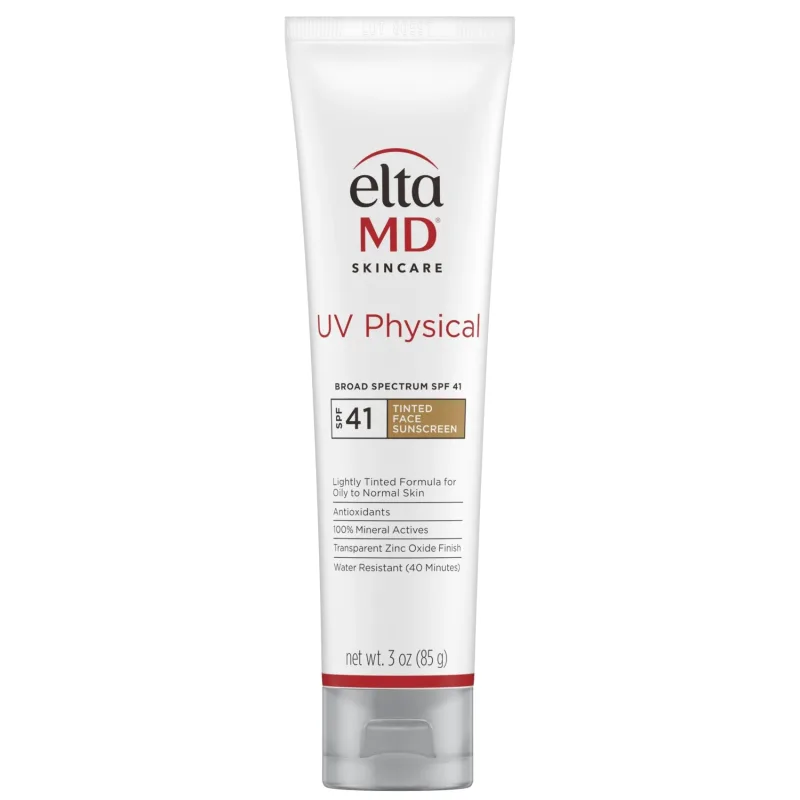
UV Physical Broad-Spectrum SPF 41
EltaMD
$43
★★★★½
Verdict: A reliable daily mineral for sensitive skin, as long as you’re fine paying for it.
A zinc-forward option
Badger’s Clear Zinc is built around non-nano zinc oxide at a high concentration, with a short ingredient list. That gives you the UVA1 advantage of zinc and a simple formula. The tradeoff is the one we described earlier: non-nano zinc at that level leaves a visible cast, and the balm-like texture takes work to spread. It’s better suited to beach days, hiking, and kids than to wearing under makeup.
Clear Zinc Mineral Sunscreen SPF 30
Badger
$18
★★★★☆
Verdict: Cheap, effective, and honest about what it is. Not for anyone who wants an invisible finish.
What About Chemical Filters?
Mineral isn’t automatically better. It’s a different set of tradeoffs. Chemical filters are typically more cosmetically elegant and easier to apply in adequate amounts, and newer filters like bemotrizinol offer very strong UVA coverage. If you’ve been avoiding sunscreen because mineral formulas look bad on you, a well-made chemical formula you’ll actually wear beats a mineral one you skip. We cover what’s available in bemotrizinol sunscreens: what to buy.
The best sunscreen is the one you use daily, in sufficient quantity.
Putting It All Together
Zinc oxide gives you the broadest coverage of any single mineral filter, including UVA1. Titanium dioxide strengthens UVB protection and helps formulas feel lighter. That’s why the best mineral sunscreens usually contain both.
White cast depends on particle size, coating, and tint more than on which mineral leads the ingredient list. For nano particles, the evidence supports their use in creams and lotions, with real caution reserved for sprays and powders you could inhale.
When you shop:
- Look for zinc oxide as an active, preferably with titanium dioxide.
- Choose a tint if you have any cast concerns, especially for deeper skin or pigmentation.
- Pick a texture you’ll apply generously.
- Avoid mineral aerosols for your face.
If you’re building out the rest of your morning routine around your sunscreen choice, our best face sunscreens roundup is the next stop.
Pick the formula you’ll actually wear. Then use enough of it.