
Ingredients
The Fragrance Loophole Is Closing: What Allergen Labeling Will Reveal
The FDA's MoCRA fragrance-allergen rules are changing what 'parfum' can hide. Here's what the new labels will show and how to read them.
Disclosure — This article may contain affiliate links. We earn a small commission at no extra cost to you when you purchase through our links. This supports our ability to create independent, evidence-based skincare content.
“Fragrance” is two words on an ingredient label. It can represent two hundred actual chemicals.
That’s the loophole — and for decades, it’s been perfectly legal. Cosmetic brands in the US could list a single word and reveal nothing about what was actually creating the scent. A moisturizer with 47 fragrance compounds? “Fragrance.” A serum with a known contact allergen? Still just “fragrance.”
That’s starting to change. The FDA’s Modernization of Cosmetics Regulation Act (MoCRA), signed into law in late 2022, includes provisions that would require fragrance allergens to be disclosed individually on labels. The EU has been doing something similar — with an expanded allergen list — for years. Understanding what these rules will actually show you, and what to do with that information, is worth getting ahead of now.
This is a guide to reading those labels when they arrive. And to understanding why “fragrance-free” has never meant quite what it sounds like.
What ‘Fragrance’ Actually Hides
The FDA has long classified fragrance formulas as trade secrets. That classification allowed brands to group hundreds of chemical compounds under a single ingredient name. The reasoning made some sense — scent formulas are genuinely proprietary, and requiring full disclosure would essentially hand competitors a recipe.
But the trade-secret logic created a real problem for consumers with sensitivities. If you’ve ever broken out in a rash from a product, only to find no obvious culprit on the label, fragrance was probably involved.
Fragrance mixtures can contain:
- Contact allergens — compounds that trigger immune-mediated skin reactions, sometimes with repeated exposure
- Irritants — chemicals that cause non-allergic inflammation, especially in compromised barriers
- Photosensitizers — ingredients that increase UV sensitivity when applied to skin
The most commonly cited culprits include linalool, limonene, citronellol, geraniol, cinnamal, and eugenol. The EU already requires these — and about 80 others — to be listed individually when they appear above a certain concentration threshold. The US has required none of them, until now.
What MoCRA Actually Changes (and What It Doesn’t)
MoCRA is the most significant overhaul of US cosmetic regulation in 80 years. We covered the broader implications in our MoCRA enforcement overview, but the fragrance piece deserves its own attention.
Under MoCRA’s fragrance allergen provisions, the FDA was tasked with establishing a list of fragrance allergens that must be disclosed on cosmetic labels when present above a defined concentration. The rulemaking process was slated to be substantially developed by 2026, though the final implementation timeline — including how brands must comply and by when — depends on the FDA’s rulemaking schedule. As of this writing, the proposed rule has not yet been finalized. Check the FDA’s MoCRA docket for current status before making purchasing decisions based on anticipated label changes.
What MoCRA does establish clearly:
- Mandatory facility registration for cosmetic manufacturers
- Safety substantiation requirements — brands must be able to demonstrate their products are safe
- Serious adverse event reporting — companies must now report serious allergic reactions to the FDA
The fragrance allergen labeling piece is still in process. But it’s coming. And the EU framework gives us a preview of what it will look like.
What the EU Already Requires
The EU’s Cosmetics Regulation (EC 1223/2009) requires individual listing of 26 fragrance allergens when they exceed 0.001% in rinse-off products or 0.01% in leave-on products. In 2023, the EU significantly expanded this list to over 80 allergens, including a broader set of tree moss extracts, certain musks, and oxidized terpenes like linalool oxide.
So a European moisturizer that would list “parfum” in the US might list “parfum, linalool, limonene, citronellol, geraniol” — each one a distinct compound with a distinct reactivity profile.
This is what US labels will eventually need to do. When they do, reading them will take about 30 more seconds. Those seconds are worth it.
How to Read the New Allergen Lists
When fully disclosed fragrance ingredients start appearing on US labels, here’s how to approach them.
Know the High-Reactivity Compounds
Not all fragrance allergens are equal. Some are common sensitizers with well-documented reaction rates. Others appear on lists mostly as a precaution. These are the ones worth paying attention to if you have reactive skin:
- Linalool and linalool oxide — found in lavender, many “natural” fragrances; the oxidized form is more reactive
- Limonene — citrus-derived, common in “fresh” scents; also oxidizes to a more allergenic form with air exposure
- Cinnamal (cinnamaldehyde) — found in cinnamon-adjacent fragrances; high sensitization rate
- HICC (hydroxyisohexyl 3-cyclohexene carboxaldehyde) — already banned in the EU; still permitted in US products
- Tree moss and oak moss extracts (atranol-containing) — potent sensitizers; EU has significantly restricted these
If you have a history of contact dermatitis or fragrance sensitivity, these are the names to scan for.
The ‘Natural’ Fragrance Trap
One thing the new labels will make clearer: “natural fragrance” is not a safer category. Linalool is natural. Limonene is natural. Cinnamal is natural. Many of the highest-reactivity fragrance allergens come directly from plants.
We wrote about the broader problem of “chemical-free” marketing in The Chemical-Free Myth — fragrance is one of the clearest examples of how naturalness and safety aren’t the same thing. If anything, some people react more readily to botanical extracts than to synthetic fragrance compounds, because botanical extracts are complex mixtures that vary from batch to batch.
The new labels won’t tell you a fragrance ingredient is natural or synthetic. They’ll just tell you it’s there. That’s actually more useful.
What ‘Unscented’ and ‘Fragrance-Free’ Mean (and Don’t Mean)
This distinction matters and is widely misunderstood.
Fragrance-free means no added fragrance — no perfume, no masking agents. This is what most dermatologists recommend for sensitive or reactive skin. But some naturally fragrant ingredients (like essential oils, rose extract, or citrus peel oil) can still appear in fragrance-free products, because they’re classified as functional ingredients rather than added fragrance.
Unscented often means the product contains masking fragrances — synthetic compounds added specifically to cover the smell of other ingredients. The end product has no detectable scent, but there are still fragrance compounds in the formula.
When the new allergen labels arrive, “fragrance-free” products will still need scrutiny. A product can claim to be fragrance-free while listing limonene as a component of, say, citrus extract or bergamot oil. Reading the full list remains necessary.
What to Do Right Now
The rule isn’t final. Labels haven’t changed yet. But the information gap between the EU and US markets already exists, and you can use it.
Check EU-version ingredient lists. Many global brands publish EU INCI lists on their European sites. If a product you use is sold in the EU, look up its European label on the brand’s UK or EU website. It will show allergens the US label doesn’t.
Use the INCI decoder databases. Sites like CosDNA, Skincarisma, and INCIDecoder already flag known fragrance allergens in ingredient lists. They won’t catch everything, but they catch the 26 compounds the EU has required since 2009.
Patch test anything new. If you’re reactive to fragrance, this hasn’t changed. Apply a small amount to your inner arm for several days before using a new product on your face. A single application often won’t trigger a reaction — contact sensitization typically requires repeated exposure.
Look for genuinely fragrance-free options. The best-formulated fragrance-free moisturizers are also some of the best moisturizers, full stop.
Vanicream Moisturizing Skin Cream
Vanicream
$14
★★★★½
Vanicream is a benchmark here. No fragrance, no dyes, no formaldehyde-releasing preservatives. The ingredient list is short and clean. Dermatologists recommend it by name, which is rare.
Toleriane Double Repair Face Moisturizer
La Roche-Posay
$22
★★★★½
La Roche-Posay’s Toleriane line is built specifically around fragrance-free, minimal-irritant formulas. The Double Repair version adds ceramides and niacinamide — relevant if you’re dealing with a compromised barrier. We covered barrier repair in more depth here.
If You Want to Simplify Further
Some people dealing with fragrance sensitivity are also looking to reduce the overall number of products they use — fewer products means fewer potential exposures. Oil-based formulas that combine steps can help here.
Kerala Botanics’ Ayurvedic Vitamin C Face Oil is worth knowing about in this context. It combines an advanced vitamin C form with bakuchiol — a plant-based retinol alternative — in a single oil that can replace serum, moisturizer, and facial oil in one step. Fewer bottles, fewer ingredient lists to audit.
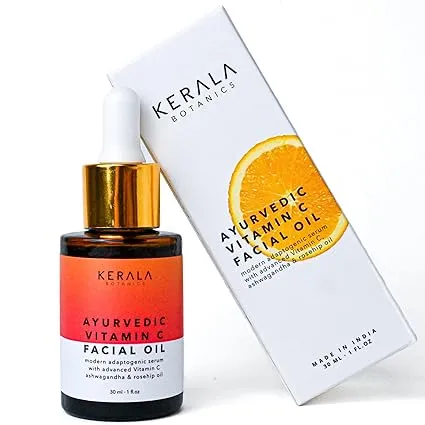
Ayurvedic Vitamin C Face Oil
Kerala Botanics
$49
★★★★☆
A few honest notes: the oil format won’t work for everyone. Oily or acne-prone skin may find it too heavy, especially in warmer months. And while the vitamin C form used is described as more stable and longer-lasting than standard L-ascorbic acid, the clinical data isn’t as deep as what exists for benchmark serums like SkinCeuticals CE Ferulic. What it offers is a meaningfully shorter routine for people who want one — and a fragrance-free formula. That last part matters here. More on vitamin C formats in our vitamin C serum vs oil comparison.
Putting It Together
“Fragrance” on a US ingredient label has functionally been a black box. MoCRA’s allergen labeling provisions are designed to open it — though the final rule and its timeline are still being established by the FDA.
What’s already true:
- The EU discloses 80+ fragrance allergens individually. US brands selling in both markets already have this data.
- “Natural fragrance” is not a safer category. Many high-reactivity allergens are plant-derived.
- “Fragrance-free” and “unscented” mean different things. The former is generally what dermatologists recommend.
- You can already access more complete ingredient information by checking EU versions of products, or running labels through ingredient decoder tools.
When the US labels catch up, reading them will be straightforward. Scan for the high-reactivity compounds listed above. Cross-reference against any reactions you’ve had. Patch test regardless.
The loophole closing isn’t the end of fragrance in skincare — it’s just the end of not knowing what you’re putting on your face. That’s a reasonable thing to want.
Note: MoCRA’s fragrance allergen rulemaking was ongoing at the time of publication. For the most current status on labeling requirements and compliance timelines, check the FDA’s official MoCRA rulemaking docket at FDA.gov.