
Ingredients
Preservatives: The Most Misunderstood Ingredients on the Label
Parabens, phenoxyethanol, and the real risk of preservative-free skincare — what the contamination data and EU-US rules actually say.
Disclosure — This article may contain affiliate links. We earn a small commission at no extra cost to you when you purchase through our links. This supports our ability to create independent, evidence-based skincare content.
Preservatives get more hate mail than almost any other ingredient category. Parabens, phenoxyethanol, formaldehyde-releasers — type any of those into a search bar and you’ll find a decade of blog posts telling you they cause everything from hormone disruption to cancer.
Here’s the part that gets left out: preservatives are the reason your moisturizer doesn’t grow mold in the jar you keep in a steamy bathroom. We’re not debating whether skincare needs them. We’re debating which ones, at what dose, and whether the fear is proportional to the evidence. It mostly isn’t.
Why Skincare Can’t Skip This Step
Any product with water in it — and that’s most of them — is a buffet for bacteria, yeast, and mold. Water, oils, plant extracts, the humid bathroom shelf it sits on. Everything a product needs to stay usable for 12 months also happens to be everything microbes need to thrive.
The data on what happens without preservatives is not subtle. Studies auditing opened cosmetic products — the kind sitting in real bathrooms, not sealed in a lab — have found contamination rates climbing past 70-90% in preservative-free formulas within weeks of first use. Pseudomonas, Staph, even E. coli show up. Most of the time it just means the product smells off and gets tossed. Occasionally it means an eye infection or a breakout that won’t quit, applied directly to skin that’s already compromised.
This is the part the “clean beauty” conversation tends to skip. We’ve written before about why the “chemical-free” label is mostly marketing — water is a chemical, vitamin C is a chemical, everything is a chemical. Preservatives are where that marketing gets its sharpest edge, because the fear is easy to sell and the contamination risk is invisible until it isn’t.
Parabens: Feared, Studied, Still Standing
Parabens (methylparaben, propylparaben, butylparaben) have been the preservative world’s main character since a 2004 study found trace amounts in breast tumor tissue. The study never established that parabens caused the tumors — it found presence, not causation — but the headline did what headlines do, and parabens never really recovered their reputation.
What’s happened since is three decades of additional research, mostly uneventful. The weak estrogenic activity parabens show in lab dishes is real but tiny — estimated at somewhere around 1,000 to 10,000 times weaker than the body’s own estrogen. The EU’s Scientific Committee on Consumer Safety and the US Cosmetic Ingredient Review panel have both concluded that parabens, at the concentrations used in cosmetics (typically under 0.4%), are safe.
The caveat worth knowing: the EU has restricted or banned the longer-chain parabens — isopropylparaben, isobutylparaben, and a few others — over data gaps, not confirmed harm. Methylparaben and ethylparaben are still permitted on both sides of the Atlantic. If a brand avoids parabens entirely now, it’s often a marketing decision more than a safety one. Nothing wrong with that choice. Just know it’s a preference, not a correction.
Phenoxyethanol: The “Natural” Swap That Isn’t Simpler
When brands pull parabens, phenoxyethanol is usually what goes in instead. It shows up in a huge share of “paraben-free” formulas, including ones marketed as gentle or natural, which is a little ironic — phenoxyethanol is synthetic no matter what else is in the bottle.
It works well: broad-spectrum, stable, doesn’t break down easily under heat or light. The concern that gets circulated is a 2008 French regulatory note suggesting infant exposure limits, which led the EU to cap phenoxyethanol at 1% in products for children under three. That’s a pediatric-specific precaution, not a verdict on adult use, and the cap for adult products remains at 1% across the board with a long safety record behind it.
Sensitization is rare but not zero — if you’ve reacted to a fragrance-free, paraben-free product and assumed you were in the clear, phenoxyethanol is worth checking as the culprit. For most people, though, it’s one of the more boring, well-tolerated preservatives on the shelf. “Boring” is the goal here.
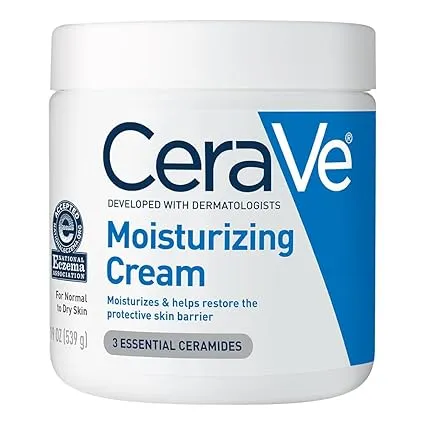
Moisturizing Cream
CeraVe
$19
★★★★½
CeraVe’s cream uses phenoxyethanol to protect a jar that’s going to get opened, closed, and fingered into for months. It’s done the job without complaints for years, which is exactly what you want from a preservative system — invisible.
Toleriane Double Repair Moisturizer
La Roche-Posay
$22
★★★★½
Same story here. Phenoxyethanol plus a small supporting cast of preservatives, formulated for sensitive and reactive skin specifically. If it caused widespread irritation, dermatologists wouldn’t be recommending it for rosacea and eczema patients as often as they do.
The EU vs. US Split: Different Rules, Not Better Rules
This is where a lot of confusion starts. The EU bans or restricts more individual preservatives than the US does, and that gets read as “Europe cares more about safety.” The real explanation is more about regulatory philosophy than outcome.
The EU works on a precautionary model — ingredients can be restricted over data gaps or theoretical risk, even without confirmed harm in humans. The US, historically, has operated closer to “innocent until proven otherwise,” leaving more ingredients on the market pending stronger evidence either way. That changed somewhat with MoCRA, which gave the FDA more authority to require safety substantiation and recall unsafe products — but the FDA still isn’t pre-approving ingredients the way the EU’s system does.
Neither system is lying to you. They’re answering a different question. “Has this been proven unsafe” and “has this been proven definitively safe” are not the same bar, and products can pass one while technically not clearing the other. A preservative banned in the EU isn’t automatically dangerous in a US product — it may just not have cleared the EU’s higher precautionary threshold yet, or the EU acted on a smaller margin of theoretical risk than the US currently requires.
The Preservative-Free Risk Nobody Markets Honestly
“Preservative-free” sounds like the safest possible label. It’s often the opposite.
A handful of formulas can genuinely skip traditional preservatives — ones with no water, a very low water activity, or packaging that limits air and finger contact (airless pumps, single-use capsules). This is the whole premise behind anhydrous, waterless formulas: no water, much lower microbial risk, less need for a preservative system at all.
Oils fall into a related category. A pure facial oil without water doesn’t support bacterial growth the way a cream does, which is one reason oil-based formats can get away with lighter preservation — or none, if the packaging and ingredient list support it.

Ayurvedic Vitamin C Face Oil
Kerala Botanics
$49
★★★★☆
This one pairs a stabilized vitamin C with bakuchiol in an oil base rather than a water-based serum, which sidesteps a lot of the preservation question that liquid vitamin C serums have to solve with additional stabilizers. It’s not for everyone — oily or acne-prone skin may find the richness too much, and it’s thinner on peer-reviewed clinical data than something like SkinCeuticals CE Ferulic. But as a one-step oil replacing a serum and moisturizer, the lighter preservation load is a genuine side benefit, not just a selling point.
What’s actually risky is a water-based cream or lotion claiming “preservative-free” with no anhydrous formulation and no airless packaging to back it up. That product is either quietly using a borderline preservative system and calling it something gentler-sounding, or it’s genuinely unprotected and living on borrowed time once it’s opened. Either way, check how to read the ingredient list before trusting the front-of-bottle claim. “Preservative-free” is not a regulated term. It means whatever the brand wants it to mean that week.
How to Actually Evaluate a Preservative on a Label
We don’t need to memorize every INCI name. Three questions cover most of it:
- Is it in a water-based product? If yes, it needs a working preservative system — full stop. The only real question is which one.
- Does the brand name a specific preservative, or just say “preservative-free”? Naming it is more honest. Vague claims are the ones worth double-checking.
- Has this ingredient been reviewed by CIR or the EU’s SCCS? Most common preservatives have. If one hasn’t been reviewed at all, that’s a bigger flag than one that’s merely controversial.
An app score or a red flag on a “clean” scorecard isn’t the same as evidence of harm — we’ve gone deeper on why a 100/100 Yuka score tells you less than it seems to. Preservatives get penalized by these tools almost automatically, regardless of the actual dose or risk profile.
Putting It Together
Preservatives aren’t the villain of the ingredient list. They’re the reason the rest of the formula gets to work at all. Parabens have more safety data behind them than almost any alternative and remain permitted at sensible doses in both the US and EU. Phenoxyethanol is the most common paraben substitute and, for most adults, just as uneventful. The EU’s stricter stance reflects a different regulatory philosophy, not a more accurate one.
The real risk sits with products that skip preservation without the formulation to support it — a water-based cream with nothing protecting it once air gets in. If a brand can’t tell you how its product stays stable after opening, that’s the question worth asking, not whether the ingredient list has a name you don’t recognize.