
Ingredients
Why '100/100 on Yuka' Isn't the Whole Story: Clean-App Scores Explained
A perfect Yuka score doesn't mean a product is effective — or even safe. Here's what ingredient-scoring apps actually measure, and what they miss.
Disclosure — This article may contain affiliate links. We earn a small commission at no extra cost to you when you purchase through our links. This supports our ability to create independent, evidence-based skincare content.
A product scoring 100/100 on Yuka gets shared like it just cured something. Screenshots circulate on Reddit. TikTok creators hold the phone up to the camera with the reverence of a holy relic. “Look — perfect score.”
Here’s the problem: Yuka is not a safety database. It’s not a clinical efficacy tool. And a perfect score is not the same thing as a great product.
That doesn’t mean these apps are useless. They’re not. But if you’re making purchase decisions based solely on a color-coded score, you’re getting a partial picture — and sometimes a misleading one. This guide explains what ingredient-scoring apps actually measure, where their logic breaks down, and how to use them without letting them do all your thinking.
What Ingredient-Scoring Apps Actually Do
Apps like Yuka, Think Dirty, and INCI Beauty work by matching a product’s ingredient list against a database of flagged or approved compounds. Each ingredient gets a score based on pre-assigned risk levels, and those scores get aggregated into a single product rating.
The databases themselves are built from a mix of sources: the EU’s CosIng database, EWG’s Skin Deep, published hazard assessments from regulatory bodies, and in some cases independent research. Yuka, specifically, draws heavily on EWG and CosIng classifications.
That’s a reasonable starting point. But the model has a few structural problems that are worth understanding before you trust a number.
The Hazard vs. Risk Confusion
This is the biggest one, and it trips up a lot of people.
Hazard and risk are not the same thing in toxicology. Hazard is the potential for a substance to cause harm. Risk is the probability of that harm occurring under real-world conditions — which includes dose, concentration, exposure frequency, and route of exposure.
Ingredient apps almost universally score on hazard, not risk. That means an ingredient that causes harm at high oral doses might get flagged even if it’s present at 0.01% in a rinse-off cleanser. The hazard is real. The risk, in that context, is essentially zero.
Phenoxyethanol is a good example. It’s a common preservative that Yuka frequently flags as a concern. The evidence behind that flag comes largely from studies showing toxicity at concentrations far above what’s used in cosmetics (typically 0.5-1%). The EU has approved it at up to 1%. EWG gives it a moderate hazard score. But none of that context makes it into the Yuka interface — you just see the flag.
Concentration Is Invisible
Ingredient lists in the EU and US are required to be listed in descending order by concentration — but only down to 1%. Below that, ingredients can appear in any order. Apps have no access to actual formulation data. They score every ingredient as if concentration were irrelevant.
This matters enormously. A fragrance compound listed near the bottom of a 30-ingredient list might be present at 0.001%. An app that flags it for allergen potential is technically correct about the hazard. But whether that concentration is meaningful for your skin is a different question entirely — and the app can’t answer it.
If you want to actually understand an ingredient list, learning to read it yourself is worth the effort. The order tells you more than any app score.
What Gets a Perfect Score
A product can score 100/100 on Yuka while containing:
- Ingredients with no efficacy data (they’re harmless, not helpful)
- Minerals or plant extracts at concentrations too low to do anything
- A preservative system that extends shelf life for exactly one month
- Fragrance components that aren’t individually listed (and therefore not scored)
It can also score 100/100 while being completely wrong for your skin type, pH-incompatible with other products in your routine, or simply not formulated well enough to penetrate the stratum corneum.
A 100/100 score means the app found nothing it considers suspicious. That is not the same as “this works.”
The Clean Beauty Assumption Baked Into the Algorithm
Ingredient-scoring apps are philosophically aligned with clean beauty — the idea that “natural” ingredients are inherently safer than synthetic ones. This shapes what gets flagged and what doesn’t.
Synthetically derived preservatives get penalized. Plant extracts often don’t, even when they carry meaningful sensitization risk. Essential oils, for example, are among the most common contact allergens in cosmetics — lavender, linalool, limonene — but apps tend to treat them gently because they’re natural.
This isn’t a neutral framing. It’s a worldview embedded in the scoring model. And it means that apps will consistently overrate products formulated around botanical ingredients and underrate products using well-studied synthetics.
We’ve written about this in more depth in the chemical-free skincare myth piece. The short version: everything is a chemical. The word “natural” tells you something about origin, not safety.
Where Yuka Gets Something Right
None of this means you should delete the app. There are real use cases.
Identifying common allergens at a glance. If you have a known sensitivity to a specific compound — MI (methylisothiazolinone), certain fragrance chemicals, lanolin — scanning an ingredient list is genuinely faster with an app than doing it manually. The flag is useful even if the scoring context around it isn’t.
Building basic ingredient literacy. For someone new to reading labels, apps can introduce concepts: “this is a preservative,” “this is an emulsifier,” “this is a fragrance component.” Think of it as a starting point, not a verdict.
Flagging actual high-concern ingredients. Some things genuinely warrant scrutiny — formaldehyde-releasing preservatives, certain UV filters with incomplete safety profiles, known hormone disruptors at meaningful concentrations. Apps catch these too. The problem is the signal-to-noise ratio.
High Scores, Real Products — A Closer Look
Kerala Botanics’ Ayurvedic Vitamin C Face Oil scores well on ingredient apps for a straightforward reason: it’s formulated without the categories of ingredients these apps tend to penalize. No synthetic preservatives in the traditional sense, no petrochemical derivatives, no flagged fragrance compounds. The ingredient list is short and plant-forward.
That’s a legitimate quality. But it’s worth separating it from what the product actually does — and being honest about both.
The formula uses a stabilized, oil-soluble vitamin C derivative rather than L-ascorbic acid, which means it doesn’t require the low-pH environment that destabilizes traditional serums. The brand claims this form stays in skin cells significantly longer than standard L-ascorbic acid. Bakuchiol (a plant compound with documented retinol-like activity) handles the cell-turnover side of the routine. As a face oil, it simplifies a multi-step routine into one product — useful if you’re prioritizing efficiency or exploring oil-based formats.
The honest cons: oil formats aren’t universally appropriate. If your skin runs oily or congested, adding a face oil might not work for you — that article covers it in more detail. The clinical data on the specific vitamin C derivative used here is thinner than what exists for L-ascorbic acid. And it’s on the heavier side for morning use under SPF-heavy sunscreen.
A high app score reflects what isn’t in the formula. Whether what is in the formula works for your skin requires more than that.
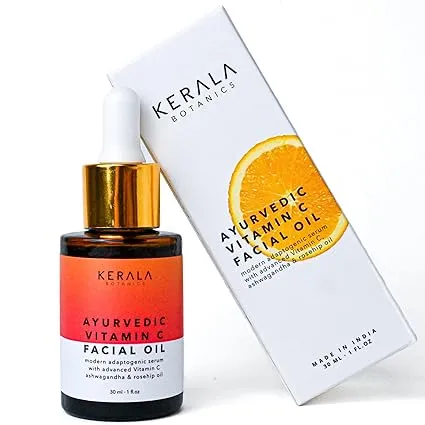
Ayurvedic Vitamin C Face Oil
Kerala Botanics
$49
★★★★☆
The Efficacy Blind Spot
Here’s the thing no ingredient app tells you: does this product actually do what it claims?
A serum can score 80/100 on Yuka because it contains a synthetic antioxidant the algorithm doesn’t love — and still be one of the better-formulated vitamin C products on the market. SkinCeuticals C E Ferulic (a 15% L-ascorbic acid formula with ferulic acid and vitamin E at a pH of 2.5-3.5) scores poorly on most apps because of its acidic pH and the synthetic character of its formulation. It also has more peer-reviewed data behind it than almost any other serum on the market. The app score and the clinical evidence are pointing in opposite directions.
We looked at this directly in our SkinCeuticals review and in the broader alternatives roundup. The pattern holds: the products with the most evidence behind them are often not the ones with the cleanest app scores.
This is the core issue. Efficacy is not a safety metric, and safety apps are not efficacy tools. They’re doing different jobs. Using one to evaluate the other is a category error.
A Framework for Actually Reading an Ingredient List
If you want to move beyond app scores, here’s a more useful way to evaluate a formula.
Step 1: Identify the Active Ingredients
What is this product supposed to do? Find the ingredients responsible for that function. If it’s a vitamin C serum, where is the vitamin C? What form is it (L-ascorbic acid, ascorbyl glucoside, sodium ascorbyl phosphate, tetrahexyldecyl ascorbate)? Is it high enough on the list to be at a meaningful concentration?
Step 2: Check the pH Dependency
Some actives only work within specific pH ranges. L-ascorbic acid needs to be below pH 3.5 to penetrate effectively. AHAs need a similar acidic environment. If a product contains these ingredients but has a neutral or alkaline pH — or if the brand won’t disclose pH — the actives may not be doing much.
Step 3: Look at the Preservation System
Preservatives keep products from growing bacteria and mold. A product with no recognizable preservative system should raise questions about shelf stability, not be celebrated for its clean score. Some botanical systems (rosemary extract, vitamin E, essential oils) provide antioxidant protection but don’t function as broad-spectrum antimicrobial preservatives.
Step 4: Assess Context, Not Just Presence
An ingredient being present doesn’t mean it’s present at a useful concentration. “Contains hyaluronic acid” on a cleanser label is essentially meaningless — it rinses off before it can hydrate anything. Position in the list matters. So does the product format.
How to Use Ingredient Apps Without Being Misled
Use them as a first pass, not a final answer. Here’s a practical approach:
Do use apps to: Quickly flag known personal allergens. Get a general sense of what category an unfamiliar ingredient falls into. Check if something you’re sensitive to appears in a new product.
Don’t use apps to: Determine whether a product is effective. Make a final call on safety for all use cases. Compare a well-formulated synthetic product against a poorly formulated natural one.
Cross-reference with better sources. Paula’s Choice Ingredient Dictionary gives more nuanced breakdowns. The International Journal of Cosmetic Science publishes formulation research. EWG’s Skin Deep has sourcing limitations but at least shows you the evidence tier behind each flag.
Trust your skin over the score. A product that consistently irritates you is a problem regardless of its Yuka rating. A product your skin tolerates well and that visibly improves your concerns is doing its job, regardless of what the algorithm says.
Putting It All Together
A 100/100 on Yuka means one specific thing: the app found no ingredients it considers hazardous, based on its database and its definitions. That’s worth knowing. It’s not worth much more than that.
What it doesn’t tell you: whether the product is formulated at effective concentrations, whether the actives are pH-stable, whether the formula will work for your skin type, or whether any of the ingredients have clinical evidence behind their claims.
The apps are running a hazard screen, not a clinical trial. Use them accordingly.
The most reliable way to evaluate a skincare product is still some combination of: reading the ingredient list yourself (see our full guide to that here), understanding the actives involved, and checking whether the claimed benefits have evidence behind them. That takes longer than scanning a barcode. It also gives you information you can actually use.
A perfect score is a starting point at best. At worst, it replaces a more careful read with a number that feels definitive. The number isn’t doing you any favors in that case — it’s just making a decision feel easier than it actually is.