
Sunscreen
Sunscreen That Survives Heat and Humidity
Sunscreen that survives heat and humidity starts with understanding water-resistance tests, film formers, and gel textures. Here's how to pick and reapply.
Disclosure — This article may contain affiliate links. We earn a small commission at no extra cost to you when you purchase through our links. This supports our ability to create independent, evidence-based skincare content.
Picture a humid July afternoon in Toronto. We watched a thick, creamy sunscreen slide off a tester’s forehead in about 20 minutes, straight into her eyes. Nobody was happy.
Here’s the short version of this guide. Sunscreen that holds up in heat comes down to three things: a real water-resistance claim, a formula built around film-forming polymers, and a light gel or fluid texture. Get those right and you can stop babysitting your face. Get them wrong and you’re wearing very expensive moisturizer.
What “Water-Resistant” Actually Means
Start with the label, because this is where most people get fooled.
In the US, the FDA doesn’t allow “waterproof” or “sweatproof” on sunscreen. Those claims are banned because no sunscreen survives forever. What you’ll see instead is “water resistant (40 minutes)” or “water resistant (80 minutes).” That’s it. Two options.
How the test works
Testers apply sunscreen to volunteers and let it settle. Then the volunteers sit in a pool or whirlpool, alternating between 20 minutes of moderate activity and 15-minute breaks, for the full 40 or 80 minutes. Afterward, the SPF is measured again. To earn the claim, the product has to still deliver its labeled SPF.
Notice what that means. The test measures how long protection lasts in water. It does not promise you’re protected for those 80 minutes plus an extra hour of sweating through a football game. And it tests on a controlled patch of skin, not a face that’s being wiped with a towel, a forearm, or a phone.
What to do with this
- Pick a product with a water-resistance claim for any day that involves sweat, a beach, or a commute on a packed train in August.
- Treat the number as a minimum reapplication timer after swimming or heavy sweating, not a guarantee.
- If a bottle has no water-resistance claim, that doesn’t make it bad. It just means you should assume it won’t survive a sweaty day.
Worth knowing: SPF labels themselves aren’t always what they seem. We dug into that in When SPF Labels Lie: Inside the Sunscreen Testing Problem.
Film-Forming Polymers: The Clear Coat on Your Face
This is the part nobody explains well, and it’s the whole trick.
Sunscreen filters, the ingredients that actually absorb or block UV, don’t stick to skin on their own. They’re suspended in a formula. To keep them from washing or sweating off, brands add film-forming polymers. Think of the clear coat on a wooden deck. The wood underneath is the same, but that thin, flexible layer on top makes rain bead up and roll away.
What to look for on the label
You’ll see these names in the ingredient list:
- Acrylates copolymer
- VP/eicosene copolymer
- Polyester-8
- Styrene/acrylates copolymer
- Various silicone elastomers and “crosspolymers”
You don’t need to memorize them. Just scan the list. If one or two of these sit in the first half of the ingredients, the formula was built to hold on.
The trade-offs
Polymers aren’t free. A strong film can feel slightly tacky or tight as it dries. It can also cling to mineral filters and make them harder to wash off at night. Most formulas that lean on film formers also need a proper cleanse. A gentle cleansing balm or a double cleanse takes care of it. If your sunscreen lasts through a swim, a basic foaming wash probably won’t finish the job alone.
Why Gels and Fluids Beat Creams in Humidity
Here’s the logic. In humid air, your sweat doesn’t evaporate well. It sits on your skin, mixes with whatever you applied, and starts moving things around.
A thick cream is an emulsion with a lot of emollients and wax-like ingredients. Those are lovely in winter. In humidity, they stay soft, slide, and mix with sweat and sebum. That’s how sunscreen ends up in your eyes and on your collar.
Gels and fluids are different. They’re lighter, often built around water, alcohol, or silicones, and they dry down faster into a thin, even layer. Less oily material means less to slide. Less slide means fewer gaps in coverage, and gaps are where burns happen.
Texture cheat sheet
- Gel: Fastest drying, lightest feel. Great for oily or acne-prone skin and for very humid days.
- Fluid or milk: Slightly more cushion than gel, still thin. A solid all-rounder.
- Cream: Best for dry skin or air-conditioned offices. Not our pick for sweating outdoors.
- Stick: Handy for touch-ups, but it’s a layer you have to apply carefully to get enough coverage.
If breakouts are your worry as well as heat, our guide to the best sunscreens for acne-prone skin covers formulas that stay light without clogging.
Our Picks for Hot, Sticky Days
We tested these over several hot weeks, including a few days of bike commuting, sticky patios, and one very ill-advised midday walk. Each one is a different kind of tool.
La Roche-Posay Anthelios Melt-in-Milk SPF 60
This is the one we reach for when we know we’ll sweat. It’s a fluid milk that spreads thin, sets quickly, and carries a water-resistance claim. Check the current bottle for the exact minutes, since brands update labels.
It does leave a slight sheen on the first application, and the scent is noticeable if you’re sensitive. On skin that gets very oily by afternoon, you may want a blotting paper. But it holds up. We covered it in detail in our full Anthelios Melt-in-Milk review.
Anthelios Melt-in-Milk Sunscreen SPF 60
La Roche-Posay
$40
★★★★½
Beauty of Joseon Relief Sun: Rice + Probiotics SPF 50+
This one is lovely for everyday heat. It’s light, comfortable, and has a cushiony, moisturizer-like finish that doesn’t turn greasy in humidity. At $18, it’s easy to use generously, which matters more than people think.
The honest con: it isn’t marketed as water-resistant. So it’s a great daily wear for commuting and errands, but it’s not what we’d wear to a pool or a long hike. If you sweat hard, plan to reapply sooner.
Relief Sun: Rice + Probiotics SPF 50+
Beauty of Joseon
$18
★★★★☆
Supergoop Unseen Sunscreen SPF 40
A clear, silky gel that doubles as a primer. It disappears on all skin tones, feels weightless, and sits comfortably under makeup. On humid days it didn’t pill or slide for us, though on very oily skin it can get a little slick by mid-afternoon.
It’s the priciest per ounce of the three, and the formula has a faintly silicone-y feel that some people don’t love. Check the label for a water-resistance claim before relying on it for swimming or intense workouts.
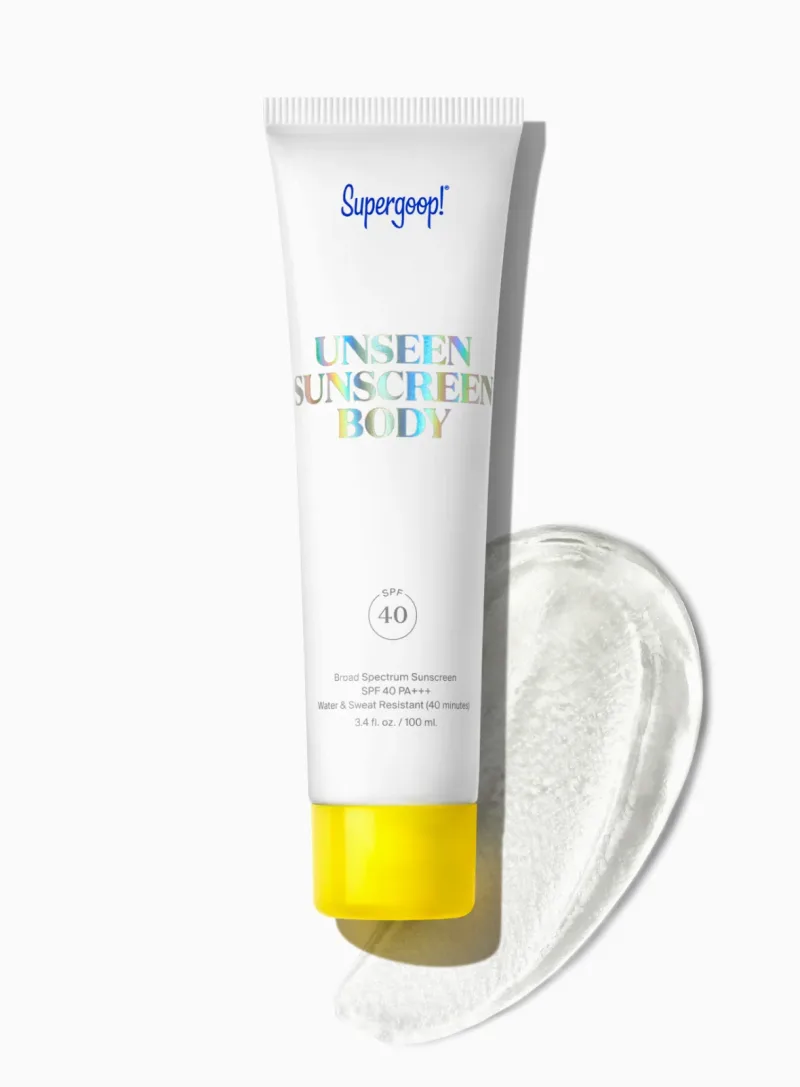
Unseen Sunscreen SPF 40
Supergoop
$38
★★★★½
For more options across budgets, our roundup of the best face sunscreens of 2026 goes deeper.
Reapplying Over Sweat Without Making a Mess
The standard advice is reapply every two hours. In heat, that’s the floor, not the ceiling. Reapply right after swimming, toweling off, or sweating heavily, whatever the clock says.
The problem is that nobody wants to slather more sunscreen on a wet, shiny face. Here’s the routine that actually works.
Step by step
- Blot first. Press a clean tissue or blotting paper against your skin. Don’t rub. Rubbing pushes sunscreen around and leaves bare patches.
- Wait a few seconds. Skin should be damp, not dripping.
- Use a fluid, gel, or stick. Dab or press it on in small sections rather than sweeping.
- Give it a minute to set. Don’t touch your face for 60 seconds. Film formers need that time to settle.
- Cover the forgotten spots. Ears, the hairline, the sides of the neck, and the tops of your hands.
Not sure how much you should be using each time? Our guide to how much sunscreen to apply breaks down the amounts, including the two-finger method.
Over makeup
This is the hardest scenario. A spray or stick is easiest, and dabbing with a damp sponge helps. We cover the full approach in how to reapply sunscreen over makeup.
A note on powders
Powder sunscreens are tempting on hot days, because they feel clean and fast. But it’s very hard to apply enough powder to reach the labeled SPF. Treat powder as a top-up, not a replacement. We explain why in our piece on whether powder sunscreen is real protection.
A Few Smart Habits for Heat
Texture and tech matter, but habits close the gap.
- Apply earlier than you think. Put sunscreen on 15 minutes before you head out, so the film has time to form before you start sweating.
- Skip heavy layers underneath. Rich moisturizers and oils under sunscreen can break up the film. Use a light gel moisturizer, or none at all on a really sticky day.
- Wear a hat. A wide brim cuts the amount of sunscreen you rely on for your face. It also keeps sweat from dripping along your hairline.
- Pack a touch-up. A stick or small bottle in your bag is the one that actually gets used.
- Wash it off properly. Water-resistant formulas need a decent cleanse at night.
Common Mistakes
Trusting the SPF number alone. SPF 50 that has sweated off protects less than SPF 30 that’s still on your face.
Using too little. Thin layers drop real-world protection a lot, and heat makes people skimp because the product feels sticky.
Rubbing instead of blotting. Moving sweat around spreads it. Blot, then apply.
Assuming “water-resistant” means “done for the day.” It means the formula survived a controlled test, not that it’s immune to your afternoon.
Putting It All Together
Heat and humidity are hard on sunscreen, but the fix isn’t complicated.
- Look for a water-resistance claim (40 or 80 minutes) when you’ll sweat or swim, and treat it as a timer.
- Choose a gel, fluid, or milk over a thick cream, and check the ingredients for film-forming polymers.
- Apply early, use enough, and cleanse thoroughly at night.
- Blot, don’t rub, and reapply at least every two hours, and right after swimming or heavy sweating.
If we had to pick one product for sweaty days, it’s the La Roche-Posay Anthelios Melt-in-Milk. For everyday heat on a budget, Beauty of Joseon’s Relief Sun is hard to beat. Pick one, use plenty, and reapply. That’s the whole plan.