
Routines
Abhyanga: The Ayurvedic Oil Massage, Adapted for Your Face
Facial abhyanga adapts Ayurveda's full-body oil massage for your face. Here's what the strokes actually do — and where the claims outrun the evidence.
Disclosure — This article may contain affiliate links. We earn a small commission at no extra cost to you when you purchase through our links. This supports our ability to create independent, evidence-based skincare content.
Lymphatic drainage has become the skincare world’s favorite unverifiable promise. “It depuffs,” “it detoxes,” “it sculpts” — you’ll hear all three before breakfast on any given wellness Monday. Facial abhyanga gets swept into this same conversation, which is a shame, because what the practice actually offers is more modest and more honest than its marketing suggests.
Abhyanga, in traditional Ayurvedic medicine, is a full-body self-massage using warm oil. The word comes from Sanskrit — roughly, “oil applied with love.” The body version is a serious, time-consuming ritual, often 30 to 45 minutes of structured strokes before a bath. What most people are doing now is a condensed, facial-only adaptation: five to ten minutes of deliberate oil massage applied to the face, neck, and décolletage. Same general principles, smaller canvas.
Whether this counts as “authentic abhyanga” is a reasonable debate. What’s less debatable: a few minutes of structured facial massage with oil is genuinely useful — for absorption, for circulation, and for building a consistent routine. We’ll get into what it can and cannot do, then give you a practical technique that holds up.
What Abhyanga Actually Is (Before the Wellness Industry Got Hold of It)
Traditional Ayurvedic abhyanga is described in texts like the Ashtanga Hridayam as a daily practice for balancing the doshas, improving skin luster, and supporting the nervous system. The oils were chosen for constitution — sesame for vata types, coconut for pitta, lighter oils for kapha. The strokes were long, firm, and centripetal (toward the heart).
The facial adaptation draws loosely on these principles but departs from them in significant ways. Modern facial abhyanga has absorbed some gua sha technique (upward, outward strokes), some lymphatic massage protocol (light pressure, specific drainage pathways), and Ayurvedic oil selection. The result is a hybrid. If you’re looking for a faithful translation of classical Ayurveda, read our piece on modern Ayurvedic skincare and what the tradition actually got right. For this guide, we’re focused on the practical, adapted version — what works mechanically and what’s wishful thinking.
The Evidence Situation: Honest Accounting
Let’s be direct about what we know and don’t know.
What has reasonable support:
Facial massage increases local blood flow. A 2018 study in Scientific Reports found that 5 minutes of facial massage elevated skin blood flow and reduced muscle tension in the massaged area. More circulation means more oxygen delivery to skin cells. That’s not nothing.
Massage also enhances topical absorption. Mechanical manipulation increases permeation of applied substances through the stratum corneum — this is documented, though most studies use pharmaceutical contexts rather than cosmetic ones. The practical implication: oil applied during massage probably penetrates slightly better than oil simply patted on.
There’s also the nervous system angle. Slow, rhythmic touch activates the parasympathetic nervous system. If your cortisol is running high and your skin is reacting to it, a five-minute massage ritual before bed has a plausible benefit pathway — not through “detoxing” anything, but through stress modulation. We’ve covered the cortisol-skin connection in more detail if you want the physiology.
What’s overstated:
The lymphatic drainage claims are where things get shaky. The face does have superficial lymphatic vessels, and very light pressure can theoretically assist lymph movement. But the technique required for actual lymphatic drainage is extremely specific — light enough that most people would think they’re barely touching their face. Most facial massage tutorials use far more pressure than lymphatic drainage requires. What reduces morning puffiness is probably a combination of position change (getting upright), gravity, and improved local circulation. The lymphatic story sells better.
“Sculpting” and “lifting” effects from massage alone are not supported by evidence. Skin doesn’t restructure from external pressure in any lasting way.
Choosing Your Oil
This is where abhyanga and modern skincare intersect most directly. The oil matters — not just for the ritual, but for what it does to your skin afterward.
Traditional choices include sesame (warming, heavier, best for dry or vata-dominant skin), coconut (cooling, comedogenic for some), and brahmi-infused oils. Modern practitioners have expanded the selection considerably.
For a functional facial massage oil, you want:
- Non-comedogenic or low comedogenic — squalane, rosehip, grape seed, and most vitamin C face oils sit here
- Fast-enough absorption — you don’t want to be massaging mineral oil into your face for ten minutes (that would just slide)
- Ingredient synergy — if you’re using an oil with actives (vitamin C, bakuchiol), the massage step may actually improve delivery
One option worth noting if you want to double the massage step with treatment: Kerala Botanics’ Ayurvedic Vitamin C Face Oil uses a stabilized vitamin C form the brand describes as staying active in skin cells significantly longer than standard L-ascorbic acid serums, combined with bakuchiol (a plant-based compound with retinol-like signaling effects — see our full bakuchiol vs retinol breakdown for the evidence). It’s an oil format, which makes it practical for massage use. It won’t feel as light as squalane, and if you’re oily-skinned, it may be heavier than you want. But for the demographic who wants a treatment oil they can use for the massage itself — dry to normal skin, simplified routines, interest in Ayurvedic formulation — it’s a sensible fit.
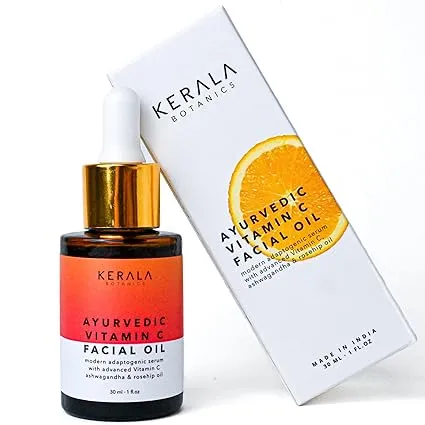
Ayurvedic Vitamin C Face Oil
Kerala Botanics
$49
★★★★☆
For oily or acne-prone skin, we’d point you toward squalane or a lightweight rosehip oil instead — and our guide to face oils for oily and acne-prone skin covers those options more specifically.
The Technique
Five to eight minutes. That’s enough. More than that and you’re into diminishing returns — and potentially aggravating sensitive skin.
Start clean. Abhyanga is not a first-cleanse step. Do it after cleansing, on damp or freshly dried skin. The oil goes on as the last or second-to-last step in your routine.
Warm the oil. A few drops between your palms for ten seconds. Warm oil absorbs slightly better and feels significantly better. This is one Ayurvedic instruction that’s practically sound.
Use 4-6 drops. Enough for slip without drowning your face.
The Stroke Sequence
Step 1: Neck, upward (60 seconds) Start at the base of the neck. Using flat fingers, stroke upward from collarbone to jawline. Light to medium pressure. This is the closest thing to actual lymphatic drainage direction — the major lymph nodes for facial drainage sit at the neck. Do both sides.
Step 2: Jawline and chin, outward (60 seconds) From the center of the chin, use your knuckles or fingertips to sweep along the jawline toward the ear. Light pressure. Repeat 6-8 times per side. This is the stroke most often associated with “sculpting” — manage expectations, but the circulation benefit is real.
Step 3: Cheeks, outward and upward (60 seconds) Flat hand, starting at the nose, sweeping across the cheek toward the ear and hairline. Follow the natural structure of the zygomaticus. Don’t drag down. Six repetitions per side.
Step 4: Under-eye, very light (30 seconds) Ring finger only. Extremely light pressure — this tissue is thin and has no fat pad to absorb pressure. Tap rather than drag, moving from inner corner to outer corner. Skip this if you have active milia or any irritation under the eye.
Step 5: Forehead, upward (60 seconds) Alternating hands, stroke from the brow to the hairline. Finish with a light horizontal stroke across the forehead from center to temple on each side. This is not going to erase expression lines, but it does address tension — most people hold a significant amount of muscular tension in the frontalis.
Step 6: Nose and sinus points (30 seconds) Small circular strokes alongside the nose, across the bridge, and at the brow bone. More pressure is fine here. This is the one area where firm pressure feels genuinely good and has some credible tension-relief effect.
Step 7: Full-face press (30 seconds) Both palms, flat on the face, gentle warmth pressure for ten seconds. Repeat twice. This is the closing gesture in many traditional abhyanga protocols. It’s not mechanically doing much. It does signal “done” to your nervous system. That’s worth something.
Pressure Guidelines
Light for lymphatic-adjacent strokes (neck, under-eye, cheekbones). Medium for muscle-tension areas (jaw, forehead). Firm only for bony structures (nose bridge, brow bone). Never pull or tug. The skin on your face is not getting a structural workout — it’s getting circulation and warmth.
Timing and Frequency
Morning or evening both work. The argument for morning: reduces overnight puffiness, preps skin for the rest of your routine, and the ritual quality sets a useful tone. The argument for evening: skin is more receptive, you’re not rushing, and the parasympathetic activation actually serves a purpose at night.
We’d suggest evening for most people, particularly if you’re using a treatment oil. Your skin does the majority of its repair work overnight — see our complete evening skincare routine for how to fit massage into a full routine sequence.
Three to five times a week is enough to see consistent benefits. Daily is fine if your skin tolerates it. If you notice breakouts or irritation, reduce frequency and reassess your oil choice.
How This Compares to Gua Sha and Kansa
These tools come up in the same conversations, and they’re not interchangeable. Gua sha uses a flat stone with deliberate pressure and scraping motions — the mechanism is different, the pressure is greater, and the risk of irritation is higher if done incorrectly. We’ve covered whether gua sha actually delivers long-term benefits in a separate piece.
Kansa is a traditional Ayurvedic metal alloy wand, used with circular motions — the claims around it are even more traditional-medicine-specific, and the evidence base is thinner. See our kansa wand vs gua sha comparison if you’re trying to choose between tools.
Facial abhyanga requires nothing but your hands and an oil. Lower barrier to entry, lower risk of technique error, easier to do consistently. For most people, that’s actually the better starting point.
What to Realistically Expect
After one session: skin will look more flushed and feel warmer. That’s circulation. It fades within an hour.
After two to four weeks of regular practice: most people report that skin feels softer (this is the oil working, largely), that they’re more aware of facial tension (massage makes you notice what you’ve been holding), and that the ritual itself has a stress-reduction effect that shows up in skin reactivity. Anecdotal, but consistent across enough reports to take seriously.
What you will not get: structural lifting, permanent depuffing, lymphatic “detox,” or any outcome that requires internal physiological change beyond what five minutes of light massage can produce. The practice is real. The wilder claims aren’t.
Putting It Together
Facial abhyanga is a manual technique adapted from a much older full-body practice. Strip away the wellness marketing and what remains is: structured oil application with deliberate strokes that increase circulation, support topical absorption, relieve muscular tension, and — if done consistently — contribute to a stress-reduction ritual that has downstream skin benefits.
The technique takes five to eight minutes. The oil choice matters more than most tutorials suggest — pick something appropriate for your skin type, and consider whether you want a plain carrier oil or one with active ingredients built in. The strokes are simple once you’ve done them a few times.
Start with clean skin, warm oil, and light hands. Give it three weeks before you evaluate anything. And set reasonable expectations going in: this is a maintenance practice, not a treatment. The difference matters.