
Routines
Cortisol Face and the Stress-Skin Axis: What Actually Helps
Cortisol face is real — but the fix isn't a cream. Here's what stress actually does to skin and which ingredients have evidence behind them.
Disclosure — This article may contain affiliate links. We earn a small commission at no extra cost to you when you purchase through our links. This supports our ability to create independent, evidence-based skincare content.
“Cortisol face” is trending. In the version that went viral, stress makes your face puffy, dull, and broken out — and the solution is some adaptogen-spiked cream and a better morning routine. Some of that is directionally correct. Most of the framing is not.
The actual relationship between stress and skin is worth understanding, because if you know the mechanism, you can make smarter choices about what to put on your face — and what to stop expecting your serum to fix.
What Stress Actually Does to Your Skin
Cortisol is a glucocorticoid hormone released by the adrenal glands in response to perceived threat. In short bursts, it’s useful. Chronically elevated? It starts breaking things.
For skin specifically, the relevant effects are:
Barrier degradation. Cortisol suppresses the production of ceramides, fatty acids, and cholesterol — the three lipid classes that hold your stratum corneum together. A 2014 study in Experimental Dermatology found that psychological stress measurably reduced skin barrier function in healthy subjects within 24 hours of a stressor. Your skin becomes more permeable, more reactive, and slower to recover from irritation.
Immune dysregulation. Chronic cortisol exposure shifts the skin’s immune response. It suppresses some inflammatory pathways while leaving others unchecked — which helps explain why stressed skin can look both dull and broken out at the same time. Two things that seem contradictory but aren’t.
Sebum changes. Stress triggers androgens (via the hypothalamic-pituitary-adrenal axis), which ramp up sebum production. More sebum doesn’t automatically mean more acne, but it creates conditions where P. acnes and other bacteria thrive. If you’re already prone to breakouts, stress is a reliable accelerant.
Collagen interference. Cortisol inhibits fibroblast activity, which slows collagen synthesis. This is probably where the “puffy but somehow also haggard” look comes from — the textural quality of the skin changes, not just its surface behavior.
None of this requires exotic research. These mechanisms are well-documented. The problem is what the wellness world has done with that documentation: built a product category around it.
What “Cortisol Face” Gets Wrong
The viral framing implies that stress leaves a distinctive visual imprint — a “cortisol face” you can identify in the mirror and treat with the right serum. This is mostly reverse-engineered marketing.
Skin responds to stress, yes. But it responds to dozens of other things too: sleep, hydration, UV exposure, product overuse, diet, humidity. Attributing puffiness or dullness specifically to cortisol, without accounting for any of that, is not diagnostic. It’s pattern-matching to a trending word.
The more honest version: chronic stress is bad for skin. The effects are real. But they work slowly, they’re nonspecific, and they’re not something you can see on your face the morning after a hard week.
What you can do is build a routine that doesn’t make things worse — and that includes ingredients with genuine evidence for barrier repair and inflammation reduction.
The Barrier Is the First Priority
If stress degrades the lipid barrier, the most direct response is supporting that barrier — not layering on actives that further compromise it.
This sounds obvious. Most stressed skin routines do the opposite. Stress breaks you out, you pile on salicylic acid and retinol, your barrier gets more damaged, your skin gets more reactive. The cycle is predictable and extremely common.
When skin is in a compromised, reactive state, the right move is simplification. Repairing a damaged barrier means cutting irritants first, adding support second.
What “Barrier Support” Actually Means
Ceramides are the most direct intervention here, because cortisol specifically depletes them. Products with a ceramide, cholesterol, and fatty acid combination (the ratio matters — research by Dr. Peter Elias suggests roughly 3:1:1 by weight) work with the skin’s natural lipid structure rather than just sitting on top.
For a straightforward, no-frills option, La Roche-Posay Cicaplast Baume B5 covers the basics: panthenol for moisture retention, glycerin, and a fragrance-free formula that won’t add irritation to an already irritated situation.

La Roche-Posay Cicaplast Baume B5
La Roche-Posay
$18
★★★★½
For a deeper look at the lipid science, our ceramide guide covers the research in full.
The Case for Beta-Glucan
Beta-glucan is underrated in the stress-skin context. It’s a polysaccharide derived from oat or yeast that activates Langerhans cells — the skin’s resident immune sentinels — while simultaneously reducing surface inflammation. It also increases moisture retention without any of the tingling or sensitivity that actives carry.
There’s reasonable clinical evidence behind it. A 2005 study in International Journal of Biological Macromolecules showed it outperformed hyaluronic acid in skin hydration at the 4-week mark. Not dramatic, but consistent. For reactive, barrier-compromised skin, consistent is what you want.
We’ve written more about it in our complete beta-glucan guide.
Inflammation: Ingredients With Real Evidence
The inflammatory component of stress-skin response is real. Here’s what’s worth considering.
Centella Asiatica
Centella (often marketed as “Cica”) is one of the better-studied calming ingredients. Asiaticoside and madecassoside — two of its active triterpenes — have documented effects on wound healing and inflammation at the cellular level. They seem to regulate TNF-α (a key inflammatory cytokine) and support fibroblast activity.
It’s not a magic cure. But for skin that’s red, sensitized, or slow to heal, it’s one of the more defensible ingredients to reach for. COSRX’s Centella Blemish Cream is affordable and keeps the formula simple — active ingredients do better when they’re not competing with twenty others.

COSRX Centella Blemish Cream
COSRX
$14
★★★★½
Our Centella Asiatica guide goes deeper on the extraction methods and which formats actually deliver the actives.
Niacinamide
Niacinamide (vitamin B3) reduces the production of certain pro-inflammatory cytokines, strengthens the barrier via ceramide synthesis support, and reduces sebum output over time. It also addresses hyperpigmentation, which can worsen under stress-related skin disruption.
The evidence base here is genuinely solid — more so than most ingredients discussed in the cortisol-face context. The ceiling is real too: concentrations above 5% show diminishing returns and occasional flushing in sensitive skin. Four percent is a reasonable target for reactive skin.
More detail in our complete niacinamide guide.
The Adaptogen Question
Adaptogens get mentioned constantly in the cortisol-face conversation. Ashwagandha, in particular, has accumulated real clinical data — primarily in the oral form. Studies including a 2019 randomized controlled trial in Medicine found that 240mg daily ashwagandha extract (KSM-66) measurably reduced serum cortisol compared to placebo over 60 days.
That’s a real effect. The problem is extrapolating it to topical application.
Cortisol is a systemic hormone. It’s released centrally and travels through the bloodstream. Rubbing an adaptogen on your face doesn’t interrupt that pathway — the molecule doesn’t penetrate to the depth required to interact with any meaningful hormonal process, and even if it did, skin doesn’t regulate serum cortisol levels.
What topical ashwagandha does appear to do, based on limited in-vitro research, is reduce surface inflammation via withanolide activity. That’s potentially useful. It’s just a different mechanism than the one being marketed.
If you’re genuinely curious about what the topical evidence looks like, we covered it in detail in Ashwagandha for Skin: What the Topical Adaptogen Actually Does.
The more defensible intervention if stress is a real issue in your life: consider the oral route. Not as a replacement for lifestyle factors (sleep, movement, etc.), but as an adjunct with actual mechanistic logic behind it.
The Oil-Based Option Worth Knowing About
For people who want to consolidate their routine under stress — fewer products, less friction — an all-in-one face oil that delivers actives alongside barrier support is worth considering.
Kerala Botanics’ Ayurvedic Vitamin C Face Oil includes bakuchiol alongside a more stable, oil-soluble vitamin C derivative. Bakuchiol is relevant here: as a plant-based compound with retinol-like effects on fibroblast stimulation and collagen gene expression, it offers some of what retinol does without the irritation that would further compromise a stressed barrier. The Ayurvedic formulation also includes ashwagandha — so if you want to test the topical adaptogen angle, it’s a reasonable vehicle.
The honest caveats: the vitamin C format has less clinical data than L-ascorbic acid at matched concentrations, and face oil doesn’t suit everyone (oily or acne-prone skin may find it too heavy, especially if stress is already driving sebum production). If you’re already managing breakouts, test on a small area first.
For a simplified, reduce-the-steps approach to a stressed-skin period, though, it works logically: one product replacing serum, moisturizer, and oil.
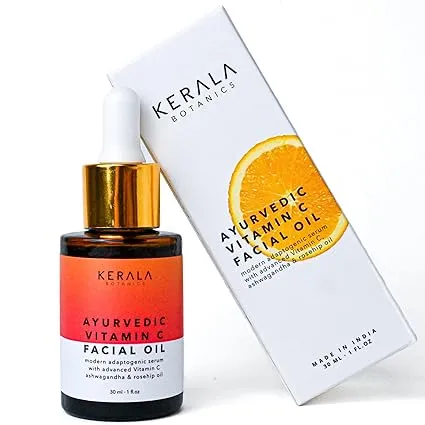
Ayurvedic Vitamin C Face Oil
Kerala Botanics
$49
★★★★☆
What to Actually Do With Your Routine During High-Stress Periods
This is where most stress-skin guides fall apart. They recommend adding products. The actual evidence suggests subtraction is more effective.
Step one: strip back actives. If you’re using retinol, AHAs, BHAs, or vitamin C at high concentrations, consider dropping frequency during a sustained stress period. Your barrier is more vulnerable. Actives that are well-tolerated during baseline conditions can tip into irritation when the lipid matrix is compromised.
For more on how to structure this kind of deload, Skin Barrier Burnout covers the signs that you’ve overtaxed things and how to pull back without losing progress.
Step two: protect the barrier you have. Ceramide moisturizer, morning sunscreen (UV stress compounds inflammatory skin response), gentle cleanser. That’s the core. Everything else is optional.
Step three: address sleep, not just products. Skin repair is heavily nocturnal. Collagen synthesis, cell turnover, and barrier restoration all peak during sleep. No serum compensates for four hours a night. This is not a moral judgment — it’s just physiology.
Step four: if you’re breaking out specifically. Stress-driven acne tends to follow the hormonal pattern — jaw, chin, lower cheeks — because the androgen pathway is doing most of the work. Salicylic acid remains a useful tool here, but keep it targeted (spot treatment over full-face) if your barrier is already compromised.
Antioxidants and Inflammaging
One angle worth noting: chronic stress contributes to what researchers call inflammaging — the low-grade, chronic inflammatory state that accelerates skin aging over time. Antioxidants are a legitimate response to that, because oxidative stress and inflammatory stress are closely linked.
Vitamin C, vitamin E, and ferulic acid have well-documented antioxidant activity in skin. They don’t counteract cortisol directly. But they reduce some of the downstream oxidative damage that chronic inflammation produces. Incorporating them into a consistent routine — not just during acute stress periods — is probably the most pragmatic long-term intervention.
Our antioxidants in skincare guide covers the evidence for this in full.
Putting It All Together
Cortisol face is real as a concept — chronic stress does measurable things to barrier function, sebum production, and inflammatory tone. It’s not real as a distinct aesthetic category you can diagnose or treat with a specific product.
The practical takeaways:
- Barrier first. Ceramides, panthenol, and lipid-rich moisturizers address the most direct mechanism of stress-skin disruption.
- Reduce actives, don’t add them, when skin is reactive or compromised.
- Centella asiatica and niacinamide are the topical anti-inflammatory options with the best evidence in this context.
- Adaptogens topically: interesting, not definitive. Oral ashwagandha has more evidence behind it than anything applied to the skin.
- Antioxidants help manage the longer-term oxidative load. Build them into your baseline routine.
- Sleep, genuinely, is the most effective skin intervention here. Skincare can support the process. It can’t replace it.
If your skin looks bad during a stressful period, that’s probably not a product problem. Simpler routine, better fundamentals, and some patience will outperform any new serum you’re tempted to add.