
Ingredients
Copper Peptides (GHK-Cu): Hype vs Evidence
Copper peptides are everywhere in anti-aging skincare — but what does the research actually support? A clear-eyed look at GHK-Cu's real benefits.
Disclosure — This article may contain affiliate links. We earn a small commission at no extra cost to you when you purchase through our links. This supports our ability to create independent, evidence-based skincare content.
Copper peptides have been around since the 1970s. They went quiet for a few decades, then came roaring back as the ingredient du jour in every anti-aging serum that wants to sound serious. The question worth asking: has the science kept pace with the marketing?
The short answer is — mostly yes, with real caveats. GHK-Cu (glycine-histidine-lysine copper complex) is one of the better-studied peptides in skincare. The evidence is promising. But “promising” and “proven” are different things, and a lot of what gets written about copper peptides is extrapolated from lab conditions that don’t quite match what’s happening when you apply a serum to your face.
Here’s what we actually know.
What GHK-Cu Is and Why It Exists in Your Skin
GHK-Cu isn’t a synthetic invention. It’s a naturally occurring tripeptide found in human plasma, saliva, and urine. Levels in the body are highest around age 20 — roughly 200 nanograms per milliliter in plasma — and drop significantly by 60. That decline tracks with slower wound healing, thinner skin, and reduced collagen density, which is why researchers got interested in the first place.
The copper part matters. GHK on its own does relatively little. Bound to copper, it becomes biologically active — capable of signaling fibroblasts (the cells that produce collagen and elastin) and influencing gene expression in ways that seem to support tissue repair.
That’s the foundation. Everything else in the copper peptide conversation builds on it.
What the Research Actually Shows
Collagen and wound healing
This is where the evidence is strongest. Multiple in vitro studies — meaning cell cultures in a lab — show GHK-Cu stimulates fibroblast activity and collagen synthesis. Animal studies support this too: copper peptides applied to wounds accelerate closure and reduce scarring.
The clinical data on intact, aging skin is thinner. A few small human trials show improvements in skin thickness, firmness, and fine lines after consistent use, but most studies have small sample sizes and short durations. We’re not talking about the kind of robust, multi-year, double-blind data that exists for tretinoin.
What we can reasonably say: GHK-Cu likely supports collagen production. The mechanism is plausible and the early evidence points in the right direction. It’s just not conclusive yet.
Antioxidant activity
Copper peptides have antioxidant properties, though they work differently than classic antioxidants like vitamin C. GHK-Cu appears to upregulate the body’s own antioxidant defenses — particularly superoxide dismutase — rather than neutralizing free radicals directly. This is interesting because it suggests the effect could be more durable than topical antioxidant application alone. Whether that translates to meaningful protection in practice isn’t settled. For a broader look at how antioxidants work in skin, our antioxidant guide covers the territory well.
Skin remodeling and barrier support
Some research suggests GHK-Cu helps regulate matrix metalloproteinases (MMPs) — enzymes that break down collagen and elastin. Too much MMP activity is one reason aging skin loses structure. GHK-Cu may help modulate that breakdown, which is a different mechanism than simply adding new collagen. Both matter.
There’s also preliminary evidence it supports the skin barrier and reduces inflammation, which would make it useful for compromised or reactive skin. See our damaged skin barrier repair guide if that’s the situation you’re working with.
What doesn’t hold up
The claim you’ll see most often is that copper peptides “reset” or “rejuvenate” skin at a cellular level. That’s an overreach. Cells don’t reset. What copper peptides appear to do is support normal repair processes — and probably more effectively as we age and those processes slow down. That’s useful, but it’s not magic.
You’ll also see claims about hair growth, referencing the role of copper peptides in follicle signaling. This is biologically plausible — and a few studies do show some efficacy in alopecia — but this is a different application from topical face care and shouldn’t be cited as proof that a face serum is doing something remarkable.
The Layering Problem
Here’s where most copper peptide guides go quiet: these ingredients don’t play well with everything.
Don’t combine with vitamin C
Copper is a metal ion. Vitamin C (L-ascorbic acid specifically) is a reducing agent. Together, they generate free radical activity — the opposite of what either ingredient is supposed to do. Mixing a copper peptide serum with a high-potency vitamin C serum doesn’t cancel them out, it creates oxidation. Use them on different days, or at different times of day with a thorough wash in between.
This is also worth knowing if you’re considering the Kerala Botanics Ayurvedic Vitamin C Face Oil, which uses an advanced, stabilized form of vitamin C along with bakuchiol. That stabilized format behaves differently than L-ascorbic acid — it’s less reactive — but if you’re using a traditional vitamin C serum, keep copper peptides on the opposite end of your routine. The Kerala Botanics oil is genuinely useful as a multi-step replacement (it covers oil, vitamin C treatment, and some of the antioxidant work in one layer), and because the vitamin C derivative is more stable, the conflict risk is lower than with a straight L-ascorbic acid formula. Still, when in doubt, alternate days.
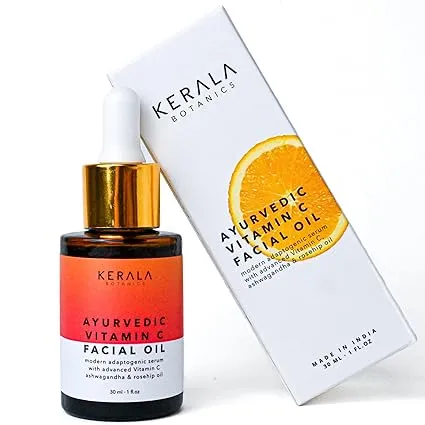
Ayurvedic Vitamin C Face Oil
Kerala Botanics
$49
★★★★☆
Be careful with strong acids
Low-pH exfoliants — AHAs, BHAs at working concentrations — can destabilize copper peptides. The peptide-copper bond is pH-sensitive. If you’re applying a glycolic acid toner right before a copper peptide serum, you’re probably not getting much from the peptide. Separate them: acids in the morning or early evening, copper peptides later or on alternate nights. Our layering guide has the full order logic if you need it.
Copper peptides and retinoids
This one is less clear-cut. There’s some concern that because copper peptides support wound healing and retinoids accelerate cell turnover, using both simultaneously could overstimulate remodeling activity. In practice, many people use both without issues. The safer approach is to alternate — copper peptides some nights, retinoids others. Skin cycling is a reasonable structure for this.
Products Worth Knowing
Most copper peptide products aren’t transparent about concentration, which makes comparison hard. That said, a few formulas have built real track records.
NIOD Copper Amino Isolate Serum 2:1
NIOD is the most serious copper peptide brand on the market. The 2:1 formula contains a high-concentration, clinically-informed level of GHK-Cu in a stable delivery system. The texture is thin and absorbs cleanly. It’s not cheap, but if you’re going to commit to copper peptides, this is the reference-point product — the one others get measured against.
Not for everyone: it’s a standalone treatment, not a moisturizer, and it works best in a simplified routine where it’s not competing with a dozen other actives.
NIOD Copper Amino Isolate Serum 2:1
NIOD
$60
★★★★☆
Drunk Elephant Protini Polypeptide Cream
Protini isn’t a dedicated copper peptide product — it’s a multi-peptide moisturizer with GHK-Cu as one of several actives. The benefit is that it’s easy to use: apply it as your moisturizer and you’re getting a low-dose copper peptide exposure without needing to build a separate serum step. The trade-off is that you’re not getting a therapeutic concentration. Good for maintenance and for people who want peptide support without complexity.
Protini Polypeptide Moisturizer
Drunk Elephant
$68
★★★★½
The Ordinary Multi-Peptide Serum for Hair Density
Included here because this is the copper peptide product most people actually buy first — it’s affordable, widely available, and the brand is transparent about ingredients. Worth knowing: this is formulated for the scalp, not the face. It contains GHK-Cu alongside other peptides and is pH-adjusted for a different context. Some people use it on their face anyway. It’s probably fine, but it’s not what the formula was designed for. If you want a face-specific option, go with NIOD or a product explicitly formulated for facial skin.
Multi-Peptide Serum for Hair Density
The Ordinary
$19
★★★★☆
Who Should Actually Use Copper Peptides
This ingredient isn’t for everyone, and there’s no point pretending otherwise.
Good candidates:
- People in their late 30s and beyond, when natural GHK-Cu levels have dropped and collagen support becomes more relevant
- Anyone focused on skin longevity rather than immediate results — this is a slow-play ingredient
- Skin that’s healing post-procedure (microneedling, lasers) — the wound-healing data is among the strongest
Probably not worth prioritizing if:
- Your routine is already stacked with actives and you’re looking for one more thing to add
- You’re under 30 with no specific concerns — the baseline evidence for younger skin is thin
- You have oily, acne-prone skin and you’re not ready to troubleshoot another variable
For anyone still building their foundational routine, starting here is a better use of time than adding a peptide serum.
Putting It All Together
GHK-Cu is one of the more credible anti-aging ingredients available over the counter. The biology is real, the mechanisms are plausible, and the early human data is encouraging — even if it’s not yet the kind of evidence we’d demand from a prescription drug.
The practical version: if you’re in your late 30s or older and want something beyond moisturizer and SPF, copper peptides are a reasonable addition. Use them at night, away from vitamin C and strong acids, and give them at least three months before expecting to see anything. Don’t layer them on top of ten other actives and hope for the best.
And keep your expectations calibrated. This isn’t going to undo decades of sun damage faster than your retinoid will. What it might do — quietly, over time — is help your skin hold on to what it has a little longer.
That’s a more modest promise than the marketing makes. It’s also probably the honest one.