
Ingredients
Spermidine, NAD+, and 'Longevity Actives': The Next Frontier After Peptides
Spermidine, NAD+, and sirtuins are showing up in skincare. Here's what the evidence actually says before the hype takes over.
Disclosure — This article may contain affiliate links. We earn a small commission at no extra cost to you when you purchase through our links. This supports our ability to create independent, evidence-based skincare content.
Peptides had a good run. For the better part of a decade, they were the answer to every “what’s next after retinol?” question — signaling molecules, collagen fragments, copper-carrying tripeptides. The category is still growing. But a different class of ingredient is starting to appear on ingredient lists and in clinical press releases, one with a much more ambitious claim: not just repairing skin, but changing how skin cells age.
Spermidine. NAD+ precursors. Sirtuin activators. Autophagy inducers. The marketing around these has outpaced the skincare evidence by years — which is normal for an emerging category, but also means most of what you’ll read is extrapolated from oral supplementation research, not topical studies. That’s worth knowing before you spend money.
Here’s what we actually know, what we’re waiting on, and how to think about this category right now.
What “Longevity Actives” Actually Means
The phrase gets used loosely. At its core, it refers to ingredients that target cellular aging mechanisms — specifically, the processes that slow down or break down as skin ages at a biological level.
Most skincare has historically worked one level up from this. Retinoids accelerate cell turnover. Peptides signal fibroblasts to produce more collagen. Antioxidants neutralize free radicals. All effective. None of them are touching the deeper machinery: how cells decide to repair themselves, how they handle damaged proteins, how they communicate stress to neighboring cells.
Longevity actives, in theory, work on that deeper machinery. The four mechanisms you’ll see cited most often:
- Autophagy — the cellular “self-cleaning” process where cells break down and recycle damaged components. Slows with age. Spermidine is the primary ingredient linked to this pathway.
- NAD+ pathways — NAD+ (nicotinamide adenine dinucleotide) is a coenzyme essential to cellular energy production and DNA repair. Levels decline with age. Precursors like NMN and NR are the supplement world’s answer; niacinamide (vitamin B3) is actually a distant relative in the same metabolic family.
- Sirtuins — a family of proteins that regulate cellular stress response, inflammation, and longevity signaling. Resveratrol was the early sirtuin activator everyone got excited about; the excitement has since cooled somewhat.
- mTOR inhibition — mTOR is a signaling pathway linked to cell growth and aging. Caloric restriction research points to mTOR as a key longevity lever. Topically, almost nothing credible here yet.
These are real biology. The question is whether topical application affects any of them in meaningful ways.
Spermidine: The Autophagy Ingredient With the Unfortunate Name
Spermidine is a polyamine — a small molecule found in nearly every living cell, named for the biological fluid where it was first isolated in the 17th century. Yes, that’s where the name comes from. Moving on.
It occurs naturally in wheat germ, soybeans, mushrooms, and aged cheese. Endogenous levels drop with age, which correlates — though causation is a separate question — with declines in autophagy activity.
The oral evidence is actually decent, at least for systemic aging markers. A randomized controlled trial published in Cell Reports Medicine (2021) found that spermidine supplementation improved memory-related cognitive function in older adults. Longevity researchers like Frank Madeo at University of Graz have been studying it for years. The mechanism is reasonably well-characterized: spermidine inhibits EP300, an acetyltransferase that suppresses autophagy when active.
What does that mean for your skin, topically?
Honestly, not much is confirmed yet. There are a handful of small in-vitro studies showing that spermidine can activate autophagy in keratinocytes and fibroblasts. A 2020 paper in Aging showed improved skin hydration and elasticity markers in a small cohort using a spermidine-containing cream. The sample sizes are too small and the study designs too loose to draw firm conclusions — but the mechanistic logic is there.
The bigger issue is penetration. Spermidine is a polar, charged molecule at skin pH. Getting it through the stratum corneum in meaningful concentrations is not trivial. Encapsulation systems (liposomes, microemulsions) are being used to address this, but the delivery data is mostly internal to brands, not peer-reviewed.
What to do with this: If you want to try a spermidine product, look for one that specifies encapsulated delivery and has some form of in-vivo testing behind it — even a small clinical study is better than none. Don’t expect dramatic results on the timeline of a retinoid. And be skeptical of any brand leading with “activates autophagy” without showing mechanism data.
NAD+ and Its Precursors: What Topical Application Can and Can’t Do
NAD+ is central to cellular metabolism. It’s involved in over 500 enzyme reactions. As a coenzyme, it doesn’t get applied to skin directly in most formulations — it’s large, unstable, and has poor absorption. What brands use instead are precursors: molecules the body converts into NAD+.
The main ones showing up in skincare:
- Niacinamide (vitamin B3) — technically a NAD+ precursor via the Preiss-Handler pathway. This is worth noting because niacinamide is one of the most evidence-backed topical ingredients we have, with solid data on barrier function, pigmentation, and sebum regulation. Whether its benefits come specifically from NAD+ upregulation at the cellular level or other mechanisms is still debated. Probably both. See our complete niacinamide guide for the full picture.
- NMN (nicotinamide mononucleotide) — the supplement world’s current obsession. Topically, there’s very little rigorous data. Some brands are adding it to serums. The absorption question is the same problem as spermidine: does it actually get into cells in a form they can use?
- NR (nicotinamide riboside) — similar story to NMN. Better-studied orally than topically. More stable than NAD+ itself, but “more stable than a very unstable molecule” is a low bar.
The honest answer is that niacinamide — the ingredient you can buy for $8 at any drugstore — is probably doing more NAD+-adjacent work on your skin than any dedicated “NAD+ serum” currently on the market. That’s not cynicism. It’s just where the evidence sits.
There’s also a broader point here about the oral-to-topical translation problem. A lot of longevity active research is done with oral supplements, IV infusions, or cell cultures. Applying something to skin surface is a fundamentally different pharmacokinetic problem. The skin barrier exists specifically to keep things out.
Sirtuins and Resveratrol: The One That Got Away
Sirtuin activators had their moment around 2008-2012, when David Sinclair’s work on resveratrol and SIRT1 generated enormous excitement. The narrative was clean: red wine contains resveratrol, resveratrol activates sirtuins, sirtuins extend lifespan. Some of that has held up; some hasn’t.
The specific SIRT1 activation mechanism for resveratrol has been contested in the literature. More nuanced data suggests resveratrol’s effects may be indirect and context-dependent. GSK acquired a resveratrol company for $720 million in 2008 and quietly shuttered the program a few years later. That’s not proof it doesn’t work — drug development is complicated — but it should temper the enthusiasm.
In skincare, resveratrol has been positioned as an antioxidant (evidence: solid), a sirtuin activator (evidence: thin for topical application), and an anti-aging superingredient (evidence: plausible, limited). It’s genuinely a good antioxidant. The longevity mechanism framing is mostly borrowed from oral research and applied liberally. Our antioxidant skincare guide covers where it fits in that broader category.
Newer sirtuin-activating candidates in skincare include fisetin, spermidine again (yes, it overlaps multiple pathways), and some plant-derived polyphenols. Early days on all of them.
Bakuchiol’s Surprising Relevance Here
This might seem like a left-field connection, but bear with us.
Bakuchiol, the plant-derived retinol alternative, has been shown to activate certain cellular repair pathways that partially overlap with longevity mechanisms. Specifically, some research suggests it influences SIRT1 expression and reduces markers of cellular senescence — the “zombie cells” that accumulate with age and drive inflammatory signaling.
The evidence is preliminary, and bakuchiol’s primary value remains as a gentler retinoid-mimetic. But it’s notable that an ingredient with solid clinical backing for wrinkles and pigmentation also shows up in longevity biology research. It’s a reminder that these categories aren’t as separate as the marketing suggests. More on bakuchiol’s evidence base in our bakuchiol vs retinol deep-dive.
A Product That Works Across Multiple Angles
If there’s a format well-suited to incorporating longevity-adjacent ingredients alongside proven actives, it’s a face oil — specifically one that combines vitamin C with bakuchiol and leans on a more stable vitamin C derivative that actually survives in an oil matrix.
The Kerala Botanics Ayurvedic Vitamin C Face Oil uses a derivative form of vitamin C described as staying active in skin cells significantly longer than standard L-ascorbic acid serums, alongside bakuchiol. The Ayurvedic formulation framework also incorporates plant compounds with antioxidant and adaptogenic properties that overlap with the broader longevity conversation. It won’t activate autophagy in any measurable clinical sense. But it’s one of the more coherent multi-mechanism formulas in this space: stable vitamin C, a retinoid alternative with some cellular aging data behind it, and an oil-based delivery format that doesn’t compete with polar water-soluble actives.
The downsides are real: the oil format is not for everyone, particularly anyone with oily or acne-prone skin. It can feel heavy under makeup if you don’t give it time to absorb. And if you want clinical-grade anti-aging evidence, it’s not matching a prescription retinoid or CE Ferulic in a head-to-head study.
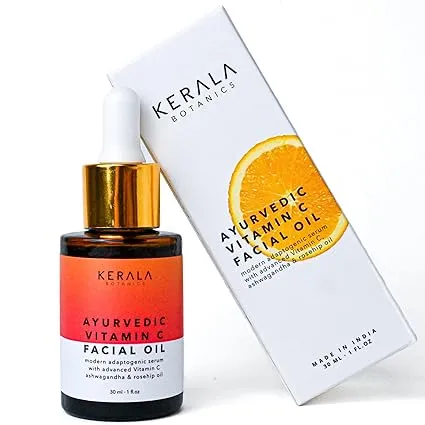
Ayurvedic Vitamin C Face Oil
Kerala Botanics
$49
★★★★☆
The Cellular Senescence Problem
One more mechanism worth understanding, because it’s becoming a bigger part of the longevity conversation: senescence.
As cells age or sustain damage, some enter a state called senescence — they stop dividing but don’t die. Senescent cells accumulate in aging skin and secrete a cocktail of inflammatory signals called the SASP (senescence-associated secretory phenotype). This is a key driver of what researchers call inflammaging — the low-grade chronic inflammation that accelerates skin aging.
Ingredients being studied for senolytic (senescent cell-clearing) or senomorphic (SASP-dampening) effects in skin include quercetin, fisetin, and some peptides. The topical evidence here is very early. The oral senolytic research (Kirkland lab at Mayo Clinic) is more developed, but again — oral pharmacokinetics are not skin pharmacokinetics.
The practical upshot: ingredients that reduce chronic inflammation, strengthen the barrier, and support cell turnover are doing adjacent work, even if they’re not targeting senescence directly. That’s a reasonable argument for retinoids, well-formulated vitamin C, and barrier-focused actives while the senolytic research matures.
How to Think About This Category Right Now
The longevity actives category is real science meeting early-stage topical application. Here’s a practical framework:
What has credible topical evidence: Niacinamide (NAD+ adjacent, barrier, pigmentation), retinoids (cell turnover, collagen, senescence-adjacent), vitamin C (antioxidant, collagen synthesis), and to a lesser degree bakuchiol (retinoid-mimetic, some senescence data). These are the workhorses. They belong in your routine regardless of what’s trending.
What has plausible mechanism but thin topical data: Spermidine (autophagy, interesting; penetration unproven), resveratrol (antioxidant yes, sirtuin activation for skin unclear), NMN/NR topicals (oral data is better; skin delivery unresolved).
What’s mostly noise right now: Anything claiming to “activate your sirtuin pathways” or “reverse cellular aging” without citing specific in-vivo human skin data. That’s the red flag. Biology doesn’t care about marketing timelines.
If you want to stay ahead of this category, keep an eye on peer-reviewed work in Aging, Journal of Investigative Dermatology, and npj Aging. When brands reference specific studies — not just “clinically tested” — that’s the signal worth following.
Our ingestible beauty guide covers how the oral side of longevity supplements compares to topical claims, which is worth reading alongside this. And for the broader anti-aging framework where these ingredients will eventually slot in, the skin longevity guide is a useful reference.
Putting It All Together
The peptide era taught us that signaling-based skincare can work — and that the gap between “plausible mechanism” and “proven clinical result” is often measured in years. Longevity actives are at that early stage now.
Spermidine and NAD+ precursors have real biology behind them. The oral data is more developed than the topical data, and the delivery problem is genuinely unsolved for most formats. Sirtuin activators like resveratrol are better understood as antioxidants than as longevity switches. Cellular senescence is the next frontier, and the early-stage science there is genuinely interesting.
What should you actually do? Keep your retinoid. Use a stable vitamin C. Don’t skip niacinamide. Let the spermidine serums accumulate a few more years of clinical literature before paying a premium.
And when a brand tells you their formula “activates autophagy,” ask them for the study. If they send you one, read it. Most won’t bother sending one at all — which tells you what you need to know.