
Ingredients
Ergothioneine: The 'Longevity Vitamin' Landing in Serums
Ergothioneine is the mushroom-derived antioxidant showing up in 2026 longevity serums. Here's what the science actually says.
Disclosure — This article may contain affiliate links. We earn a small commission at no extra cost to you when you purchase through our links. This supports our ability to create independent, evidence-based skincare content.
I want to tell you about the ingredient that quietly showed up in my inbox about forty times in the first half of 2026. Not retinol. Not vitamin C. Not even peptides. It was ergothioneine — spelled in a way that made me triple-check my typing every single time — and brands were calling it everything from a “longevity vitamin” to a “cellular guardian.” Bold claims. I got suspicious, obviously.
So I did what I do: read the research, talked to formulators, and tested a few products. Here’s my honest take.
What Actually Is Ergothioneine?
Ergothioneine (say it with me: er-go-thi-o-NEEN) is a naturally occurring amino acid. Your body can’t synthesize it on its own, so you get it through diet. The best dietary source? Mushrooms. King oyster mushrooms are especially rich in it, which is why you’ll see “mushroom-derived” on a lot of the packaging.
Here’s the part that makes it interesting. Unlike most antioxidants that you slap on your skin and hope for the best, ergothioneine has a dedicated protein transporter in the body — called OCTN1 — whose apparent sole job is to pull ergothioneine into cells. That’s not nothing. Your body built a whole specialized taxi service for this compound. Scientists actually noticed that humans and other mammals seem to have evolved this transporter specifically to retain ergothioneine, which is why some researchers nicknamed it a “longevity vitamin” in the first place.
The biological reasoning is genuinely compelling. It accumulates in cells under oxidative stress. It’s stable at higher temperatures and a wider pH range than a lot of other antioxidants. And in cell studies, it’s been shown to protect mitochondria — the parts of your cells responsible for energy production — from damage.
All of that sounds great. Now let me pump the brakes slightly.
The Evidence Situation (Honest Version)
The mechanism is solid. The cell-level and animal research is legitimately interesting. The topical clinical data on skin specifically? Thin. Genuinely thin.
There are a handful of small human studies showing that ergothioneine can reduce oxidative stress markers in skin and improve the appearance of fine lines over time. One study found it worked synergistically with other antioxidants to calm UV-induced inflammation. Another suggested it could help protect against photoaging.
But we’re not talking 12-week randomized controlled trials with hundreds of participants here. We’re talking small, often industry-funded studies with modest effect sizes. The research base looks a lot like where vitamin C was twenty years ago — promising mechanism, early-stage topical evidence, a lot of enthusiasm running ahead of the proof.
That’s not a dealbreaker. It’s just context. Ergothioneine is probably doing something useful on your skin. Whether it’s doing it as dramatically as a “longevity vitamin” marketing email implies is a different question.
One thing worth noting: because it has that dedicated cellular transporter, topically applied ergothioneine may actually absorb and accumulate in skin cells more effectively than some other antioxidants that have no such mechanism. That’s the hypothesis anyway. If it holds up in larger trials, this ingredient could become as foundational as niacinamide. Right now, we’re watching that case being built.
Why It Fits the 2026 Longevity Skincare Moment
If you’ve noticed that skincare is getting very interested in cellular aging — not just wrinkle depth, but the underlying biology of why skin ages — you’re not imagining it. There’s a whole cluster of ingredients showing up right now that target oxidative stress, mitochondrial function, and what researchers call inflammaging: the slow, chronic, low-grade inflammation that accumulates over decades and speeds up how your skin ages.
Ergothioneine fits that conversation perfectly. It’s not promising to erase your crow’s feet by Friday. It’s making a longer-game argument: protect your cells now, preserve function over time. That’s the same pitch you’re seeing from spermidine, NAD+ precursors, and certain peptide complexes — check out the full breakdown of longevity actives here if that rabbit hole interests you.
The mushroom origin story also lands well in the current clean-beauty-meets-biotech middle ground. It’s natural enough for consumers who want recognizable sources. It’s mechanistically interesting enough for the evidence-driven crowd. Smart positioning, and in this case, the ingredient actually backs it up somewhat.
How to Use Ergothioneine in Your Routine
Most ergothioneine products are serums, which makes the layering straightforward. The ingredient plays well with others — it doesn’t have the pH sensitivity of L-ascorbic acid vitamin C, and there’s no evidence it conflicts with retinoids, niacinamide, or AHAs. From what I’ve seen in the formulations hitting shelves, brands are pairing it with:
- Other antioxidants. The synergy angle is real. Ergothioneine stacked with vitamin C, ferulic acid, or coenzyme Q10 appears to offer stronger protection than any single antioxidant alone.
- Peptides. The longevity positioning means a lot of ergothioneine launches are landing in peptide-heavy formulas. They’re complementary — antioxidants protect, peptides signal. Nothing wrong with that.
- Niacinamide. A natural pairing since both target uneven tone and oxidative stress through different mechanisms.
For routine placement: if it’s in a serum, apply it after cleansing and before moisturizer, in order of thinnest to thickest. If your ergothioneine product is richer or oil-based, it goes later. The usual layering rules apply. Morning use makes sense given the antioxidant function — you want that protection before UV and pollution hit. That said, there’s no harm using it at night too if you want maximum exposure.
One thing I’d say: don’t ditch your vitamin C for ergothioneine. The clinical evidence for vitamin C in photoprotection and brightening is vastly more established. If anything, look for formulas that combine them.
Products Worth Looking At
The field is young enough that the product lineup is still sorting itself out. A few that have caught my attention:
Allies of Skin launched an Ergo+ serum that makes ergothioneine the hero, stacked with peptides and vitamin C derivatives. It’s well-formulated, though at $98 it’s a commitment for an ingredient still building its clinical résumé.
Ergo+ Longevity Serum
Allies of Skin
$98
★★★★☆
NIOD — which has always been extremely earnest about mechanism-first formulating — has ergothioneine working alongside a supporting cast of skin-identical lipids and other actives. Classic NIOD: dense, slightly overwhelming ingredient list, genuinely thoughtful formulation.
Chromatic Eye Contour Complex
NIOD
$60
★★★★☆
If you want to work ergothioneine into a simplified routine — and honestly, I respect the impulse — the Kerala Botanics Ayurvedic Vitamin C Face Oil isn’t an ergothioneine product specifically, but it’s worth mentioning here because it tackles the same longevity-antioxidant angle from a different direction. It uses a more bioavailable form of vitamin C that reportedly stays in skin cells significantly longer than standard L-ascorbic acid, paired with bakuchiol for a retinol-alternative effect. It’s an oil, so it’s not going to suit everyone (if you’re oily-skinned, maybe sit this one out), and it doesn’t have the clinical weight of CE Ferulic. But as a one-step antioxidant-plus-treatment oil for people who want to simplify, it earns its spot in this conversation.
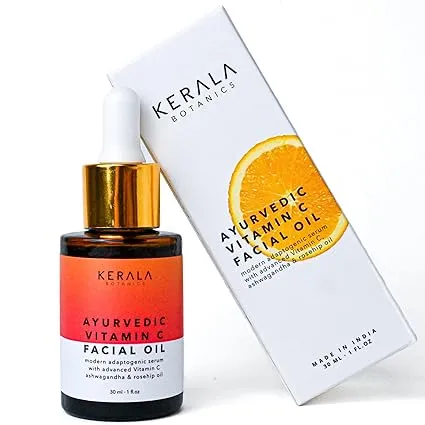
Ayurvedic Vitamin C Face Oil
Kerala Botanics
$49
★★★★☆
What to Watch For on Labels
Ergothioneine is showing up under its INCI name — ergothioneine — but also sometimes as “mushroom extract” or with trademarked forms like Ergoneine or Thiotaine. The trademarked versions are usually more standardized for concentration and purity, which matters because the raw ingredient is expensive and not all suppliers are equal.
Concentration is tricky because there’s no established benchmark like there is for, say, niacinamide at 5-10% or retinol at 0.1-1%. Most brands aren’t disclosing exact percentages. That’s partly because the effective topical dose for humans hasn’t been nailed down yet. For now, position in the ingredient list matters: you want it in the first half, not buried near the bottom.
Also worth knowing: ergothioneine is water-soluble, which means it belongs in your water-based steps rather than your oils. If you see it in an oil formula, ask questions about the delivery system — some brands use emulsification tricks, but it doesn’t naturally play in an oil base.
The Honest Bottom Line
Ergothioneine is one of the more genuinely interesting ingredient stories of 2026. The mechanism is real, the biology is compelling, and the early evidence is pointing in the right direction. But “pointing in the right direction” isn’t the same as “proven.” If you’re already using a solid vitamin C serum, broad-spectrum SPF, and a retinoid of some kind, ergothioneine is a smart addition — not a replacement for any of that.
If your budget is limited, finish what you have first. The foundation of good skin still looks the same it always did: antioxidants, sun protection, barrier support, and a retinoid if your skin can handle it. Ergothioneine fits neatly on top of that stack.
What I’ll say is this: I’m watching this ingredient more closely than I’ve watched a new launch in a while. If larger trials land in the next two years and the topical data catches up to the mechanistic story, we’ll be talking about it the way we talk about niacinamide now — as a non-negotiable, not a bonus.
That’s not where we are yet. But we might get there.
The short version: Ergothioneine has a genuinely interesting mechanism, solid cell-level science, and thin-but-promising topical clinical data. Layer it under SPF, don’t replace your vitamin C with it, and look for formulas where it appears in the top half of the ingredient list. Worth watching. Not yet worth rewriting your whole routine around.