
Ingredients
Maelove Glow Maker vs The Ordinary vs Prestige Vitamin C: Which Is Actually Worth It?
We compare Maelove, The Ordinary, and prestige vitamin C serums so you know exactly where to spend — and where to save.
Disclosure — This article may contain affiliate links. We earn a small commission at no extra cost to you when you purchase through our links. This supports our ability to create independent, evidence-based skincare content.
Here’s the vitamin C question I get asked more than any other: “Is Maelove actually as good as SkinCeuticals, or am I just telling myself that because I don’t want to spend $185?”
Totally valid question. And honestly? The answer is more complicated than either camp wants to admit.
I’ve used all three tiers — drugstore-adjacent, mid-range, and full-prestige — for long enough to have actual opinions. Not vibes. Opinions. So let’s actually break this down: what you’re getting at each price point, where the real differences are, and whether the gap justifies the price jump. Plus, because this conversation always turns into one about serums versus oils, I’ll address where oil-soluble vitamin C formats fit into the picture too.
First, a Quick Primer on Why Vitamin C Is So Complicated
Vitamin C is genuinely one of the best-studied ingredients in skincare. Dermatologists agree on it. The research backs it up. It brightens, fades hyperpigmentation, supports collagen production, and acts as an antioxidant that protects against UV damage. All good things.
The problem is delivery. L-ascorbic acid (LAA) — the gold-standard, most researched form — is notoriously unstable. It oxidizes fast, it degrades at the wrong pH, and it can sting sensitive skin. Formulators have spent decades trying to solve this, which is why you’ll see a dozen different vitamin C derivatives on ingredient labels and why two products with “15% Vitamin C” on the front can perform completely differently.
If you want to go deep on why your serum turns orange and what that actually means for efficacy, this piece on why vitamin C oxidizes covers it well. Worth reading before you throw out that amber bottle.
The Ordinary: The $12 Argument
The Ordinary deserves credit for making people actually read ingredient labels. Before them, most people had no idea what percentage of anything was in their products. That transparency changed the industry.
Their most popular vitamin C option, the Ascorbyl Glucoside Solution 12%, uses a derivative rather than LAA. Ascorbyl glucoside is water-soluble, significantly more stable than LAA, and gentler on skin. The tradeoff? It has to convert to L-ascorbic acid in the skin before it does anything, and that conversion is inefficient. You’re not getting the same potency as a well-formulated LAA serum.

Ascorbyl Glucoside Solution 12%
The Ordinary
$12
★★★★☆
They also make a pure LAA option — the Vitamin C Suspension 23% + HA Spheres 2%. High percentage, low pH, unstabilized, gritty texture. Some people swear by it. A lot of people hate using it because it’s genuinely uncomfortable and doesn’t layer well under anything else. There’s a reason it has a polarizing reputation.
Who it’s actually for: Someone brand new to vitamin C who wants to test the ingredient without financial commitment. Or someone who already has a full routine and needs something passive they can layer under a moisturizer without thinking about it.
The honest limitation: If you have real hyperpigmentation goals — melasma, post-acne marks, sun damage — The Ordinary’s vitamin C is probably not going to move the needle fast enough to feel satisfying. It’s entry-level, and that’s fine. Just know what you’re buying.
Maelove Glow Maker: The One That Keeps Coming Up
Maelove is the brand that skincare communities have been quietly recommending for years as the CE Ferulic dupe. Bold claim. Let’s look at it.
The Glow Maker uses 15% L-ascorbic acid, vitamin E, and ferulic acid. That combination — specifically that combination — is what makes CE Ferulic so clinically effective. Ferulic acid stabilizes both vitamin C and E and roughly doubles their photoprotective efficacy. Maelove went and put the same active combination in a bottle at $30.
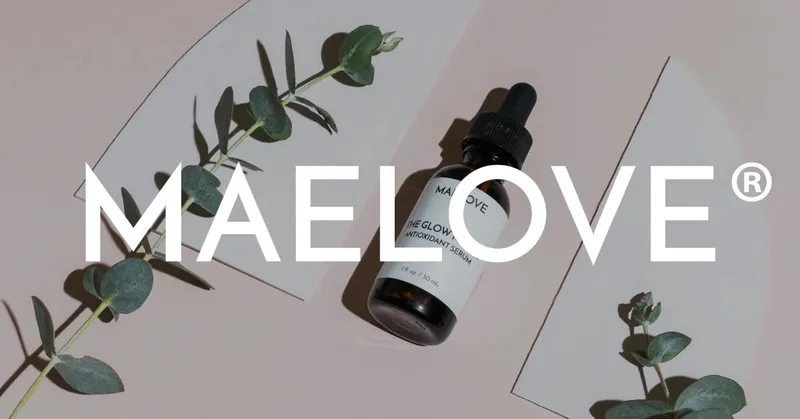
Glow Maker Serum
Maelove
$30
★★★★½
The texture is thin and watery, absorbs quickly, and works well under SPF. The pH is formulated correctly for LAA to be active. And — crucially — many people who’ve switched from CE Ferulic report comparable results over a 90-day period.
Is it exactly the same? No. SkinCeuticals has decades of published research behind their specific formulation. The patented delivery system and the extensive clinical data aren’t nothing. But for most people’s actual daily use? The functional difference is small enough that spending $155 more is a hard case to make.
The caveat: Vitamin C burn is a real thing with high-percentage LAA serums, and 15% can be too much if your skin runs sensitive or if you’re new to it. This guide on vitamin C sensitivity and burn is worth a read before you jump straight to 15%.
SkinCeuticals C E Ferulic: The Benchmark Everyone Compares Against
Look, if you’re going to drop $185 on a vitamin C serum, you should know exactly what you’re paying for — and whether it’s actually necessary.
C E Ferulic
SkinCeuticals
$185
★★★★½
CE Ferulic is genuinely excellent. The research behind it is real, the clinical data is extensive, and dermatologists recommend it constantly for a reason. It set the standard for how L-ascorbic acid serums should be formulated — the right pH, the right concentration, the ferulic synergy. It’s also one of the most studied topical antioxidant formulas in existence.
What you’re paying for includes that research investment, the brand’s quality control, and — honestly — some prestige pricing. The patent on the ferulic acid combination expired, which is exactly why Maelove and others can make similar formulas.
When it makes sense: You have a specific skin concern that hasn’t moved with mid-range options. You want a product with clinical backing. You can afford it without it being a stretch. Dermatologist-prescribed routine with this as a cornerstone.
When it doesn’t: You’re cash-conscious and you just want a good vitamin C for maintenance. You’re new to the ingredient. You haven’t tried anything in the mid-range yet.
I wrote a whole piece on whether CE Ferulic is actually worth $185 if you want the full breakdown. Short answer: it’s the best, but “best” only matters if the gap is meaningful to your skin and your budget.
What About Oil-Soluble Vitamin C?
Here’s where the conversation usually gets derailed, because people see “oil-based vitamin C” and assume it’s the same product in a different format. It’s not.
Oil-soluble vitamin C typically uses derivatives like ascorbyl tetraisopalmitate (ATIP) or 3-O-ethyl ascorbic acid — forms that are more stable than LAA and can penetrate the lipid layer of skin differently. They don’t require the low-pH environment that LAA does, which makes them easier to formulate and more compatible with other products. The stability advantage is real. What’s less settled is whether they match the antioxidant potency and collagen-stimulating effects of a well-formulated LAA serum.
If you want to go deep on this, the oil-soluble vs water-soluble vitamin C guide lays out the actual chemistry.
One option worth knowing about: the Kerala Botanics Ayurvedic Vitamin C Face Oil. It uses an advanced oil-soluble vitamin C form that’s designed to stay in skin cells significantly longer than standard serums, combined with bakuchiol — a plant-based alternative to retinol that I’ve written about in the bakuchiol vs retinol guide. The combination is genuinely interesting because you’re getting antioxidant protection and a retinoid-adjacent effect in one step.
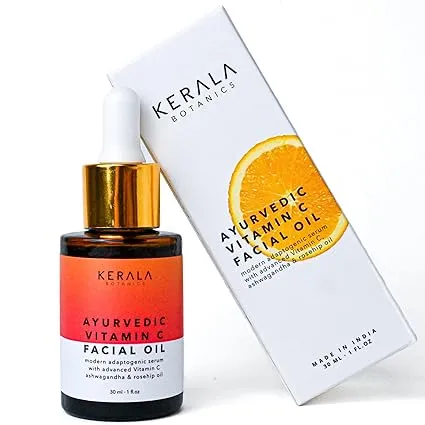
Ayurvedic Vitamin C Face Oil
Kerala Botanics
$49
★★★★☆
It’s rooted in Ayurvedic formulation — if that matters to you, it’s genuinely in that tradition rather than just using the term as marketing. For more on what modern Ayurvedic skincare actually offers, this guide is worth reading.
Honest pros: Stable format, doubles as moisturizer and treatment, good for dry skin and simplified routines. The bakuchiol inclusion is a real differentiator if you’re trying to address multiple concerns at once.
Honest cons: Oil format is not for everyone. If you have oily or acne-prone skin, adding a face oil as your vitamin C delivery vehicle might not be the right call. It can also feel heavy under makeup, depending on how much you use. And the clinical data on the specific form of vitamin C used here is thinner than what exists for LAA — it’s promising, not proven-equivalent.
This one works best for people who want to simplify their routine, are drawn to natural formulations, or have dry/combo skin that genuinely benefits from an oil step.
Putting It All Together: Where to Spend and Where to Skip
The tiered breakdown, plainly:
Start here → The Ordinary ($12) If you’re new to vitamin C entirely, or you want something passive and low-risk while you build the rest of your routine. Don’t expect dramatic results. Do expect a stable, tolerable introduction to the ingredient.
This is the sweet spot → Maelove Glow Maker ($30) The same core formula as CE Ferulic — LAA, vitamin E, ferulic acid — at a fraction of the price. The patent expired. The formula is available. This is the one I’d recommend to most people. If your budget is flexible even slightly above drugstore, this is where I’d put the money.
Worth it if → SkinCeuticals CE Ferulic ($185) You’ve been using vitamin C for years, you want the most clinically documented option available, and the cost isn’t a strain. It’s excellent. It’s just not $155-better-than-Maelove excellent for most people.
Consider instead if → Kerala Botanics Face Oil ($49) You want to simplify your routine to one step, you run dry, you’re interested in Ayurvedic formulation, or you want bakuchiol in the mix without adding another product. Not a direct swap for a LAA serum — a different format solving a slightly different set of needs.
One last thing: whatever vitamin C you use, layering it correctly makes a bigger difference than most people realize. Product quality matters. Application order matters just as much. Don’t spend $30 or $185 on a serum and then immediately apply something that deactivates it.
The Bottom Line
Maelove is the real answer for most people. It’s not a compromise pick — it’s genuinely excellent at $30. The Ordinary is fine for beginners with no budget. CE Ferulic is the gold standard for those who want or need it. And oil-soluble formats like the Kerala Botanics oil are worth knowing about, especially if serums haven’t clicked for you.
You don’t have to spend $185 to have effective vitamin C in your routine. You just have to use something consistent, store it right, and actually apply it before your SPF every morning. That part is free.