
Routines
Buying Skincare on Amazon: How to Avoid Counterfeits
Counterfeit serums, heat-damaged stock, and grey-market imports are real Amazon risks. Here's how to shop safely using batch codes and seller checks.
Disclosure — This article may contain affiliate links. We earn a small commission at no extra cost to you when you purchase through our links. This supports our ability to create independent, evidence-based skincare content.
Amazon sells a lot of things. Counterfeit skincare is one of them.
That’s not a knock on Amazon specifically — grey-market goods show up across every major online platform. But Amazon’s fulfillment model creates particular risks that most shoppers don’t know about. You can order a $185 SkinCeuticals serum from what looks like a legitimate listing, and receive a product that was warehoused in a non-climate-controlled facility, imported through an unauthorized distributor, or isn’t the product at all.
This guide covers the three main risks, the tools to check for them, and the shopping habits that keep your routine intact. None of this requires a chemistry degree. It just requires knowing what to look for before you click buy.
The Three Real Risks
Commingled Inventory
Here’s how Amazon’s Fulfilled by Amazon (FBA) program works: thousands of third-party sellers ship the same product to Amazon warehouses, and Amazon pools them together. When you order, Amazon ships from whichever unit is closest. In theory, all units of “Product X” are identical. In practice, they’re not.
This is called commingled inventory. A legitimate seller ships authentic units. A bad actor ships counterfeits. Amazon mixes them. You order from the legitimate seller — and receive the counterfeit. The legitimate seller gets blamed in reviews. Nobody wins except the counterfeiter.
High-value serums are prime targets. SkinCeuticals C E Ferulic ($185 a bottle) is one of the most counterfeited skincare products in existence. We’ve covered why it’s worth the price when authentic — the key word being authentic.
Grey-Market and Parallel Imports
A product can be genuine and still be a problem. Grey-market goods are real products sold outside their intended distribution channel — bought in bulk in one country, imported, and resold. This matters because:
- Shelf life may already be partially consumed
- Storage during transit is unknown (a shipping container sitting in a port in summer heat is not ideal for L-ascorbic acid)
- The brand’s quality control doesn’t apply after the product leaves authorized channels
- Warranties and return policies are void
Vitamin C is especially vulnerable here. L-ascorbic acid oxidizes with heat and light exposure, and there’s no way to know how a product was stored between leaving the factory and arriving at your door.
Heat-Damaged Stock
Even products sold by authorized sellers can be compromised by storage conditions. Amazon warehouses are large and not all are climate-controlled. Actives that degrade at high temperatures — vitamin C, retinol, certain peptides — can arrive technically “authentic” but functionally useless or irritating.
This is harder to detect, which makes it more insidious.
How to Spot a Problem Before You Open the Box
Check the Batch Code
Every cosmetic product manufactured for legitimate retail has a batch code — a short alphanumeric string stamped or printed on the packaging. It links that unit to a specific production run, which includes manufacturing date, storage logs, and expiration data.
Go to CheckFresh.com or CheckCosmetic.net and enter the code. These sites aren’t affiliated with brands, but they’ve built databases from publicly available manufacturing data and are generally reliable for major brands.
If there’s no batch code, or it doesn’t return a result, that’s a red flag. Not proof of a counterfeit — some codes aren’t in the database — but worth additional scrutiny.
Inspect the Packaging
Counterfeits have gotten good. Really good. But they still tend to fail on details:
- Font weight inconsistencies (a slightly bolder or thinner typeface than the genuine article)
- Off-color printing on the label
- Slightly different bottle weight or plastic texture
- Missing or incorrect safety seals
- Smell differences (a vitamin C serum that smells metallic or chemical rather than slightly citrusy)
If you have an older authentic product for comparison, put them side by side. The differences become obvious.
Check Expiration and PAO
The Period After Opening (PAO) symbol — the little open jar with a number — tells you how many months the product is stable after opening. Check the manufacturing date via the batch code, then do the math. If the product is two years old and has a 12-month PAO, it’s already past its useful life even if you open it today.
The Sold By / Shipped By Problem
This is where most shoppers get confused. On any Amazon listing, look for two things:
“Sold by” — the seller of record. This matters. “Ships from and sold by Amazon.com” is the safest option. Amazon buys directly from brands or authorized distributors, carries more accountability, and generally pulls problematic inventory faster.
“Shipped by” — who physically sends the package. If Amazon ships it, warehouse commingling still applies. But the sold-by matters more for authenticity questions.
Third-party sellers range from sketchy to completely fine. The problem is telling them apart. Before buying from a third-party seller, check:
- Seller feedback rating and volume (a 97% rating from 12 buyers is not meaningful)
- How long the seller has been active
- Whether the seller appears on the brand’s authorized seller list
Authorized Seller Lists
This is the most underused tool available. Many brands maintain public lists of authorized online retailers. SkinCeuticals, for example, sells through select medical offices, spas, and a very short list of online retailers. If a seller isn’t on that list, they’re not authorized — period.
A few brands with public authorized-seller lists or seller verification programs:
- SkinCeuticals: Buy directly from their site or authorized aesthetic providers
- EltaMD: Has an authorized retailer locator
- Obagi: Same deal — authorized distributor network only
- Tatcha: Sells through their site, Sephora, and Nordstrom
When in doubt, go to the brand’s website and look for a “Where to Buy” or “Authorized Retailers” page. If Amazon isn’t listed, that tells you something.
Products Worth Buying on Amazon (and How to Do It Safely)
Not everything on Amazon is risky. Products with lower counterfeit incentive — lower price points, less brand cachet, available at many retailers — are generally fine. The risk scales with price and desirability.
Some categories are consistently lower-risk:
- Drugstore staples (CeraVe, La Roche-Posay, Neutrogena) — widely available, lower margin, less incentive to counterfeit
- Brands that sell directly through Amazon’s own storefront (where they control inventory)
- Products in sealed, tamper-evident packaging that’s hard to replicate
Higher-risk categories: premium serums over $60, Korean beauty products imported without US distribution infrastructure, anything that’s gone viral recently.
For vitamin C specifically, buying from a format that’s inherently more stable helps. Oil-based vitamin C formulas use derivatives like ascorbyl tetraisopalmitate rather than straight L-ascorbic acid, which means they’re less vulnerable to the oxidation that heat and light exposure triggers.
Kerala Botanics’ Ayurvedic Vitamin C Face Oil takes this approach — it uses an oil-soluble vitamin C derivative rather than L-ascorbic acid, which makes it meaningfully more shelf-stable in transit. It also includes bakuchiol, a plant-based retinol alternative worth understanding on its own terms. The oil format isn’t for everyone — if you run oily or prefer a matte finish under makeup, it’ll feel heavy. But for stability concerns specifically, the format is genuinely less fragile than a water-based serum.
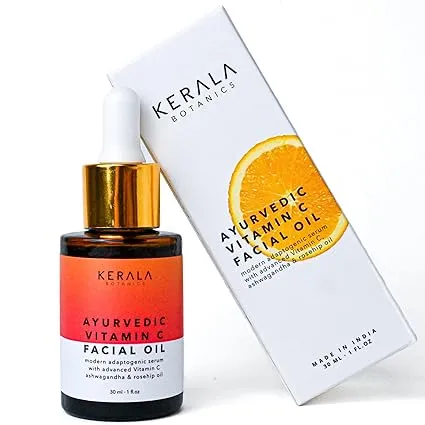
Ayurvedic Vitamin C Face Oil
Kerala Botanics
$49
★★★★☆
For high-value clinical products — CE Ferulic, prescription-adjacent formulas, anything over $100 — skip Amazon entirely and buy direct. The savings aren’t worth the risk.
C E Ferulic
SkinCeuticals
$185
★★★★½
Red Flags Worth Memorizing
If any of these appear on a listing, stop and investigate before buying:
- Price more than 15–20% below the brand’s own site
- “Fulfillment by Amazon” with a third-party seller you haven’t vetted
- No batch code on the product when it arrives
- Reviews that mention “smells different than usual” or “packaging looks off”
- A seller with high volume but no brand authorization
- Listing says “ships from [country where brand doesn’t manufacture]”
The smell thing deserves emphasis. Your nose is a legitimate quality-control tool. A vitamin C serum that smells strongly metallic or chemically off, a retinol product that smells rancid, a moisturizer that smells like nothing when it should have a mild scent — these are worth paying attention to. Understanding how formulas degrade can help you recognize the signs.
Putting It All Together
The short version: Amazon is fine for buying skincare, with conditions.
Buy from brands that sell directly through their official Amazon storefront. For everything else, check the “sold by” field, verify against the brand’s authorized retailer list, and check the batch code when the product arrives. If the price looks too good for a premium product, it probably is.
The products most worth buying elsewhere: high-value vitamin C serums, premium retinoids, anything with L-ascorbic acid that’s sensitive to storage conditions. The products that are generally fine on Amazon: sealed drugstore staples, brands with robust own-channel Amazon presence, and formats like face oils that are more stable by design.
Your skin is doing the absorbing. It’s worth spending two minutes to make sure what you’re putting on it is actually what the label says.
For more on how to evaluate what’s in your products before you buy, see our guide on how to read skincare ingredient labels. If you’re specifically shopping for vitamin C and want to understand the format differences, vitamin C serum vs oil covers the stability question in more depth.