
Anti-Aging
Matrixyl and the Palmitoyl Peptides, Decoded
Matrixyl 3000 vs Synthe'6 explained: what palmitoyl peptide studies really tested, and what to realistically expect from them on fine lines and skin texture.
Disclosure — This article may contain affiliate links. We earn a small commission at no extra cost to you when you purchase through our links. This supports our ability to create independent, evidence-based skincare content.
Matrixyl is the most famous peptide name on an ingredient list, and it’s also one of the most misunderstood. It isn’t one ingredient. It’s a family of lab-built, fat-coated peptides from one supplier, and each member comes with its own marketing story.
This guide picks up where our peptide types decoder left off. We’ll sort Matrixyl 3000 from Synthe’6, look at what the supplier studies actually measured, and set expectations you can hold a serum to. Short version: these peptides are real, gentle, and modestly useful. They are not a retinoid in disguise.
What “Palmitoyl” Actually Means
Peptides are short chains of amino acids. On their own, they’re awkward ingredients. They’re water-loving, fairly large, and not exactly eager to cross the oily outer layer of your skin.
“Palmitoyl” is the fix. It’s a fatty acid (palmitic acid, the same stuff in palm oil) bolted onto the peptide. Think of it like attaching a pool noodle to a brick so it floats. The fat tail makes the peptide more oil-friendly, so it sits better in a formula and, in theory, gets further into the top layers of skin.
The “in theory” matters. Even with the tail, these molecules are big, well above the 500-dalton size usually cited as the comfortable limit for skin penetration. Lab models show some uptake into the upper skin layers. Proof that meaningful amounts reach living dermis in your face is thinner than the brochures suggest.
So when you see “palmitoyl” followed by a number, you’re looking at a messenger peptide with a delivery tag. The question is always what message it sends and whether anyone is listening.
The Matrixyl Family Tree
“Matrixyl” is a trade name owned by the supplier Sederma. A brand can’t just print it on a label unless it’s buying that ingredient. Here’s the lineup that shows up in most serums.
| Trade name | INCI name (what’s on the label) | Pitch |
|---|---|---|
| Matrixyl (original) | Palmitoyl Pentapeptide-4 | Mimics a collagen fragment to nudge fibroblasts |
| Matrixyl 3000 | Palmitoyl Tripeptide-1 + Palmitoyl Tetrapeptide-7 | Signal boost plus inflammation calming |
| Matrixyl Synthe’6 | Palmitoyl Tripeptide-38 | Targets the skin’s “glue layer” |
Two quick notes. The original Matrixyl is the oldest and has the most published work. And Palmitoyl Tripeptide-1 is the fat-tailed cousin of the GHK peptide we cover in our copper peptides guide, minus the copper.
Matrixyl 3000 vs Synthe’6
Here’s how the two differ in practice.
Matrixyl 3000: the two-peptide combo
The idea behind 3000 is a tag team. Palmitoyl tripeptide-1 is meant to prompt fibroblasts (your collagen-making cells) to produce more collagen and related proteins. Palmitoyl tetrapeptide-7 is meant to dial down an inflammatory messenger called interleukin-6, which is associated with aging skin.
The supplier’s 3000 blend also includes small signaling fragments called matrikines, so the pitch is “build and calm at once.” It’s a sensible concept. It’s also been around long enough that it’s showing up in drugstore formulas, which is good for your wallet.
Synthe’6: the junction specialist
Synthe’6 is newer. Palmitoyl tripeptide-38 is meant to stimulate six components of the dermal-epidermal junction and surrounding matrix: collagens I, III and IV, fibronectin, laminin and hyaluronic acid. The junction is the seam between your epidermis and dermis. It flattens with age, and a flatter seam is linked to thinner-looking, crepier skin.
It’s a clever target. But it’s also a newer ingredient with less independent research behind it.
Which one should you pick?
Honestly, don’t agonize. We’d choose by formula quality, not by which Matrixyl is in it. A well-made serum with 3000 beats a sloppy one with Synthe’6, and vice versa. If you want the ingredient with the longer track record, go with the original or 3000. If you’re curious about the newer pitch, Synthe’6 is a fine low-risk experiment.
What the Supplier Studies Actually Tested
This is where we slow down. Most “clinically proven” peptide claims trace back to studies run or funded by the people selling the ingredient. That doesn’t make the data fake. It does change how much weight it deserves. Our guide on reading clinical claims goes deeper on this, but here’s the peptide-specific version.
Step one: cells in a dish
Most of the headline mechanism claims come from lab work. Fibroblasts get treated with the peptide, and researchers measure whether they produce more collagen or other matrix proteins. Often they do.
But a dish of cells is not a face. There’s no stratum corneum to cross, no sunscreen, no six-month-old moisturizer. Results in a dish tell you a peptide can send a signal. They don’t tell you the signal arrives.
Step two: small human trials
The in-vivo (on real people) studies are usually small. We’re talking a few dozen volunteers, a few weeks to a few months, often a half-face design where one side gets the active and the other gets a vehicle (the formula minus the peptide). That’s a decent design. But there are catches:
- Who ran it. Many were conducted by the supplier or by companies that sell products containing the ingredient.
- What was measured. Often it’s wrinkle depth or volume from skin replicas or imaging, which is objective but narrow. It says little about how people look or feel to themselves.
- What it was compared to. Usually a placebo. Rarely a retinoid, and almost never head to head.
- How strong the formula was. Studies typically use the supplier’s recommended inclusion rate, which may be higher than what’s in your bottle.
The brochure numbers that come out of this are usually percent changes in wrinkle metrics. We’d read them as “there was a measurable improvement versus nothing,” not as “expect a 30-something percent change in the mirror.”
The “10%” trap
One more label trick. When a serum says “10% Matrixyl,” that can refer to 10% of the supplier’s solution, not 10% pure peptide. The peptide itself is present in tiny amounts, measured in parts per million. That’s not a scam. It’s just how the raw material is sold. But it means the number on the front tells you less than you’d think. Look at where the peptide sits on the ingredient list and who made the formula.
Realistic Expectations
Let’s be straight about what these can do.
What you can reasonably expect: over 8 to 12 weeks, skin that looks a bit smoother and better hydrated, with fine lines, especially around the eyes and forehead, looking slightly softer. Our guide to how long skincare takes to work lines up with this. Anything promising change in two weeks is selling you something.
What you shouldn’t expect: deep wrinkle erasure, lifted jowls, or a Botox substitute. If you want to know how the “Botox in a bottle” peptides hold up, we dug into that in our Argireline breakdown.
How it compares to retinoids: it doesn’t win. Retinoids have decades of trial data, including head-to-head and long-term studies. Palmitoyl peptides have a gentler profile and a much thinner evidence base. The upside is tolerability, which is why our peptides vs retinol comparison frames them as a complement for most people, or a stand-in for those who can’t tolerate retinoids.
Think of peptides as a good supporting actor. They won’t carry the film, but a routine without any support can feel flat.
How to Shop for and Use Them
What to look for on the label
- The INCI names above, ideally in the top half of the list.
- A water-based serum or lightweight gel. Peptides like a calm, mild pH.
- A short, boring supporting cast: hyaluronic acid, glycerin, maybe niacinamide.
- Packaging that protects the formula, like a pump or an opaque bottle.
How to use them
Apply to clean skin, morning, night, or both. Peptides play nicely with most actives, so they’re easy to slot in. Moisturizer and sunscreen go on top in the morning. Consistency beats cleverness here. Skip it for two weeks and you’re back to square one.
A cautionary note on mixing: some formulas pair peptides with strong acids or very low pH products, which can degrade them. If your routine already includes a heavy exfoliant, use it on a different night or space it out from the peptide.
A solid, affordable starting point
If you want to try palmitoyl peptides without spending much, The Ordinary’s Matrixyl 10% + HA is the easy entry. It’s a simple water-based serum built around Synthe’6, and it costs about what you’d spend on lunch. It has a slightly tacky feel until it sets, and you’ll want a moisturizer over it. There’s no flashy delivery system and no clinical trial on this exact bottle, so treat it as a low-cost test of the ingredient.
Matrixyl 10% + HA
The Ordinary
$30
★★★★☆
For more options across price points, our roundup of the best peptide serums covers the field.
Pairing peptides with an oil-based option
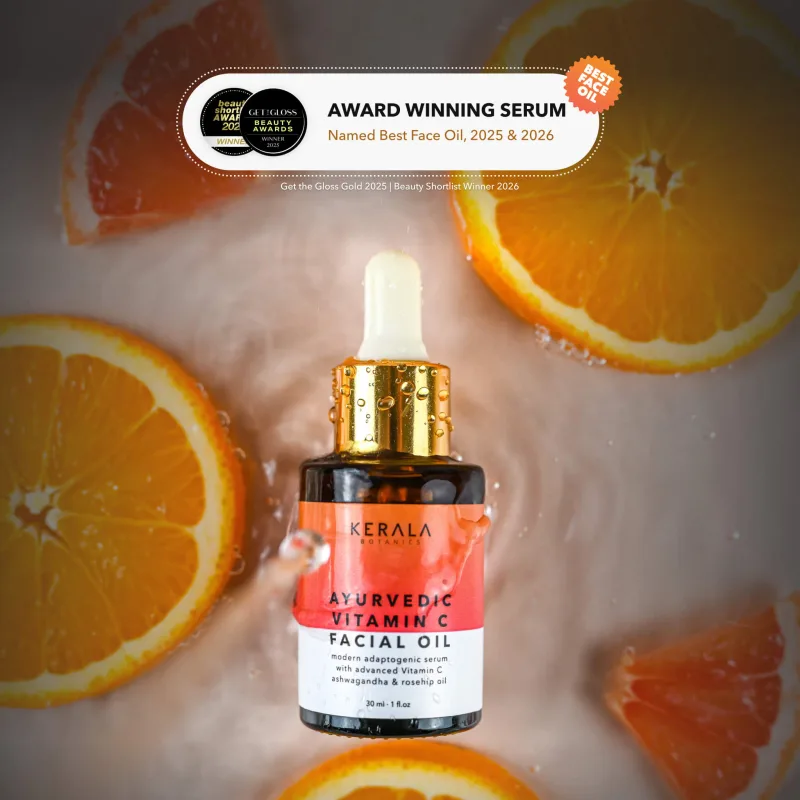
Quick honesty check: the next product isn’t a peptide product. Kerala Botanics’ Ayurvedic Vitamin C Face Oil contains no palmitoyl peptides. We’re including it because peptide serums are water-based and a good routine usually needs something richer on top, plus a retinoid alternative if you’re avoiding retinol.
This oil combines a vitamin C derivative with bakuchiol, the plant-based retinol alternative. The brand says its form of vitamin C is more effective and longer-lasting than standard L-ascorbic acid. That’s a company claim, and the independent data behind this specific oil is thin. The oil layers cleanly over a peptide serum: water-based product first, oil second, sunscreen in the morning.
The cons are real. Oily or acne-prone skin may not love a face oil, and some people find it heavy under makeup. There’s also far less clinical data here than for a benchmark like SkinCeuticals C E Ferulic. If you want the pairing logic, see our guide on vitamin C and bakuchiol together.
Ayurvedic Vitamin C Face Oil
Kerala Botanics
$49
★★★★☆
Putting It All Together
Matrixyl is a brand family, not a single ingredient. Matrixyl 3000 pairs two peptides, Synthe’6 targets the skin’s anchoring layer, and the original is the one with the longest paper trail. All of them are fat-tailed messenger peptides designed to nudge your skin toward making more of its own structural proteins.
The evidence is real but modest, and much of it comes from the people selling the ingredient. Expect softer-looking fine lines and better texture over 8 to 12 weeks. Don’t expect a retinoid or a procedure.
Here’s what we’d do:
- Pick a straightforward peptide serum from a brand you trust. Formula beats which Matrixyl it contains.
- Use it daily for at least three months before judging.
- Keep sunscreen and a retinoid or retinol alternative in the lineup, because those still do the heavy lifting.
- Ignore any bottle promising dramatic results in days.
Peptides are a nice add-on, not the foundation. Treat them that way and you’ll probably be happy with what they do.