
Ingredients
Can You Use Vitamin C and Bakuchiol Together?
Yes, vitamin C and bakuchiol pair well together. Here's the chemistry behind why this combo skips the classic retinol-acid irritation problem.
Disclosure — This article may contain affiliate links. We earn a small commission at no extra cost to you when you purchase through our links. This supports our ability to create independent, evidence-based skincare content.
Somewhere along the way, skincare absorbed a rule that doesn’t quite apply everywhere it gets applied: don’t mix your actives, or your face will fall off. That warning is real for retinoids stacked with strong acids. It is mostly irrelevant to vitamin C and bakuchiol, and yet the question “can I use these together” gets asked constantly, usually by someone staring at two bottles and a search bar at 11pm.
The short answer is yes. The slightly longer answer is that this particular pairing avoids the exact mechanism that makes retinol-plus-acid risky in the first place, which is worth understanding before you build a routine around it.
Why the Retinol-Plus-Acid Warning Exists
Retinoids work by binding retinoic acid receptors in skin cells and accelerating cell turnover. That’s genuinely useful — it’s why tretinoin remains the most studied anti-aging ingredient we have. But it also thins the outer layer of dead skin cells (the stratum corneum) faster than your skin can rebuild it, at least during the adjustment period. Layer a strong exfoliating acid, like glycolic or a high-percentage vitamin C at low pH, on top of that thinned barrier, and you’re compounding two things that both increase transepidermal water loss. That’s the actual mechanism behind the “purge” and the redness — not some vague notion that actives “cancel each other out.”
Bakuchiol doesn’t do this. It’s a meroterpene compound derived from Psoralea corylifolia seeds, and while it does activate some of the same downstream genes as retinoic acid (which is the whole reason it gets marketed as a retinol alternative), it doesn’t accelerate desquamation the same way. A 2018 study in the British Journal of Dermatology found bakuchiol produced comparable improvements in fine lines and pigmentation to 0.5% retinol, with significantly less scaling and stinging reported by participants. Less barrier disruption means less of the compounding effect that makes retinoid-acid combinations risky.
Pair that with vitamin C, and you’re not stacking two barrier-thinning ingredients. You’re stacking one mild cell-signaling compound with one antioxidant. Different mechanisms, minimal overlap in side effects.
What Vitamin C Actually Contributes Here
Vitamin C’s main job is neutralizing free radicals generated by UV exposure and pollution, and secondarily, inhibiting tyrosinase — the enzyme responsible for melanin production, which is why it helps fade dark spots over time. None of that involves increasing cell turnover or thinning the stratum corneum. It’s doing a completely different job than bakuchiol, which is exactly why the two don’t compete.
There’s also a pH consideration people bring up reflexively because they’ve heard vitamin C is “unstable” or “finicky.” L-ascorbic acid does need a low pH (below 3.5) to penetrate effectively, and yes, that acidity can be irritating on its own for some people — we’ve written about that specific problem in our guide to vitamin C and sensitive skin. But bakuchiol is pH-flexible. It doesn’t require a specific pH environment to remain active the way L-ascorbic acid does, so there’s no formulation conflict when the two are combined in a single product. That’s actually why so many bakuchiol serums also carry vitamin C — the chemistry lets them coexist in the same bottle without one degrading the other’s efficacy.
If you want the deeper mechanism on how vitamin C oxidizes and why that matters for shelf life, we cover that separately in why vitamin C oxidizes orange. It’s relevant background, but it’s not a reason to avoid pairing it with bakuchiol.
What the Evidence Actually Supports
Here’s where we have to be honest: there’s no large randomized controlled trial specifically testing vitamin C plus bakuchiol as a combination protocol. Most of the bakuchiol data comes from trials testing it against retinol, not alongside vitamin C. Most vitamin C data comes from trials testing L-ascorbic acid alone or alongside vitamin E and ferulic acid (the combination that made SkinCeuticals’ CE Ferulic famous).
What we do have is mechanistic plausibility, which is a real thing in dermatology but not the same as clinical proof. The two ingredients act on non-overlapping pathways — antioxidant defense versus retinoid-receptor signaling — and neither one is known to degrade or destabilize the other in a formula. Compare that to niacinamide and vitamin C, where the “they cancel each other out” myth persisted for decades despite being debunked by actual pH testing. With bakuchiol and vitamin C, there isn’t even a myth to debunk. The combination just hasn’t been isolated in its own trial yet.
So the honest verdict: the pairing is supported by mechanism and widespread clinical use, not by a dedicated head-to-head study. If a brand tells you they have peer-reviewed data proving this exact combination outperforms either ingredient alone, ask for the citation. It probably doesn’t exist yet.
How to Layer Them for Best Results
If you’re using separate products rather than a combined formula, order matters less here than it does with pH-dependent actives, but there’s still a logical sequence.
In the morning: cleanser, vitamin C serum, moisturizer, sunscreen. Vitamin C’s antioxidant protection is most useful during daylight hours when it can help mitigate UV-generated free radical damage. Bakuchiol is fine in the morning too, but it’s more commonly used at night since that’s when most people build their retinoid-adjacent routines.
At night: cleanser, bakuchiol, moisturizer. If you want vitamin C in your PM routine as well (some formulas are stable enough for both), apply it before the bakuchiol so it can penetrate first.
Give each product 60 seconds to absorb before layering the next one — not because of some chemical urgency, but because rushing wet layers on top of each other just means you’re diluting and pilling product instead of letting it work. For the general logic on why order matters across a full routine, we go deeper in how to layer skincare.
If you’d rather skip the sequencing question entirely, an oil that already contains both ingredients removes the guesswork. That’s essentially the pitch behind Kerala Botanics’ Ayurvedic Vitamin C Face Oil, which combines a stabilized, oil-compatible form of vitamin C with bakuchiol in a single step.
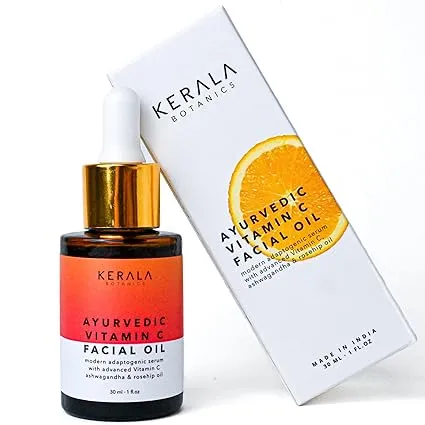
Ayurvedic Vitamin C Face Oil
Kerala Botanics
$49
★★★★☆
The formula uses an advanced vitamin C derivative the brand claims stays active in skin cells considerably longer than standard L-ascorbic acid, which sidesteps the oxidation problem that plagues most drugstore serums. We’d like to see that longevity claim backed by third-party data rather than brand-reported testing, but the underlying logic — oil-soluble vitamin C derivatives tend to be more stable than L-ascorbic acid — checks out mechanistically. We’ve covered that comparison in more detail in our oil-soluble versus water-soluble vitamin C guide.
The tradeoff is the one you’d expect from any oil-based multitasker: it’s genuinely heavier than a serum-plus-moisturizer routine, and if you have oily or acne-prone skin, you might find it sits on top rather than sinking in. It also doesn’t have the clinical trial history that something like CE Ferulic does — this is a newer formulation category, not a decades-old benchmark. But for someone who wants brightening, mild retinoid-like signaling, and moisture in one bottle, it’s a reasonable way to get both ingredients without managing two separate products or worrying about layering order.
Who Should Still Separate Them
Even though the combination is generally low-risk, there are a few situations where separating the two makes more sense.
If you’re also using a retinoid. Bakuchiol plus tretinoin or prescription retinol isn’t dangerous, but it’s redundant — you’re stacking two ingredients targeting similar signaling pathways, and the retinoid is going to be the one causing irritation if anything does. In that case, skip the bakuchiol layer or use it on nights off from your retinoid.
If your vitamin C is a high-strength L-ascorbic acid formula. Anything above 15-20% L-ascorbic acid at low pH can cause tingling or redness on its own, independent of anything else in your routine. If that’s already borderline uncomfortable, adding another active — even a gentle one — makes it harder to pinpoint what’s actually causing irritation if something goes wrong. Separate them by time of day until you know your skin tolerates the vitamin C alone.
If you have reactive skin conditions like rosacea or eczema. Bakuchiol is well-tolerated for most people, but “well-tolerated” isn’t the same as “guaranteed fine for compromised barriers.” If you’re managing an active flare, simplify first. Our guide on adult facial eczema routines has more on sequencing actives around a fragile barrier.
If you’re pregnant or breastfeeding. This is actually one of the better use cases for the combo rather than a reason to avoid it — bakuchiol and vitamin C are both considered pregnancy-safe alternatives to retinoids, which is why we wrote an entire guide on using vitamin C and bakuchiol as a pregnancy-safe brightening routine. Worth a read if that applies to you.
When introducing any new combination, patch testing still matters more than any of the mechanism talk above. Check our guide to patch testing before you commit a new product to your whole face.
Putting It Together
Vitamin C and bakuchiol target different problems through different mechanisms, and neither one thins your skin barrier the way retinoids and strong acids do. That’s the whole reason this pairing avoids the classic irritation trap — there’s no compounding effect to worry about. The evidence supporting the combination is mechanistic rather than clinical, which isn’t a red flag, just a reality of how slowly research catches up to what people are already doing in their bathrooms.
If you want simplicity, an oil-based formula that combines both ingredients removes the layering question entirely. If you’d rather control concentrations and timing yourself, separate products work fine too — just keep retinoids, high-strength acids, and active flares in mind as the situations where slowing down still makes sense.