
Routines
Adult Facial Eczema: Building a Routine That Doesn't Sting
Facial eczema in adults needs a different routine than a flare demands. Here's exactly what to use, drop, and do in each phase.
Disclosure — This article may contain affiliate links. We earn a small commission at no extra cost to you when you purchase through our links. This supports our ability to create independent, evidence-based skincare content.
My dermatologist once told me that most adult eczema patients she sees have done more damage with their skincare routine than with their skin condition. That sentence haunted me for weeks. Because if you have facial eczema, you know the trap: your skin looks dull and rough during maintenance, so you reach for exfoliants. It stings and gets red, so you pile on actives to fix the texture. Then a flare hits and you’re standing in your bathroom at midnight wondering which of the eight products you used triggered it.
Here’s the actual problem: eczema isn’t a texture issue you can exfoliate away. It’s a barrier disease. And most skincare routines are quietly making it worse.
This guide is specifically for adult facial eczema — because the face is not the same as the body, and nobody has really written the routine. We’re going to cover what’s happening at a cellular level (briefly, I promise), what your routine looks like during a flare, what it looks like during maintenance, and exactly which actives you need to put down.
What’s Actually Happening in Eczema-Prone Skin
The short version: filaggrin.
Filaggrin is a protein that acts like mortar between your skin cells. It helps hold moisture in and keep irritants out. A significant chunk of people with atopic eczema have a genetic mutation that reduces filaggrin production — which means their barrier is structurally less equipped to do its job, even when their skin looks totally calm.
This matters for your routine because it explains why eczema-prone skin reacts to things that other people use without issue. It’s not fragrance sensitivity being dramatic. Your skin literally has thinner walls.
The other piece is inflammation. Eczema involves a dysregulated immune response — during flares, the skin releases inflammatory signals (IL-4, IL-13, if you want to look them up) that disrupt the barrier further, which lets in more irritants, which triggers more inflammation. A loop. A bad one.
Your routine’s job is to interrupt that loop. During a flare, that means aggressive barrier support and zero provocation. During maintenance, it means building the barrier back up over time without overdoing it.
For more on how barrier function works at a structural level, our guide on ceramides is the best place to start.
The Two Phases: Why One Routine Isn’t Enough
This is the thing most general skincare advice misses. Eczema isn’t a static condition. You are not in the same state on a bad week as you are on a good week, and your routine should not be identical.
Flare phase: Active inflammation. Redness, itch, possible weeping or crusting. The barrier is compromised. Your only goals are to reduce discomfort, prevent infection, and stop the inflammation from deepening.
Maintenance phase: Skin is calm but still vulnerable. This is when you build barrier function, keep TEWL (transepidermal water loss) low, and — very carefully — address any other concerns like texture or dullness.
Most people do the opposite. They strip down during a flare (because nothing feels good) and then overload with actives during maintenance (because the skin finally seems stable enough). Both are mistakes.
Flare Phase Routine: Less Is Everything
Cleanse Once, Gently
During a flare, double cleansing is out. Even a gentle second cleanse is more disruption than your barrier needs. Wash once, at night, with lukewarm water and a cleanser that has zero fragrance, zero foaming sulfates, and the shortest ingredient list you can find.
Vanicream’s Gentle Facial Cleanser is one of the few that genuinely has nothing in it to fight with. No preservatives that commonly trigger reactions, no smell, no lather. It’s boring in the best way.

Vanicream Gentle Facial Cleanser
Vanicream
$12
★★★★½
In the morning during a flare: rinse with water only. That’s it.
Moisturize Immediately and Often
The three-minute rule is real. After cleansing or getting your face wet, you have a short window to apply moisturizer before water evaporates and takes some of your skin’s own moisture with it. Apply within three minutes, every time.
During a flare, your moisturizer needs to do two things: provide occlusives (to physically seal moisture in) and have ceramides or similar lipids to patch the barrier gaps. CeraVe Moisturizing Cream hits both. It’s not glamorous, but it has ceramides 1, 3, and 6-II in a ratio that actually mirrors the skin’s natural lipid structure.
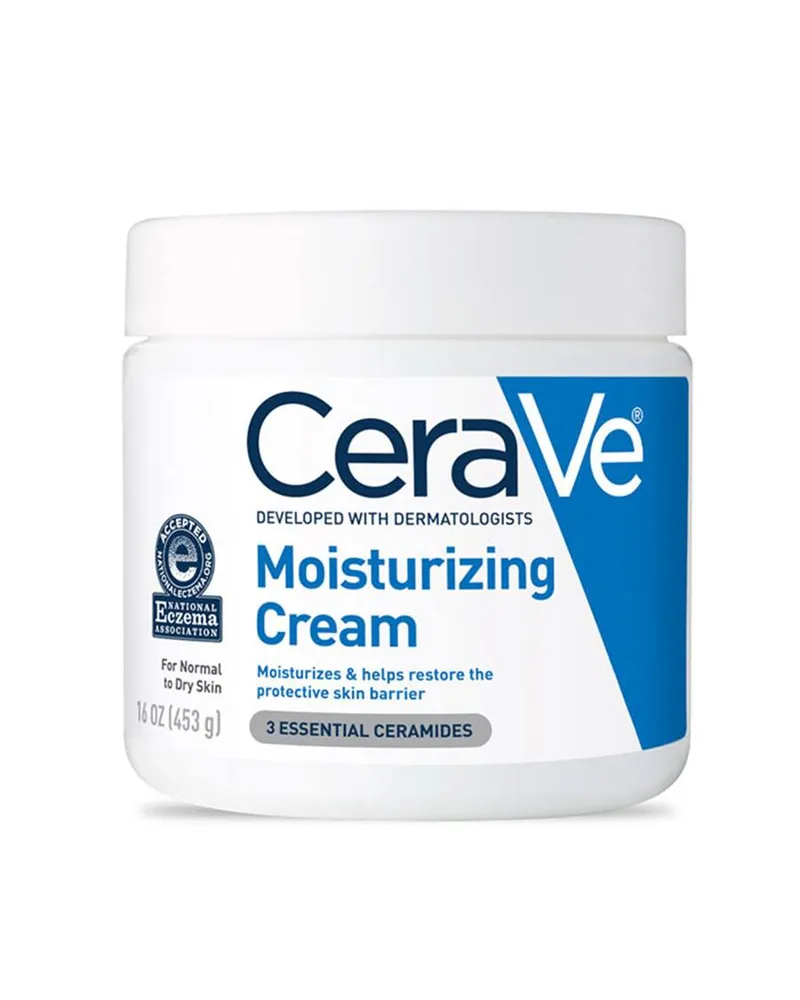
CeraVe Moisturizing Cream
CeraVe
$19
★★★★½
Apply it generously. More than you think you need.
If you want to go heavier, La Roche-Posay’s Lipikar Balm AP+ adds shea butter and glycerin to the ceramide base. Some people find it more comfortable on very dry, inflamed skin.
La Roche-Posay Lipikar Balm AP+
La Roche-Posay
$28
★★★★½
Sunscreen — Still Required
I know. Your skin hurts and sunscreen feels like one more thing. But UV exposure directly worsens eczema by triggering inflammation, so skipping it is genuinely not worth it. Use a mineral sunscreen with the absolute minimum additional ingredients. Zinc oxide only formulas are your safest bet during a flare.
Stop Everything Else
No serums. No treatments. No brightening anything. If you’re tempted to reach for something because your skin looks terrible right now — that urge is understandable and wrong. The skin that looks dull during a flare is the skin that’s trying to heal. Let it.
The Actives to Drop (And Why Each One Stings)
This section exists because I’ve seen every one of these mistakes in my inbox.
Retinol and retinoids: They work by accelerating cell turnover. That mechanism is also how they disrupt an already-compromised barrier. During a flare, retinoids are essentially pouring irritant into a crack. Even during maintenance, reintroduce them extremely slowly. Bakuchiol is a gentler alternative if you want anti-aging benefits without the disruption risk — it doesn’t carry the same barrier load.
AHAs and BHAs: Glycolic acid, lactic acid, salicylic acid — all exfoliants, all wrong for active eczema. The reason your skin feels rough isn’t dead skin buildup. It’s the barrier being disrupted. Exfoliating that roughness makes the underlying problem worse. Our guide on recognizing over-exfoliation reads like a description of a bad eczema flare for a reason.
Vitamin C (L-ascorbic acid): At the low pH needed to make it effective, traditional vitamin C serums sting on compromised skin. Full stop.
Fragrance, essential oils, and botanical extracts: Fragrance is the number one contact allergen in skincare. Essential oils are concentrated fragrance. And plenty of “soothing botanical” extracts are actually sensitizing — citrus especially. The photosensitivity issue with citrus oils is one problem; the irritation risk on broken skin is another.
Alcohol-forward toners: The astringent feeling is barrier damage. Skip them.
During a flare, your ingredient list should be short enough to read in under a minute. If you can’t do that, edit.
Maintenance Phase Routine: Building Back Up
Once the flare has settled — skin is no longer actively weeping, itching has quieted, redness is fading — you can start thinking about a slightly more functional routine. The keyword is slightly.
The Role of Colloidal Oatmeal
Colloidal oatmeal is the only over-the-counter ingredient the FDA formally recognizes as a skin protectant for eczema. That’s not a marketing claim; it’s a regulatory designation. It reduces itch, calms inflammation, and supports the barrier. If you want the full breakdown, our colloidal oatmeal guide covers the mechanism in detail.
Aveeno’s Eczema Therapy uses it as the active ingredient. It’s gentle enough to use every day during maintenance and light enough for the face.
Daily Moisturizing Lotion with Colloidal Oatmeal
Aveeno
$14
★★★★½
Urea at the Right Concentration
Urea is a humectant and a keratolytic — at 5–10%, it draws moisture into the skin and very gently dissolves rough, thickened patches. It’s one of the few ingredients that can actually address eczema-related texture without the inflammation risk of exfoliants. It’s having a well-deserved moment in dermatology circles.
For the face, stay at 5–10% during maintenance. Above that and you’re in keratolytic territory that can be irritating. Eucerin’s 10% Urea cream is a solid choice — fragrance-free, widely available, and the concentration is labeled clearly.
Intensive 10% Urea Treatment Lotion
Eucerin
$13
★★★★½
Reintroducing Actives — Very Slowly
When your skin has been stable for at least four to six weeks, you can start thinking about reintroduction. One product at a time, with at least two weeks between additions, so you know what you’re reacting to if something goes wrong.
The safest reintroduction order, roughly:
- Niacinamide (barrier-supportive, anti-inflammatory, well-tolerated)
- Azelaic acid (anti-inflammatory itself, good for post-eczema redness)
- PHAs over AHAs if you want gentle exfoliation — gluconolactone specifically is much gentler than glycolic or lactic acid
- Vitamin C, in a non-acidic, oil-soluble form if you want brightening without the pH sting
On that last point: if you want vitamin C during maintenance, the standard L-ascorbic acid serum is often too aggressive for eczema-prone skin. An oil-soluble vitamin C in a facial oil format sidesteps the low-pH issue entirely. Kerala Botanics’ Ayurvedic Vitamin C Face Oil uses a stabilized, oil-soluble form that stays in skin cells significantly longer than standard serums, paired with bakuchiol as a gentler retinol alternative. The oil base also functions as a moisturizer, which means one fewer step and one fewer potential trigger. Worth noting: it’s not for everyone — if your skin runs oily or you’re mid-flare, the occlusive oil format isn’t the right call. But for someone in stable maintenance looking to simplify and add a little glow, it’s a genuinely smart option.
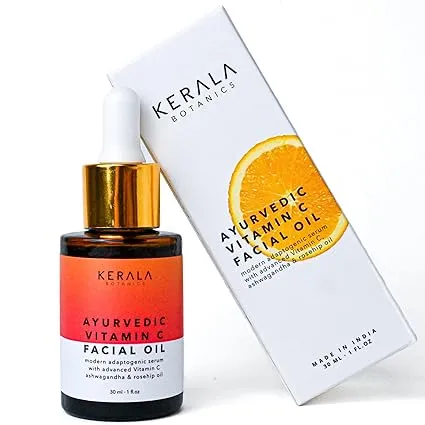
Ayurvedic Vitamin C Face Oil
Kerala Botanics
$49
★★★★☆
Retinol stays off the table the longest. If you do bring it back, start with the lowest possible concentration, on the least reactive nights of your cycle, buffered under your moisturizer. Skin cycling — alternating active and recovery nights — was essentially designed for this kind of careful reintroduction.
What to Look For (and Avoid) on Ingredient Labels
A few quick rules for reading labels when you have facial eczema:
Look for: ceramides (any type), colloidal oatmeal, glycerin, squalane, panthenol (vitamin B5), niacinamide, allantoin, urea (5–10% for face).
Avoid: fragrance (including “parfum”), essential oils, alcohol denat., witch hazel, glycolic acid, salicylic acid, benzoyl peroxide, retinol (during flare), sodium lauryl sulfate, and anything with “citrus” in the name.
Treat with caution: preservatives like MI (methylisothiazolinone) and MCI are common eczema triggers — check for these even in “sensitive skin” products.
Our guide on how to actually read a skincare ingredient label walks through placement, concentration, and the tricks brands use to bury ingredients low on a list.
Putting It All Together
The hardest part of managing facial eczema isn’t finding the right products. It’s accepting that your routine needs to be different from everyone else’s, and that “doing less” is not the same as giving up.
During a flare: one gentle cleanser, one ceramide-heavy moisturizer, one mineral sunscreen. Nothing else. Repeat until the skin settles.
During maintenance: keep the ceramide moisturizer, layer in colloidal oatmeal and urea for barrier and texture support, and reintroduce actives one at a time over months — not weeks.
Always: skip fragrance, skip alcohol-forward products, and resist the texture-fixing urge when your barrier is compromised. The roughness will resolve when the barrier heals. Exfoliating it will not speed that up.
If your skin isn’t responding after four to six weeks of a stripped-down routine, that’s the sign to see a dermatologist. Patch testing for contact allergens is genuinely useful for eczema-prone adults who can’t figure out why their skin reacts to “gentle” products. Sometimes the trigger isn’t an active — it’s something you’d never expect.
Your skin is doing its best with a structural disadvantage. The routine’s job is to stop getting in the way.