
Ingredients
Polyglutamic Acid vs Hyaluronic Acid: Is There a New Humectant King?
Polyglutamic acid is marketed as 4x more hydrating than hyaluronic acid. We check the actual evidence and tell you which humectant is worth your money.
Disclosure — This article may contain affiliate links. We earn a small commission at no extra cost to you when you purchase through our links. This supports our ability to create independent, evidence-based skincare content.
The skincare industry loves a successor narrative. Retinol had peptides. Vitamin C had niacinamide. Now hyaluronic acid — the reigning humectant for about two decades — has a challenger: polyglutamic acid, or PGA, showing up in serums marketed with claims like “4x more hydrating than hyaluronic acid.”
That number sounds impressive. It also sounds like marketing. So let’s look at what PGA actually is, what the evidence says, and whether “more hydrating” even means what those ads imply.
What Each Ingredient Actually Does
Before comparing them, it helps to understand the mechanism. Both are humectants — they attract and hold water molecules. But they do it differently, and that difference matters.
Hyaluronic Acid: The Established Standard
Hyaluronic acid (HA) is a glycosaminoglycan, a naturally occurring polymer found in your skin’s extracellular matrix. It’s genuinely impressive at holding water — up to 1,000 times its own weight, which is a figure you’ll see everywhere and is, for once, roughly accurate.
HA works by penetrating into the upper layers of the skin (how deep depends on molecular weight) and pulling water in from below and from the environment. The multi-weight formulas you’ll find in well-made serums — like Hada Labo’s Gokujyun line, which stacks three molecular weights — deliver both surface plumping and deeper hydration simultaneously.
One caveat worth knowing: in very low-humidity environments, HA can actually pull moisture out of your skin if there’s not enough ambient moisture to draw from. This is why layering a moisturizer or occlusant on top matters. If you want a deeper look at how this plays out in practice, our guide on dehydrated vs dry skin covers the distinction and how to build around it.

Hada Labo Gokujyun Premium Hyaluronic Acid Lotion
Hada Labo
$18
★★★★½
Polyglutamic Acid: What It Is and What It Does
PGA is a naturally derived polymer — a chain of glutamic acid amino acids — originally produced through bacterial fermentation of soybeans. You’ll find it in natto (fermented soybean), which is where some of the early interest in its skin-care potential came from.
The key structural difference: PGA molecules are significantly larger than high-molecular-weight HA. They don’t penetrate the skin. They sit on the surface and form a film that slows transepidermal water loss (TEWL) — essentially acting as a semi-occlusive layer that traps moisture already in your skin rather than actively drawing water in from elsewhere.
There’s also evidence that PGA inhibits hyaluronidase, the enzyme that breaks down HA in the skin. In theory, that means it could help your existing HA last longer. In theory.
The “4x More Hydrating” Claim: A Hype Check
This is the number you’ll see most often, and it deserves scrutiny.
The claim appears to trace back to a 2008 study published in the Journal of Cosmetic Dermatology, which found that PGA held more moisture than HA under specific in vitro (lab, not skin) conditions. A few important caveats: the study was small, conducted on isolated materials rather than formulated products on actual skin, and has not been meaningfully replicated in large-scale clinical trials.
What “holds more moisture in a petri dish” doesn’t automatically translate to “does more on your face.” The mechanisms are different enough that a direct comparison is somewhat misleading. PGA films moisture in. HA attracts moisture. Comparing them on raw water-holding capacity is like comparing a lid to a sponge.
The honest summary: the evidence that PGA is dramatically superior to HA in a real-world routine is thin. That doesn’t mean PGA doesn’t work. It means the marketing has significantly outrun the science, which is a pattern we see constantly in this industry. For more on how to read ingredient claims critically, our piece on how to read skincare ingredient labels is a good starting point.
What PGA Is Actually Good At
Here’s where it gets more useful. PGA’s film-forming behavior isn’t a consolation prize — it’s a legitimate mechanism with real benefits.
Surface smoothing. Because PGA sits on top of the skin rather than penetrating it, it creates an immediate smoothing effect that HA doesn’t replicate as well. Skin feels softer and looks more refined within minutes of application. This is mostly cosmetic, not structural — but “mostly cosmetic” still means you can see it in the mirror.
Slowing water loss. TEWL reduction is measurable and meaningful, especially for people with a compromised barrier. If your skin tends to lose moisture quickly — tight and flaky by afternoon despite moisturizing in the morning — a film-former like PGA can extend how long that hydration stays put. For context on barrier repair broadly, our damaged skin barrier repair guide covers this in more depth.
Working alongside HA. The most interesting application isn’t PGA vs. HA. It’s using both. PGA pulls fewer heads-I-win, tails-you-lose comparisons when you look at them as complementary. HA draws moisture in; PGA helps keep it there. Formulators are increasingly stacking them for this reason.
Tolerability. PGA has a gentle profile. No pH dependency (unlike L-ascorbic acid serums), no purging, no known irritation triggers. It’s a reasonable option for anyone working through a reactive skin period.
Where PGA Falls Short
The film-forming behavior that makes PGA good at surface smoothing also has a downside: it can interfere with the absorption of active ingredients layered on top. If you apply a PGA serum before a retinoid or vitamin C, you might be reducing how much of those actives actually reach the skin. Sequence matters here — PGA works better as a mid-layer or mixed into a moisturizer than as an immediate first step on bare skin.
PGA also has essentially no data behind it for long-term structural benefits — collagen stimulation, wrinkle depth reduction, barrier repair at a cellular level. It hydrates and films. That’s it. Managing expectations is part of using it well.
The third issue is cost-to-evidence ratio. Some PGA serums are priced as if they represent a meaningful clinical advance. The evidence doesn’t support premium pricing over a well-formulated HA product. If you’re spending $80+ on a PGA serum because you think it’s doing something HA fundamentally cannot, that money would probably work harder elsewhere.
Product Recommendations
For Hyaluronic Acid: The Budget Pick That’s Hard to Beat
The Hada Labo Gokujyun Premium Hyaluronic Acid Lotion is one of the most well-formulated multi-weight HA products available at any price. For $18, you’re getting a stacked formula that outperforms products at three times the cost. It’s not glamorous. It works.
If you want to spend more, SkinCeuticals’ Hyaluronic Acid Intensifier adds proxylane and licorice root, which nudges it toward a more functional serum — but you’re paying $108 for ingredients that, individually, have solid evidence and work well in combination.
SkinCeuticals Hyaluronic Acid Intensifier
SkinCeuticals
$108
★★★★½
For Polyglutamic Acid: The Honest Entry Point
The INKEY List Polyglutamic Acid Serum is $15 and does exactly what PGA does — no more, no less. It layers cleanly, applies easily, and doesn’t pretend to be something it isn’t. If you want to try PGA without paying a premium for the privilege, this is the right way to do it.
The INKEY List Polyglutamic Acid Serum
The INKEY List
$15
★★★★☆
For a Different Kind of Hydration Altogether
If the HA-vs-PGA debate leaves you cold, there’s a third path worth mentioning. Oil-based hydration works on a different principle — occlusion and lipid replenishment rather than water-attracting. The Kerala Botanics Ayurvedic Vitamin C Face Oil combines a stabilized vitamin C derivative (designed for better cellular retention than standard L-ascorbic acid) with bakuchiol, making it a multitasker that handles hydration, antioxidant protection, and a retinol-alternative in one step. The oil format means it seals in whatever humectant you’ve applied underneath — a genuine functional advantage if you run dry.
It’s not a humectant and shouldn’t replace one. But for anyone building a simplified routine who wants an elegant seal over their HA or PGA layer, it’s worth knowing about. The oil format won’t suit everyone, particularly those with oily or acne-prone skin, and it doesn’t have the clinical volume behind it that Skinceuticals’ lineup does. Our full Kerala Botanics Vitamin C Face Oil review covers the tradeoffs in more detail.
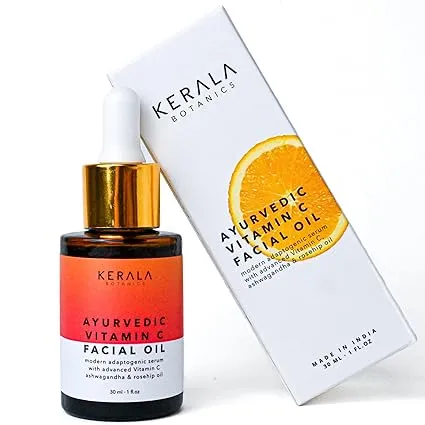
Ayurvedic Vitamin C Face Oil
Kerala Botanics
$49
★★★★☆
Head-to-Head: How They Stack Up
Here’s the practical comparison, stripped of marketing language.
| Hyaluronic Acid | Polyglutamic Acid | |
|---|---|---|
| Mechanism | Draws water into skin | Films and traps surface moisture |
| Penetration | Yes (molecular weight-dependent) | No — sits on skin surface |
| Evidence base | Extensive, decades of data | Limited, mostly in vitro |
| Irritation risk | Very low | Very low |
| Best use case | Core hydration in any routine | Surface smoothing, TEWL reduction |
| Works well with | Occlusants, actives | HA, moisturizers, as mid-layer |
| Cost range | $10–$108 | $15–$80+ |
| Verdict | Proven, essential | Useful addition, not a replacement |
How to Layer Them Correctly
If you want to use both — and there’s a reasonable case for it — sequence matters.
Apply your HA serum first, on damp skin. Let it absorb for 60 seconds. Then apply PGA. The HA draws moisture in; the PGA film helps hold it there. Follow with your moisturizer to reinforce the barrier layer. If you’re using any actives (retinoids, vitamin C, acids), those go before the humectants or in a separate routine window entirely — not after a PGA layer that will partially block absorption.
For a full breakdown of layering logic, our how to layer skincare guide walks through the underlying principles. The short version: thinnest to thickest, actives before humectants, occlusants last.
Putting It All Together
PGA is a real ingredient with real, measurable benefits. The film-forming mechanism is legitimate science, not nonsense. What it isn’t is a revolution, and the “4x more hydrating” claim doesn’t hold up to scrutiny when you look at how and where that number was generated.
Hyaluronic acid remains the better-studied, more versatile humectant. Multi-weight HA formulas are genuinely excellent, and the best ones cost less than most PGA serums. If your routine already has a solid HA product and your skin is consistently well-hydrated, you don’t need PGA.
Where PGA earns its place is in a specific scenario: skin that loses moisture quickly despite adequate humectant use, or as a smoothing layer when immediate texture refinement matters. Used together — HA to hydrate, PGA to retain — they’re more useful than either is alone.
No king has been dethroned. The chemistry just got more interesting.