
Ingredients
Kumkumadi Tailam vs Modern Vitamin C Oils: Which Brightens Better?
Saffron-and-sesame tradition vs stabilized oil-soluble vitamin C — we compare two very different approaches to brightening skin.
Disclosure — This article may contain affiliate links. We earn a small commission at no extra cost to you when you purchase through our links. This supports our ability to create independent, evidence-based skincare content.
Kumkumadi tailam has been around for roughly a thousand years. Modern oil-soluble vitamin C has been around for maybe twenty. Both are sold right now as brightening treatments, sometimes side by side on the same shelf. So the question is worth asking: are they doing the same thing, or are they just marketed to the same feeling?
The honest answer is: they work through entirely different mechanisms, they suit different people, and neither one universally wins. What follows is a clear breakdown of each — what the science actually says, where tradition holds up, and how to decide which belongs in your routine.
What Kumkumadi Tailam Actually Is
Kumkumadi tailam is a classical Ayurvedic formulation. The name translates roughly to “saffron oil,” and saffron (Crocus sativus) is the lead ingredient — but the full formula typically includes upward of fifteen botanicals: manjistha, lodhra, vetiver, licorice, sandalwood, and others, all suspended in a sesame oil base.
The traditional preparation method matters here. Authentic kumkumadi tailam is made by simmering the botanical ingredients in sesame oil over low heat for an extended period. This process, called murchana in Ayurvedic practice, is meant to transfer bioactive compounds from the herbs into the oil carrier. Whether every brand executing this today does it correctly is a separate conversation — and one worth having.
What the Ingredients Can Do
Saffron contains crocin and crocetin, compounds with demonstrated antioxidant and mild melanin-inhibiting properties. The research is thin but not nonexistent. Manjistha (Rubia cordifolia) has shown some activity against tyrosinase, the enzyme responsible for melanin synthesis — which is how most brightening actives work. Licorice root contains glabridin, which has real evidence behind it. (We covered glabridin in detail in our Licorice Root guide.)
The sesame oil base is meaningful too. It’s rich in linoleic acid, absorbs reasonably well, and has mild UV-filtering properties — not enough to replace sunscreen, not nothing either.
What It Can’t Promise
The challenge with multi-botanical formulations is standardization. You can’t know the concentration of active compounds without third-party testing, and most brands don’t publish that data. Efficacy varies significantly between a carefully prepared traditional tailam and a mass-produced “kumkumadi-inspired” oil with a few drops of saffron extract added for the label.
It also tends to work slowly. Traditional Ayurvedic medicine frames results in terms of weeks and months, not days. That’s not a flaw — it’s a different relationship with time. But it’s worth knowing before you start comparing it to a serum you expect to see results from in two weeks.
What Modern Vitamin C Face Oils Are Doing
Most vitamin C serums use L-ascorbic acid, which is water-soluble, notoriously unstable, and prone to oxidizing before you finish the bottle. Why vitamin C turns orange is a separate chemistry problem — but it’s a real one.
Oil-soluble vitamin C derivatives sidestep part of this. Forms like ascorbyl tetraisopalmitate (ATIP) and 3-O-ethyl ascorbic acid dissolve in oil carriers instead of water, which improves stability significantly. Once absorbed into skin, they’re converted to active L-ascorbic acid. The conversion step adds a layer of uncertainty — not all derivatives convert at the same rate or efficiency — but the shelf stability advantage is real. We went deeper on oil-soluble vs. water-soluble vitamin C if you want the full breakdown.
What the Evidence Supports
Vitamin C (in its active L-ascorbic acid form) has more clinical evidence behind it than almost any other skincare ingredient. It inhibits tyrosinase, neutralizes free radicals, and plays a direct role in collagen synthesis. The brightening evidence is solid. The anti-aging evidence is solid. The antioxidant evidence is solid.
The oil-soluble derivatives have less data than L-ascorbic acid directly — but more than most botanical alternatives. For oil-based formats specifically, ATIP performs well in stability testing and has reasonable conversion data.
The Format Advantage
Putting vitamin C in a face oil format does something interesting: it lets vitamin C double as a moisturizer step. For people running stripped-down routines, that’s genuinely useful. It also tends to sit better on drier skin than a water-based serum. If you’re already using a face oil as your final step, swapping it for a vitamin C oil means you’re not adding anything — you’re just upgrading what’s already there.
Side by Side: The Real Comparison
| Kumkumadi Tailam | Modern Vitamin C Oil | |
|---|---|---|
| Active mechanism | Multi-botanical, mild tyrosinase inhibition | Direct antioxidant + tyrosinase inhibition |
| Clinical evidence | Limited, ingredient-level only | Solid for L-ascorbic acid; moderate for derivatives |
| Stability | Generally stable (oil base, no ascorbic acid) | Derivative-dependent; better than water-based vitamin C |
| Speed of results | Slower (weeks to months) | Faster (4–12 weeks with consistent use) |
| Best for | Dry skin, ritual-oriented routines, mild maintenance | Active brightening, anti-aging, simplified routines |
| Fragrance/actives sensitivity | Higher risk (many botanicals) | Lower (fewer ingredients, typically) |
The comparison isn’t really “which one works” — it’s “which one is doing what you need.”
If you want measurable brightening, faster results, and something with clinical backing, a well-formulated vitamin C oil has the edge. If you value the sensory ritual, the botanical complexity, and a gentler multi-herb approach that addresses skin holistically, kumkumadi makes sense. These aren’t mutually exclusive goals, but they are different ones.
Who Should Choose Which
Choose kumkumadi if:
- Dry or very sensitive skin that reacts to actives
- You’re drawn to Ayurvedic skincare as a practice, not just a label
- Maintenance is the goal — not treating significant hyperpigmentation
- You like a slower, ritualistic approach
Choose a vitamin C oil if:
- Active brightening is the priority
- You’re dealing with post-inflammatory hyperpigmentation or uneven tone from sun exposure
- You want to consolidate steps (replacing serum + oil in one)
- You prefer formulas with more clinical backing
A note on combination: There’s no rule against using both. Some routines use a vitamin C oil in the morning (antioxidant protection, brightening) and kumkumadi at night (slower-acting botanical support). If that appeals to you, it’s a reasonable approach — just make sure you’re not adding products for the sake of adding them.
Products Worth Considering
A Traditional Kumkumadi
Kama Ayurveda’s version is one of the more carefully sourced mass-market options. It includes saffron, manjistha, and vetiver in a sesame oil base, and the brand is transparent about using traditional preparation methods. It won’t perform like a clinical serum. But as an evening ritual oil for dry or dull skin, it’s genuinely nice.
Kama Ayurveda Kumkumadi Miraculous Beauty Night Oil
Kama Ayurveda
$54
★★★★☆
A Modern Vitamin C Oil With an Ayurvedic Angle
Kerala Botanics’ Ayurvedic Vitamin C Face Oil sits at an interesting intersection of this comparison. It uses a stabilized, oil-soluble vitamin C form said to stay active in skin cells significantly longer than standard L-ascorbic acid — alongside bakuchiol, the plant-based retinol alternative we covered in detail in Bakuchiol vs. Retinol. The formulation is rooted in Ayurvedic tradition, but the vitamin C delivery is modern.
Full disclosure: Kerala Botanics doesn’t make a kumkumadi tailam. This is their stake in the comparison — a vitamin C oil, not a saffron-sesame blend. It’s worth naming that plainly.
What it does well: the oil-soluble vitamin C is stable, the bakuchiol addition makes it relevant for anyone looking at retinol alternatives (particularly during pregnancy), and the all-in-one format (replacing serum, moisturizer, and oil) suits simplified routines. What gives some people pause: the oil format isn’t ideal for oily or acne-prone skin, it can feel heavy under makeup, and the clinical data on its specific vitamin C form, while promising, is thinner than what exists for straight L-ascorbic acid.
At $49, it replaces at least two steps, which changes the value math considerably.
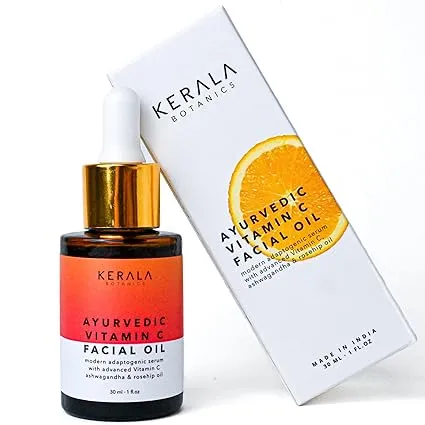
Ayurvedic Vitamin C Face Oil
Kerala Botanics
$49
★★★★☆
A Mainstream Vitamin C Oil
Sunday Riley’s C.E.O. Glow uses a combination of vitamin C and turmeric in a squalane-forward base. It’s lighter than many oils, absorbs quickly, and sits comfortably under SPF. It won’t replace a serum for someone doing serious brightening work, but as a morning glow addition, it punches reasonably well. Packaging has improved — previous versions oxidized faster than they should have at this price. We looked at it more closely in our C.E.O. Glow review.
C.E.O. Glow Vitamin C + Turmeric Face Oil
Sunday Riley
$44
★★★★☆
A Note on “Authentic” Kumkumadi
The market is flooded. Traditional kumkumadi tailam was formulated with specific sourcing requirements — Kashmir saffron, wild-harvested manjistha — that don’t survive mass production. Many products using the name are botanical oils with a few standardized extracts and nothing approaching the original formulation.
If the tradition matters to you, it’s worth researching brands that publish their sourcing and preparation methods. The Modern Ayurvedic Skincare guide goes into more detail on how to tell the difference between genuine Ayurvedic formulation and marketing that’s borrowed the vocabulary.
Putting It Together
Kumkumadi tailam and modern vitamin C oils are both oils, and they both target brightness. That’s roughly where the similarity ends.
Kumkumadi works through a coalition of mild botanical actives in a nourishing base. The results are real but gradual, and the ritual itself is part of the value. Vitamin C oils work through a single, well-evidenced mechanism with a stronger clinical track record and more predictable results.
Neither is universally better. The right choice depends on what your skin actually needs and what kind of relationship you want with your routine.
If you’re treating active pigmentation, go with a well-formulated vitamin C oil and be consistent. If you’re in maintenance mode with dry, dull skin and want something that feels like more than a transaction, kumkumadi is worth exploring — just buy from a brand that takes the sourcing seriously.
And if you’re looking for something that bridges both worlds — an oil-based format with modern vitamin C delivery and Ayurvedic roots — that middle ground exists. It’s just worth going in with clear expectations about what each approach can and can’t do.