
Routines
Seborrheic Dermatitis on the Face: A Treatment Guide
Flaky, red nasal folds that won't quit? Learn how to treat facial seborrheic dermatitis with antifungals, the right moisturizer, and a calmer routine.
Disclosure — This article may contain affiliate links. We earn a small commission at no extra cost to you when you purchase through our links. This supports our ability to create independent, evidence-based skincare content.
Seborrheic dermatitis on the face is one of the more frustrating skin conditions to manage — not because it’s rare, but because most people mistake it for dry skin or rosacea and treat it with the wrong things. Rich moisturizers. More oils. Sometimes more exfoliation. All of which can make it significantly worse.
This guide covers the facial presentation specifically: the red, flaky patches around the nasal folds, eyebrows, and sometimes the hairline that don’t respond to anything you’d normally reach for. We’ll get into what’s actually causing it, which ingredients help, which ones feed the problem, and how to build a routine that doesn’t fight itself.
What Seborrheic Dermatitis Actually Is
Seborrheic dermatitis is a chronic inflammatory skin condition driven by an overgrowth of Malassezia — a genus of yeast that lives on virtually everyone’s skin. The problem isn’t the yeast itself. It’s how certain skin types react to the fatty acids Malassezia produces when it metabolizes sebum. That reaction triggers inflammation, accelerated skin cell turnover, and the characteristic flaking.
On the face, it shows up most predictably in sebaceous-gland-rich zones: the sides of the nose, the eyebrows, the area between the nose and upper lip, and sometimes the ears or forehead. The skin looks red and slightly greasy even as it flakes. That combination — oily AND flaky — is the tell.
It’s also worth being clear about what it isn’t. Seborrheic dermatitis is not the same as fungal acne, though both involve Malassezia. The fungal acne guide covers the follicular presentation — small, uniform bumps that look like acne but don’t respond to acne treatments. Seborrheic dermatitis presents differently: it’s a surface inflammation, not a clogged follicle.
It’s not eczema, either, although the two can overlap. And it’s not rosacea, though red nasal folds get misread as flushing constantly. The distinction matters because the treatments are quite different.
Why Your Moisturizer Might Be Making It Worse
This is where most routines go wrong.
Malassezia is lipophilic — it thrives on fats. Specifically, it metabolizes fatty acids with carbon chain lengths between C11 and C24. Many common moisturizer ingredients fall right in that range. Oils like olive, coconut, and avocado are particularly problematic. Oleic-acid-heavy formulas feed the yeast and accelerate the inflammatory cycle.
This is also why a nourishing face oil that works beautifully for most people can cause a flare in someone with seborrheic dermatitis. It’s not that oils are inherently bad — it’s that the wrong fatty acid profile directly feeds the organism driving the problem. The linoleic vs. oleic guide goes deeper on this if the chemistry is useful.
Occlusive products present a similar issue. Petrolatum is generally considered safe for Malassezia — it doesn’t metabolize it — but thick, emollient-rich formulas that trap heat and sebum can still worsen the environment for overgrowth.
The practical takeaway: moisturize, yes, but reach for simple, lightweight, fragrance-free formulas rather than anything rich, botanical, or oil-forward.
The Treatment Approach
Seborrheic dermatitis is managed, not cured. Flares come back — usually triggered by stress, seasonal changes, hormonal shifts, or humidity. The goal is to control Malassezia during a flare and maintain a calm environment between them.
Antifungal First
The first-line treatment isn’t a serum or a fancy moisturizer. It’s an antifungal.
For the face, the most accessible option is ketoconazole 1% shampoo — the same product used for scalp dandruff. Nizoral A-D is the common over-the-counter version. The approach: apply a small amount to the affected areas, leave it on for two to five minutes, then rinse. Do this two to three times per week during a flare. It’s not glamorous, but it directly addresses the Malassezia overgrowth rather than just soothing the symptoms.
Nizoral A-D Anti-Dandruff Shampoo
Nizoral
$17
★★★★½
Selenium sulfide 1% (Selsun Blue) is the other option. It works by a different mechanism — slowing skin cell turnover and reducing the Malassezia load simultaneously. Same application method. Some people find it slightly more irritating on facial skin, so start less frequently and see how it lands.
Selsun Blue Moisturizing Dandruff Shampoo
Selsun Blue
$9
★★★★☆
If over-the-counter antifungals aren’t making a dent after four to six weeks, that’s a dermatologist conversation. Prescription ketoconazole 2% cream, ciclopirox, or in stubborn cases, a short course of oral fluconazole are all options. Topical steroids are sometimes prescribed for the inflammatory component — they work fast, but they’re not a long-term solution and can cause rebound flares. A derm can help calibrate that.
Cleanse Simply
During a flare, the cleanser needs to do very little. Remove surface debris, rinse clean, and not disturb the skin barrier further. Fragrance-free, gentle, no actives. If a cleanser has AHAs, BHAs, or strong surfactants in it, set it aside temporarily.
A mild syndet bar or a fragrance-free gel cleanser is usually the right format. The face should not feel tight after washing. If it does, the cleanser is adding to the problem rather than solving it.
Moisturize, But Simply
Moisturizer is still necessary — inflamed, flaking skin needs hydration support. The key is choosing formulas that don’t feed Malassezia. That means avoiding products with plant oils high in oleic acid, heavy emollients, and anything with a long list of botanical extracts.
Safe options are simple and short-ingredient-listed. Vanicream Moisturizing Skin Cream is a reliable choice — no fragrance, no botanical oils, no irritants. It won’t feed the yeast and it won’t irritate already-inflamed skin.
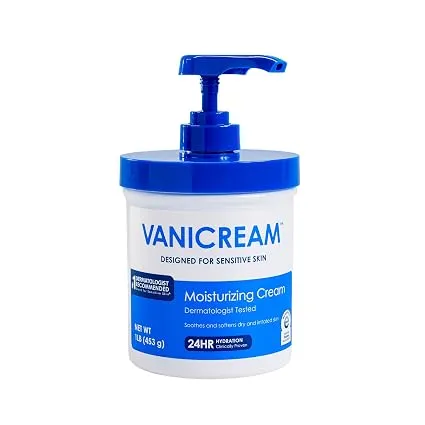
Vanicream Moisturizing Skin Cream
Vanicream
$14
★★★★½
La Roche-Posay Cicaplast Baume B5 is another option that works well for the facial presentation. It’s not oil-heavy, it has madecassoside and panthenol for barrier support, and the formula sits flat without feeling occlusive. Some people with seborrheic dermatitis find it calms redness between antifungal applications.

La Roche-Posay Cicaplast Baume B5
La Roche-Posay
$20
★★★★½
What to Pause During a Flare
This is equally important as what to use.
Vitamin C serums. Most are acidic and can irritate already-inflamed skin. Some oil-based formats contain fatty acids that may feed Malassezia. This isn’t a permanent ban — once the skin is stable, reintroducing vitamin C is fine. Just not mid-flare.
Retinoids. They accelerate cell turnover, which is the opposite of what irritated skin needs right now. If tretinoin or retinol is part of the regular routine, pause it until the flare resolves. The skin barrier burnout guide covers the broader principle here.
Exfoliants. AHAs, BHAs, PHAs — set them all aside. The skin is already turning over faster than it should. Adding exfoliation on top of that compounds the irritation. Once stable, salicylic acid can actually be helpful at low concentrations, since it’s both an exfoliant and has some antifungal properties. But that’s maintenance, not flare management.
Facial oils. Worth repeating. Even “clean” or “natural” oils that are beloved in other contexts are likely to make things worse here. Rosehip, jojoba (technically a wax ester, slightly safer, but still proceed cautiously), argan — all are high in fatty acids that Malassezia metabolizes readily.
If the routine is currently oil-forward, this is a meaningful shift. For context on why simplified, non-oil-based routines can be useful for certain skin conditions, the minimalist 3-step routine is worth a read.
Managing Between Flares
The pattern with seborrheic dermatitis is flares and remissions. The goal between flares is to slow the next one down, not eliminate every possible risk factor.
A few things that help:
- Maintenance antifungal use. Once the active flare resolves, dropping to once-weekly ketoconazole shampoo application can extend the remission. Some people go years between significant flares doing this.
- Keeping stress low. This is real, not generic advice. Cortisol affects sebum production and immune response in the skin. The connection between stress and seborrheic dermatitis flares is well-documented. The stress-skin axis article is relevant here.
- Watching for triggers. Common ones are humidity changes, winter dry air (heating systems especially — relevant reading here), heavy sunscreen formulas with fatty bases, and new products introduced too quickly.
- Simple sunscreen. SPF daily, but choose carefully. Mineral-only formulas tend to sit better on seborrheic dermatitis-prone skin than chemical options, which sometimes contain emollients that aggravate. A lightweight mineral SPF applied thinly is usually fine.
A Note on What This Isn’t
Seborrheic dermatitis on the face is sometimes mistaken for rosacea — both present as redness in the central face. The treatment overlap is partial. The rosacea-friendly routine is worth reading if redness is the primary complaint and the flaking pattern doesn’t match what’s described above. A dermatologist can distinguish between the two with a straightforward exam.
It’s also worth knowing that the two conditions can coexist. Seborrheic dermatitis doesn’t prevent rosacea, and managing one doesn’t automatically address the other.
Putting It Together
Seborrheic dermatitis on the face responds to antifungals. Everything else — the skincare routine, the moisturizer choice, the actives schedule — is supporting that primary intervention.
During a flare:
- Ketoconazole 1% shampoo two to three times weekly, left on for several minutes before rinsing
- A simple, fragrance-free, oil-free moisturizer applied after
- No actives, no oils, no exfoliants
Between flares:
- Drop antifungal use to once weekly as maintenance
- Reintroduce actives slowly once the skin is stable
- Keep the moisturizer simple even when skin feels calm
- Watch for early signs of a new flare and respond quickly rather than waiting
Most people with seborrheic dermatitis find that once they understand the Malassezia connection, the condition becomes much more manageable. It stops being a mystery about why the “nourishing” routine isn’t working — because the answer is that nourishing, in this case, was feeding the problem.