
Anti-Aging
'Ozempic Face': Skincare for GLP-1 Weight-Loss Facial Changes
GLP-1 drugs can change your face fast. Here's what's actually happening, what skincare can help, and what it genuinely cannot fix.
Disclosure — This article may contain affiliate links. We earn a small commission at no extra cost to you when you purchase through our links. This supports our ability to create independent, evidence-based skincare content.
The nickname is a little ungenerous, but the phenomenon is real. People on GLP-1 medications — semaglutide, tirzepatide, and their relatives — are losing weight faster than the skin can adapt. The face shows it first.
This isn’t a vanity complaint. It’s a structural biology question. Fat pads in the face aren’t just filler — they’re scaffolding. Lose them quickly and the skin above them has nowhere to go. The result is hollowing under the eyes, softening of the jawline, and a kind of looseness that reads as older rather than leaner.
Here’s what skincare can actually do about it, and where it runs out of road.
What’s Actually Happening to the Skin
The Role of Facial Fat
The face ages in three dimensions. We talk about collagen and elastin — the stuff in the skin itself — but there’s a third factor that doesn’t get enough attention: subcutaneous fat. Specifically, the discrete fat compartments that sit beneath the skin and give the midface its lift, the under-eye its fullness, the temples their roundness.
GLP-1 medications accelerate fat loss systemically. The face isn’t exempt. And because the loss can happen over months rather than years, the skin above doesn’t have time to contract along with the tissue underneath it.
The technical term is cutaneous redundancy — more skin than structure beneath it. Most people experience this as deepening nasolabial folds, a flattened cheek, hollowing around the orbital area, and a general deflation that SPF and serums weren’t designed to address.
The Collagen Problem
Rapid weight loss also has a secondary effect on skin quality itself. Extended caloric restriction and significant metabolic changes can affect collagen synthesis. There’s also the simple math of skin stretch: skin that was held taut by volume — even modest volume — will show its structural age once that volume goes.
This is why “Ozempic face” often looks like accelerated aging rather than just thinness. It’s not just laxity. It’s the combination of laxity, hollowing, and the unmasking of sun damage and fine lines that volume was quietly softening before.
What Skincare Can (and Cannot) Do
Let’s be honest about the ceiling here. No serum replaces lost fat. No cream re-inflates a deflated cheek. The procedures that actually address volume loss — filler, biostimulators like Sculptra, radiofrequency treatments, ultrasound devices — work at a structural level that topicals simply can’t reach.
That said, skincare is not useless here. It works on a different layer of the problem.
What it can do:
- Support collagen synthesis and slow the structural thinning of the dermis
- Improve skin surface quality — texture, brightness, elasticity at the epidermal level
- Strengthen the barrier so skin looks and behaves more resilient
- Reduce the appearance of fine lines that become more visible when volume recedes
What it cannot do:
- Restore lost fat volume
- Reverse significant skin laxity
- Replace the lifting effect of structural treatments
Work with that honestly and the routine becomes clearer.
Building a Routine Around the Real Problem
Lead With Retinoids
If there’s one category that earns its place here, it’s retinoids. They remain the most evidence-backed topical for stimulating collagen production and improving skin thickness over time. When volume loss has revealed the structural age of skin, this is where to start.
The practical approach: consistency over strength. A mid-strength retinaldehyde used three to four nights a week will do more than a high-strength formula applied erratically because of irritation. Start lower, build tolerance, don’t rush it.
Medik8’s Crystal Retinal 6 sits at a useful middle point — retinaldehyde converts to retinoic acid in the skin faster than retinol, with less irritation than prescription tretinoin. For anyone just starting, the tretinoin for beginners guide is worth reading before deciding how far to push it.
Medik8 Crystal Retinal 6
Medik8
$65
★★★★½
Peptides for Structural Support
Peptides work differently from retinoids — they signal the skin to produce collagen rather than forcing the turnover process. The evidence is less dramatic than retinoids, but they’re easy to layer, generally well-tolerated, and genuinely useful when the goal is skin firmness over time.
For someone managing skin that’s responding to significant structural change, the combination of retinoids and peptides covers the main topical bases. The best peptide serums for 2026 breaks down the specific signal sequences worth paying attention to.
The Ordinary’s Multi-Peptide + HA Serum is the practical entry point. It covers multiple collagen-signaling peptides at a price that makes daily use realistic.
Multi-Peptide + HA Serum
The Ordinary
$18
★★★★☆
Vitamin C for Collagen Synthesis and Brightness
Vitamin C does two things relevant here. First, it’s a required cofactor for collagen synthesis — without adequate vitamin C at the skin level, the collagen-building process is compromised. Second, as volume recedes and sun damage becomes more visible, a good vitamin C serum genuinely helps with surface clarity.
The catch is stability. Most L-ascorbic acid serums oxidize within weeks of opening. Why vitamin C oxidizes explains what’s actually happening chemically. The short version: look for formulas with low pH and antioxidant co-factors, and replace them when they turn orange.
SkinCeuticals C E Ferulic is the clinical standard — the ferulic acid stabilizes the vitamin C and enhances its photoprotective effect. It’s expensive, and if the price is a barrier, the best alternatives to C E Ferulic covers what comes close.
C E Ferulic
SkinCeuticals
$185
★★★★½
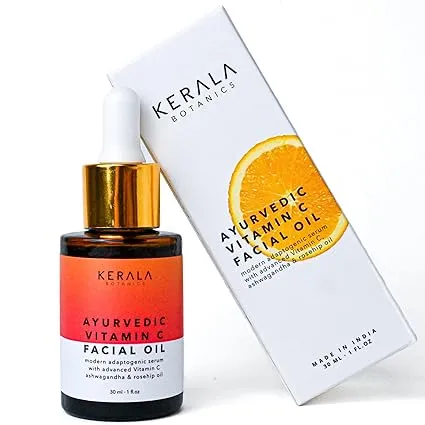
For anyone interested in an oil-based vitamin C with a different approach, the Kerala Botanics Ayurvedic Vitamin C Face Oil combines a stabilized, oil-soluble vitamin C form with bakuchiol — a plant-based retinol alternative that can work on the same collagen-support pathway through a gentler mechanism. The oil format means it doubles as a moisturizer, which simplifies the routine. It won’t replace a clinical-strength serum for someone with significant concerns, and the oil texture isn’t for everyone, but as a multitasker for a streamlined routine it’s worth considering. The full breakdown is in the vitamin C serum vs oil guide.
Ayurvedic Vitamin C Face Oil
Kerala Botanics
$49
★★★★☆
Barrier and Hydration — Don’t Skip This
Here’s where people underinvest. When skin is under structural stress — from laxity, from the mechanical effects of fat redistribution, from any topical actives being used to address it — a compromised barrier makes everything worse. Dry, reactive skin looks older and more crepey than the same skin, hydrated and intact.
Ceramides are the priority. They’re the lipids that hold the barrier together, and they decline with age and with certain medication side effects. A ceramide-rich moisturizer used consistently does more for skin appearance than a lot of the serum-stacking that tends to happen in this category. The ceramides explained guide goes deeper on why.
CeraVe Moisturizing Cream is the baseline recommendation here. There’s no reason to spend more unless there’s a specific reason to.
Moisturizing Cream
CeraVe
$20
★★★★½
The Sunscreen Note
Volume loss reveals sun damage. The hollowing and deflation of rapid weight loss tends to make existing pigmentation, surface texture, and fine lines more visible — because the slight plumpness that was softening them is gone. This makes sun protection more important, not less.
Daily SPF 30 minimum, every day, full stop. If you’re already doing this, the how much sunscreen to apply guide is worth checking — most people are applying about half what they need.
The Conversation Worth Having With a Dermatologist
Skincare is maintenance and support. For actual volume replacement and significant laxity, the conversation shifts to aesthetics procedures. This isn’t a failure of skincare — it’s just an honest acknowledgment of what tissue loss requires.
The procedures most relevant to GLP-1-related facial changes:
Biostimulators (Sculptra, Radiesse): Stimulate the body’s own collagen production over time. Work slowly but create durable, natural-looking volume. Different from filler — these don’t inject volume directly; they trigger the skin to rebuild it.
Hyaluronic acid fillers: Restore volume more immediately to specific areas — under-eye hollowing, cheek deflation, nasolabial folds. Results depend heavily on the injector, but the technology is mature and reversible.
Energy-based devices (radiofrequency, ultrasound): Target skin laxity specifically by heating the dermis and stimulating collagen remodeling. Particularly useful for jawline and neck laxity. Worth exploring alongside the menopause skincare guide for anyone dealing with hormonal changes alongside GLP-1 weight loss, since the skin challenges overlap significantly.
None of these replace each other, and most people doing well with them are combining a good topical routine with one or more of the above. The skincare does the ongoing maintenance work. The procedures address the structural deficit that skincare can’t.
A Note on Timing
One thing that matters and rarely gets mentioned: timing within the GLP-1 process. Starting a collagen-support routine after weight has stabilized is more effective than starting during active, rapid loss — because the skin is still adapting while the loss is ongoing. Beginning early is still better than not beginning, but expectations should be calibrated accordingly.
The same logic applies to procedures. Most aesthetic practitioners recommend waiting until weight has been stable for several months before doing filler or biostimulators, because continued volume loss will shift the results.
Putting It Together
The core routine for GLP-1-related facial changes:
- Morning: Vitamin C serum or oil, moisturizer with ceramides, SPF 30+
- Evening: Retinoid (three to four nights per week), peptide serum on the other nights, moisturizer with ceramides
That’s it. The temptation is to add more — eye creams, firming serums, tools — but the fundamentals above, done consistently, will outperform a complicated routine done inconsistently. The skin longevity guide makes this case in more depth.
Skincare addresses the surface. It keeps the skin strong, supports its own collagen production, and makes the best of what’s there. For someone navigating significant facial changes from GLP-1 medications, that’s genuinely useful. It’s just not the whole picture.
If the changes are significant and affecting quality of life, a consultation with a board-certified dermatologist or plastic surgeon is the right next step. The skincare keeps working in the background either way.