
Anti-Aging
Perimenopause and Menopause Skincare: Estrogen, Collagen, and the Neck
How falling estrogen reshapes your skin — and the gentle, effective routine that actually responds to what's happening hormonally.
Disclosure — This article may contain affiliate links. We earn a small commission at no extra cost to you when you purchase through our links. This supports our ability to create independent, evidence-based skincare content.
The conversation around menopause skincare tends to go one of two ways. Either it’s vague reassurance — “your skin changes, moisturize more” — or it’s an aggressive push toward prescription-strength everything. Neither is particularly useful.
What’s actually happening is specific. Estrogen decline triggers a measurable drop in collagen production, barrier function weakens, and the skin on the face, neck, and décolleté starts behaving differently than it did in your 30s. Understanding the mechanism makes the solution obvious. You don’t need a 10-step routine. You need a few targeted ingredients, applied consistently, with some attention paid to areas that most skincare guides ignore entirely.
This is that guide.
What Estrogen Actually Does for Skin
Estrogen isn’t just a reproductive hormone. It plays an active role in skin structure, hydration, and healing. When levels start declining — in perimenopause, which can begin in the early 40s — the skin feels it almost immediately.
Three things happen in parallel:
- Collagen production slows significantly. Studies suggest women lose roughly 30% of skin collagen in the first five years after menopause. The loss continues, though more gradually, for decades after. Collagen is what gives skin its structure and resistance to gravity. Less of it means thinner skin, more visible lines, and that characteristic loosening around the jaw and neck.
- The skin barrier becomes less efficient. Estrogen supports ceramide synthesis and skin lipid production. As levels drop, the barrier loses some of its ability to hold water. The result is skin that feels dry even when you’re drinking enough water, and that reacts more easily to things it tolerated before.
- Wound healing slows. This is less talked about, but relevant: skin in perimenopause and beyond takes longer to recover from irritation, sun exposure, and aggressive treatments. The tolerance for strong actives often drops even if it was high before.
None of this is catastrophic. It’s biology, and it responds well to the right approach.
The Neck Problem Nobody Talks About
Open almost any skincare guide and you’ll find detailed instructions for the face. The neck gets a footnote, if that. But the neck is often where hormonal aging shows up first and most clearly.
The skin on the neck is thinner than facial skin, has fewer oil glands, and loses elasticity faster when collagen declines. It also receives less product, less SPF attention, and less treatment than the face — because most routines stop at the chin. The result is a visible disconnect: a face that looks relatively well-maintained and a neck that tells a different story.
The fix isn’t complicated. Extend every step downward. Cleanser, serum, moisturizer, sunscreen — all of it goes to the neck and onto the upper chest. The one adjustment worth noting: the neck’s skin is thin and can be more reactive, so if you’re introducing a retinoid or an acid, start with a lower concentration there than you’d use on your face, or apply it every other day initially.
The collagen work matters here too. Peptides, vitamin C, and retinoids all support collagen synthesis. Using them only on the face and stopping at the jawline is leaving the most visibly aging area untreated.
The Routine Framework: What Changes, What Stays the Same
A lot of the foundational skincare advice doesn’t change at menopause. Cleanse gently, use SPF every day, don’t skip moisturizer. The adjustments are in the actives and the texture of what you’re reaching for.
Cleansing
If a cleanser felt fine in your 30s but now leaves your face tight or reactive, this is the first thing to revisit. A barrier that’s less robust needs a gentler cleanser — lower pH, no sulfates, no fragrance. Cream or oil-based formulas are often better tolerated now than foaming ones. The double cleansing method remains valid if you wear SPF or makeup, but the second cleanse should be genuinely mild.
Moisturizer: Heavier, Richer, More Often
The shift toward drier skin in perimenopause usually calls for a heavier moisturizer than you used before. Ceramides are especially relevant here — they’re the lipids that hold the skin barrier together, and their production declines alongside estrogen. A ceramide-rich moisturizer helps compensate directly.
CeraVe Moisturizing Cream is the obvious starting point. It’s not glamorous, but the formulation is genuinely solid — ceramides, hyaluronic acid, and a texture that works under makeup or as a night cream. At $19 for a tub that lasts months, the barrier repair argument is hard to dispute.
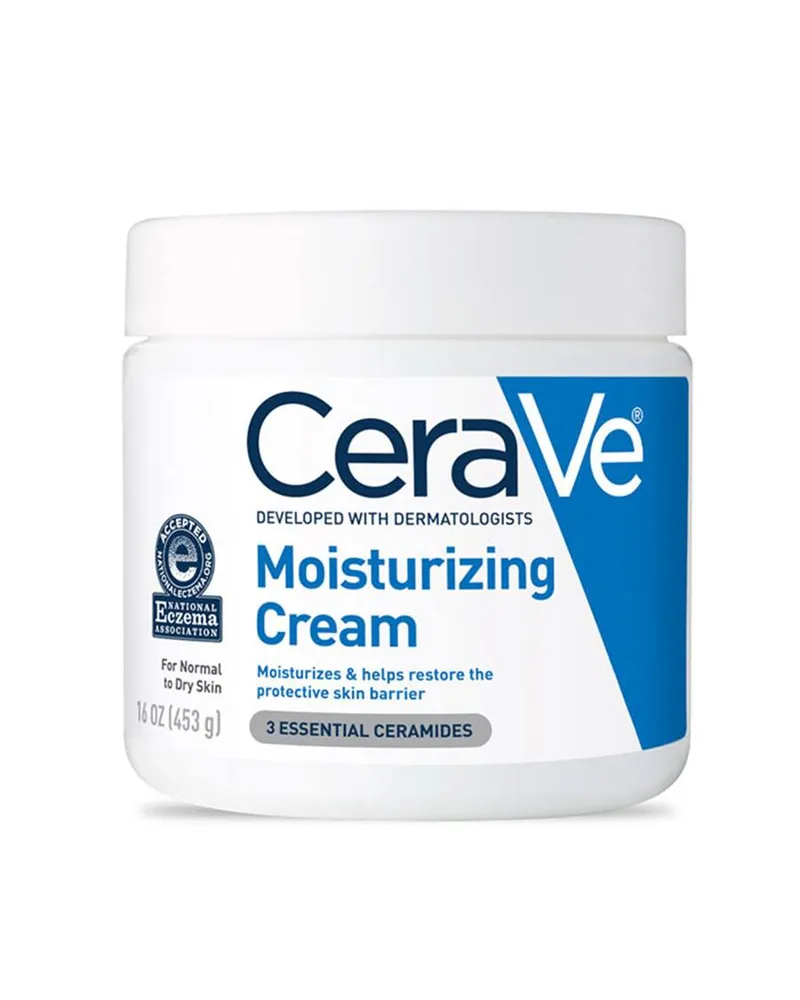
CeraVe Moisturizing Cream
CeraVe
$19
★★★★½
For a step up in texture and ingredients, The INKEY List Peptide Moisturizer layers in signal peptides alongside barrier-supporting humectants. Peptides deserve more attention in menopausal skincare than they typically get — they send collagen-stimulating signals to fibroblasts, the cells responsible for producing new collagen. They’re not as dramatic as retinoids, but they’re also not irritating, which matters when the barrier is compromised.
Peptide Moisturizer
The INKEY List
$16
★★★★☆
The Collagen Actives: What to Use
Three ingredients have real evidence behind them for collagen support in post-estrogen skin:
Retinoids. Still the most well-studied option. They stimulate fibroblast activity, increase cell turnover, and have the longest track record of any topical for structural skin improvement. The catch during menopause is that skin is often more reactive than before, so starting gently matters more than it did in your 30s. Retinaldehyde (retinal) sits between retinol and tretinoin in potency — effective enough to do real work, gentle enough that most people adjust without significant purging or peeling. Medik8’s Crystal Retinal line is formulated specifically to minimize irritation, and the encapsulated retinaldehyde releases slowly on skin. See our retinol vs. retinaldehyde vs. tretinoin breakdown if you’re deciding between formats.
Crystal Retinal 3
Medik8
$58
★★★★½
Vitamin C. Collagen synthesis requires vitamin C — the skin can’t produce collagen without it. Topical vitamin C also neutralizes the free radical damage that degrades existing collagen, and it addresses the uneven pigmentation (often called age spots or sun damage) that frequently appears during this period. The challenge with L-ascorbic acid serums is stability — they oxidize quickly. If you’re finding your serum turns orange before you finish it, here’s why that happens and what to do about it.
Bakuchiol. The plant-based retinol alternative has a growing body of evidence showing it improves fine lines and firmness through a different pathway than retinoids. It’s not a substitute for tretinoin in clinical terms, but it’s genuinely effective and notably well tolerated — relevant when reactivity is a concern. For a deeper look at how it compares, the bakuchiol vs. retinol guide covers the evidence without the hype.
A Note on Oil-Based Formulas
Skin in perimenopause and menopause often responds better to richer, oil-containing formats than it did before. Serums that worked well in your 30s — lightweight, water-based, fast-absorbing — can feel insufficient now. The barrier needs more.
This is one context where facial oils make practical sense rather than being an indulgence. And some formulations do double duty: Kerala Botanics’ Ayurvedic Vitamin C Face Oil combines an advanced, oil-stable vitamin C derivative (formulated to stay active in skin cells significantly longer than standard L-ascorbic acid) with bakuchiol, making it one of the few products that addresses both collagen support angles simultaneously. It’s rooted in Ayurvedic formulation traditions, which means it draws on plant botanicals alongside the active ingredients — ashwagandha is in the formula, which has its own emerging evidence for skin barrier support. We’ve covered what topical ashwagandha actually does separately.
The format works well for drier, thinner menopausal skin. It won’t suit everyone — oily skin types may find it too heavy, and it can feel rich under makeup if you don’t give it time to absorb. But for someone who wants to consolidate their vitamin C serum, facial oil, and part of their moisturizer step into one thing, the math is reasonable. $49 for a product that replaces two or three is genuinely good value.
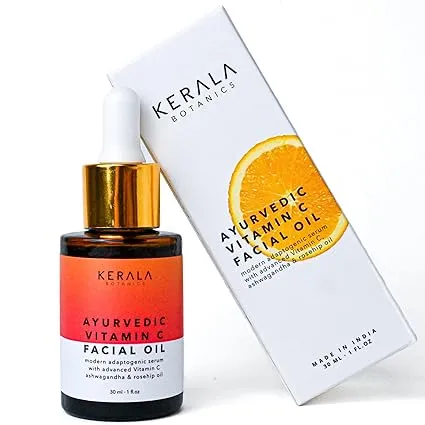
Ayurvedic Vitamin C Face Oil
Kerala Botanics
$49
★★★★☆
SPF: The Single Highest-Return Step
This stays true at every age, but it becomes especially pointed during and after menopause. The collagen you have left is worth protecting. UV exposure is the primary driver of extrinsic aging — it degrades existing collagen directly, causes the fragmented, disordered collagen that characterizes photoaged skin, and accelerates every other sign of aging.
Daily SPF is not optional in an anti-aging routine. It’s foundational. Everything else — the retinoids, the vitamin C, the peptides — is undermined without it.
EltaMD UV Clear is a reliable choice for skin that’s become more reactive. The formula is fragrance-free, niacinamide-containing, and sits comfortably under makeup. It doesn’t feel heavy. For skin that’s both more sensitive and more prone to hyperpigmentation (a common combination in this period), the niacinamide inclusion is useful. Full EltaMD UV Clear review here.
UV Clear Broad-Spectrum SPF 46
EltaMD
$39
★★★★½
What to Scale Back
More is not more during this period. The instinct to add things — more actives, more exfoliation, more targeted treatments — often makes things worse when the barrier is less resilient.
A few things worth reconsidering:
- Daily exfoliation. If you’ve been using a glycolic acid toner or a strong AHA every night, this is the moment to pull back to two or three times a week. The barrier needs recovery time between acid exposures. Signs you’ve overdone it are worth reading if your skin has been persistently irritated.
- High-concentration L-ascorbic acid. The 20–25% vitamin C serums that some people tolerate in their 30s often become sensitizing later. Lower concentrations (10–15%) or oil-stable forms are often more appropriate.
- Stacking multiple actives on the same night. Retinoid nights should be retinoid nights. Adding a vitamin C serum, an exfoliating acid, and a strong niacinamide on top creates more irritation risk than benefit. How to layer skincare covers the logic in detail.
The goal is a routine with fewer moving parts that you can actually sustain — not a triage operation for permanent irritation.
Hyperpigmentation and Uneven Tone
Sun damage from decades of UV exposure often becomes more visible during and after menopause, for two reasons: the skin is thinner and less able to manage melanin distribution, and hormonal shifts can trigger new melasma or worsen existing pigmentation. The vitamin C and SPF work covered above addresses this directly — it’s not a separate problem requiring a separate routine.
If hyperpigmentation is a primary concern, niacinamide is worth adding to the stack. It’s anti-inflammatory, supports ceramide production, and inhibits the transfer of melanin to skin cells without the irritation risk of stronger brightening actives. The complete niacinamide guide covers the evidence and the right concentrations.
For persistent melasma specifically, the picture is more complex — topical care alone often isn’t enough, and hormonal birth control can make it worse. The melasma treatment guide is the right starting point.
Putting It Together
The routine that makes sense for most people navigating perimenopause or menopause is simpler than the internet makes it look.
Morning: Gentle cleanser. Vitamin C (serum or oil-based, depending on your skin type and preference). Ceramide-heavy moisturizer if your skin is dry. SPF every day, including to the neck and upper chest.
Evening: Same gentle cleanser. Retinoid two to four nights per week, starting with a lower concentration and increasing slowly. On non-retinoid nights, a peptide moisturizer or a rich oil. Always include the neck.
What changes from a standard anti-aging routine: richer textures, gentler retinoids, more attention to the neck, and fewer actives stacked on top of each other at once.
What stays the same: the commitment to consistency over complexity. Skin in this period responds to steady, gentle signals better than it does to aggressive intervention. The collagen support work takes months to show up. The barrier repair happens faster. Both are worth doing.
The goal isn’t to fight what’s happening. It’s to give the skin what it needs to work as well as it can.
For more on building a sustainable anti-aging routine, see our complete evening skincare routine guide and our best peptide serums of 2026.