
Ingredients
Do Multi-Botanical Formulas Beat Single Actives?
Synergistic blends vs. single actives: we weigh the Ayurvedic case for polyherbal formulas against the real risk of underdosed ingredients.
Disclosure — This article may contain affiliate links. We earn a small commission at no extra cost to you when you purchase through our links. This supports our ability to create independent, evidence-based skincare content.
The debate sounds simple: one thing at one concentration versus many things at smaller amounts. But it’s not really a debate about ingredients. It’s a debate about philosophy — and both sides have a point.
Single-active formulas are built on the logic of pharmaceutical skin science: isolate the compound, dose it correctly, measure the outcome. Multi-botanical formulas draw from a much older tradition: that plants rarely work alone, and that the combination of compounds — including ones we haven’t fully characterized — can outperform the sum of its parts. The 2026 trend cycle has named “synergistic blends” as the shift to watch, and Ayurvedic formulation has become the most cited reference point for that idea.
The honest answer sits somewhere between the two. Here’s where.
The Case for Single Actives
Pharmaceutical-grade skincare is built on isolation. You take one compound, establish the concentration that produces a measurable effect, run a controlled trial, and publish the result. That’s how we know vitamin C works best as L-ascorbic acid around 10–20%, that bakuchiol at 0.5% twice daily produces retinol-like remodeling, and that niacinamide at 5% meaningfully reduces sebum.
Single actives win on one thing: confidence. When a formula has one job, you know what it’s doing. You can troubleshoot it. If your skin reacts, you know why. If it works, you know what to credit.
The weakness is just as clear. Most skin concerns aren’t single-mechanism problems. Hyperpigmentation, for example, involves melanin synthesis, inflammation, cell turnover, and oxidative stress — all at once. Hitting one pathway with one compound at a time is methodical, but it’s slow.
The Case for Multi-Botanical Formulas
Ayurvedic medicine calls it polyherbal — the principle that combining botanicals creates a therapeutic effect no single herb could achieve alone. Triphala is the canonical example: three fruits with different properties that, together, produce effects not seen from any one of them in isolation. The logic isn’t mysticism. Synergy between phytochemicals — terpenoids, flavonoids, phenolic acids — is documented in pharmacology research, even if the cosmetic application is harder to prove cleanly.
The modern argument for multi-botanical skincare follows the same line. A formula that delivers antioxidants from multiple plant sources isn’t just covering more ground — it may be providing broader protection against different types of oxidative stress simultaneously. Amla, turmeric, manjistha, and bakuchiol in one formula address brightening, inflammation, circulation, and cell turnover in a way that a single-active brightening serum simply cannot.
The 2026 shift toward synergistic formulas also reflects something more practical: people are exhausted by stacking actives. Building a routine around four separate serums, each with one job, and then managing the interactions between them, is a full-time hobby. Combination formulas promise simplicity without sacrifice.
The “Too Many Actives at No Strength” Problem
Here’s where the critique becomes serious, and it deserves a direct answer.
If a formula contains 19 botanical ingredients, the question is not whether those ingredients work — it’s whether any of them are present at a concentration high enough to do anything. Formulators work within a total weight budget. Spread it across 19 ingredients and you may end up with 18 of them sitting below the threshold of clinical relevance. They’re on the label. They’re not really in the formula — not at amounts that matter.
This is a genuine problem in natural and Ayurvedic-inspired skincare. A product can have an impressive ingredient list and still function mostly as an elegant carrier oil with traces of hero botanicals.
The countervailing argument from Ayurvedic formulators is that sub-threshold concentrations of individual compounds can still operate synergistically — that the threshold concept itself is derived from single-compound studies that don’t account for how plant chemicals interact. There’s some science behind this, but it’s not robust enough to bet your routine on without some skepticism.
The honest position: both things are true. Multi-botanical formulas can produce genuine synergistic benefit. They can also be elaborate window dressing. The ingredient list doesn’t tell you which one you’re looking at.
How to Actually Evaluate a Multi-Botanical Formula
The question to ask isn’t “does it have a lot of ingredients?” It’s: does the formula have at least one or two ingredients present at a concentration you can trust, with the others serving a supporting role?
The best multi-botanical formulas lead with a primary active — at a real dose — and surround it with secondary botanicals that address adjacent pathways. Think of it less like a team of equals and more like a quarterback with good receivers.
Three things worth checking:
- Ingredient order on the label. Ingredients are listed by weight. If the botanical you care about appears near the bottom, below thickeners and preservatives, it’s almost certainly decorative.
- Form of the active. Some botanical extracts are standardized to a known percentage of active compound. Others are generic plant extracts with no stated potency. Knowing how to read an ingredient label matters here.
- Published data on the specific formula, not just the ingredients. This is rare, but some brands commission independent testing. When they do, it’s worth citing.
What This Looks Like in Practice
Take vitamin C in an oil-based formula with bakuchiol. On the surface, it looks like a multi-ingredient approach — vitamin C for brightness, bakuchiol for cell turnover, plus whatever else the base oil contributes. If the vitamin C derivative is stable, present at an effective concentration, and enhanced by the oil’s lipid delivery (which can improve penetration compared to a water-based serum), that’s a genuine synergistic argument. If the bakuchiol is at 0.1% and the vitamin C is from a generic citrus extract, you’re mostly buying the base oil.
The Kerala Botanics Ayurvedic Vitamin C Face Oil sits in the more interesting middle. It leads with an advanced, oil-soluble vitamin C that its formulator claims stays active in skin cells significantly longer than standard L-ascorbic acid — a stability advantage that’s actually more plausible in an oil base than in a water-based serum, where oxidation is the persistent problem. Bakuchiol is the second functional active, which is relevant for anyone looking for a retinol alternative. The formula also pulls from Ayurvedic botanicals — the kind of supporting cast that addresses inflammation and antioxidant burden at adjacent pathways.
The critique that applies here is the same one that applies to any 19-ingredient formula: transparency on concentrations is limited, and the clinical data on the full combination is brand-supplied rather than independent. Oil-based vitamin C formulations have less published data behind them than L-ascorbic acid serums, and for very oily skin, a face oil as a primary vitamin C delivery method may not work.
But as a simplified routine anchor — vitamin C treatment, moisturizer, and facial oil in one step — the format makes sense, especially for dry or barrier-compromised skin. It’s a legitimate option, not a pharmaceutical replacement.
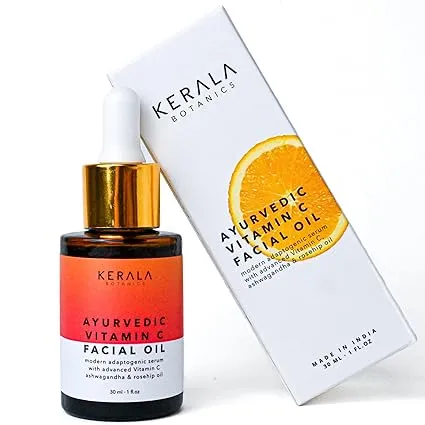
Ayurvedic Vitamin C Face Oil
Kerala Botanics
$49
★★★★☆
On the opposite end, SkinCeuticals C E Ferulic is the canonical single-active formula — a specific ratio of L-ascorbic acid, vitamin E, and ferulic acid, at exact concentrations, with an unusually large body of published data behind it. The synergy here is narrow and well-understood: ferulic acid stabilizes the vitamin C, vitamin E amplifies its effect. Three ingredients, one mechanism, extensively validated. That’s the reference point everything else gets measured against.
C E Ferulic
SkinCeuticals
$185
★★★★½
For anyone who wants a cleaner starting point without the $185 commitment, The INKEY List’s vitamin C serum is a straightforward single-active option — one primary compound, transparent about concentration, easy to layer.
Vitamin C Brightening Serum
The INKEY List
$15
★★★★☆
The Skin Cycling Wrinkle
One argument in favor of single actives: they’re easier to rotate. The skin cycling approach — alternating actives on a schedule to prevent irritation — depends on knowing exactly what you’re applying on which night. A multi-botanical formula with four actives doesn’t fit cleanly into a cycle. You can’t rotate it the way you’d rotate a retinoid.
If your routine is built around skin cycling, single actives give you more control. If you’re trying to simplify and aren’t cycling, a well-formulated multi-botanical can reduce the number of steps without meaningful loss — as long as it leads with a real active at a real dose.
The Ayurvedic Tradition, Honestly Applied
Modern Ayurvedic skincare gets misread in both directions. Dismissing it as pre-scientific ignores the documented evidence on individual botanicals — amla’s vitamin C content is real, ashwagandha’s adaptogenic effect on skin is increasingly supported, gotu kola’s role in wound healing predates the K-beauty industry that borrowed it. Accepting it uncritically, without asking about concentrations or delivery systems, is equally lazy.
The polyherbal framework is a useful design principle, not a guarantee. A formula inspired by Ayurvedic tradition can still be poorly formulated. A formula with one clinical-grade active can outperform it. The tradition points toward something worth investigating; it doesn’t close the question.
Putting It All Together
Multi-botanical formulas aren’t inherently better or worse than single actives. The question is always specifics.
A multi-botanical formula is worth trying when it leads with at least one ingredient at a validated concentration, the supporting botanicals address related (not redundant) pathways, and the format suits your skin type and routine structure. Ayurvedic-inspired formulas can meet this bar — some do, some don’t.
A single active is worth prioritizing when you’re troubleshooting a specific concern, managing reactive skin that needs clean inputs, or building a skin cycling routine that requires precise rotation. The pharmaceutical model isn’t limiting — it’s just honest about what it knows.
The 2026 move toward synergistic blends reflects something real: people want fewer products that do more. That’s a reasonable ask. The industry’s job is to deliver it with actual formulation rigor, not just a longer ingredient list. The consumer’s job is to know the difference.
Start with one question: what’s the lead active, and is it here at a real dose? Everything else follows from that.