
Routines
What Skincare Will Look Like in 2027
Our predictions for skincare in 2027: pro-regeneration replaces anti-aging, biotech actives go mainstream, and budgets get tighter.
Disclosure — This article may contain affiliate links. We earn a small commission at no extra cost to you when you purchase through our links. This supports our ability to create independent, evidence-based skincare content.
Every October we write some version of this piece, and every October we’re wrong about at least one thing. So before we tell you what’s coming in 2027, we’re going to own up to what we got right and wrong last year. Transparency first, hot takes second. That’s the deal.
The short version of where things are headed: the industry is finally retiring “anti-aging” as a marketing frame, biotech actives are moving from niche to normal, microbiome claims are about to get a regulatory gut check, and almost everyone is spending less per bottle than they did two years ago. None of this is speculative fan fiction — we’re seeing the early signals already, in ingredient filings, in what brands are quietly testing, and in what readers keep asking us.
Grading Our 2026 Predictions First
Last year we predicted exosomes would “go mainstream by summer.” That one landed, but not the way we expected. Exosomes did get big — right up until the FDA started sending warning letters to brands making unapproved biologic claims. We covered the whole mess in our exosome FDA reckoning piece, and honestly, we should have flagged the regulatory risk harder in 2025. Grade: C+. Right trend, wrong confidence level.
We also called peptides as “the new retinol alternative category to watch,” and that one aged well. The peptide serum market basically doubled, and most of what launched was legitimately decent — not just marketing dressed up in Latin names. If you want the current landscape, our peptide types decoder is still the clearest map we’ve got. Grade: A-.
Where we whiffed completely: we predicted “clean beauty” messaging would fade. It didn’t. If anything, the backlash against lab-grown and biotech ingredients got louder, which we actually cover now in our piece on the familiar-ingredient backlash. People want ingredients they can picture growing in the ground, not ones synthesized in a bioreactor, even when the bioreactor version works better. We underestimated how much that instinct would hold. Grade: D. Noted, and we’re not making that mistake again.
So that’s the scorecard. Two hits, one real miss. Now here’s what we think happens next.
”Anti-Aging” Is Finally Dying — and Good Riddance
For about twenty years, the entire skincare industry was built on a premise nobody questioned out loud: aging is a problem to fight. Fine lines were the enemy. Collagen loss was a crisis. Every serum promised to “turn back the clock,” as if your face were a car odometer you could roll backward with enough retinoids.
That framing is finally cracking, and 2027 is when it breaks for real.
The replacement isn’t “pro-aging” or some forced positivity campaign about wrinkles. It’s regeneration. The conversation is shifting from stopping damage to helping skin repair and rebuild itself — better barrier function, healthier cell turnover, resilience against stressors like heat and pollution, not just wrinkle suppression. We’ve been tracking this shift for a while over in our skin longevity guide, and it’s not just vibes. The actives getting serious R&D money right now — senolytics, NAD+ precursors, growth factor analogs — aren’t designed to erase a line. They’re designed to help skin cells function the way they did a decade ago. That’s a meaningfully different goal, and it changes how brands will market things next year.
Expect fewer product names with “youth” or “age-defying” in them. Expect more language about “cellular function,” “repair,” and “resilience.” Some of that will be genuine innovation. A lot of it will be the same retinol in a new bottle with rebranded copy. Your job as a reader stays the same: ignore the headline on the box and look at the ingredient list.
What to Actually Do About It
Don’t rip up your routine because the marketing vocabulary changed. If tretinoin or a retinoid is working for you, it’s still working — regeneration framing doesn’t invalidate it, it just describes the mechanism more honestly. If you’re retinoid-curious but want the gentler, repair-first angle this shift is pointing toward, bakuchiol remains the most-studied plant-based option. We broke down how it stacks up in our bakuchiol vs retinol comparison, and for anyone wanting that regenerative angle alongside brightening, a bakuchiol and vitamin C combo is worth a look.

Ayurvedic Vitamin C Face Oil
Kerala Botanics
$49
★★★★☆
This one fits the regeneration moment pretty well, honestly. It pairs a long-lasting vitamin C with bakuchiol — so you’re getting brightening and a gentle retinol-alternative in one oil, instead of stacking three products that each do one job. It won’t out-perform a dedicated clinical vitamin C like CE Ferulic on raw concentration (we compared the two head-to-head here), and the oil format isn’t going to thrill anyone with genuinely oily skin. But as an all-in-one for people tired of ten-step routines, it’s a real option, not a gimmick.
Biotech Actives Stop Being Weird
Three years ago, telling someone their serum contained “synthetic growth factors” would’ve gotten you a weird look. Now it barely raises an eyebrow, because the actives pipeline has quietly gone biotech across the board.
Peptides opened that door. Now we’re seeing lab-engineered versions of things that used to come from questionable sources — polynucleotides instead of actual salmon sperm extract, synthetic growth factors instead of plant stem cell extracts that did very little. We wrote about this exact shift in our piece on synthetic growth factors, and the short version is: the lab-made versions are often more stable, more consistent, and easier to regulate than their “natural” predecessors. That’s a genuinely good development, even if it sounds less romantic than a botanical story.
The catch for 2027 is going to be evidence versus hype, same as always. Topical senolytics — ingredients that claim to clear out aged, dysfunctional skin cells — are getting a lot of buzz, and we dug into what the research actually shows in our topical senolytics breakdown. Spoiler: promising in early studies, nowhere near proven at the level the marketing implies. Expect more of these ingredients to show up in serums next year with confident copy and thin clinical backing. Read the actual study, not the brand’s summary of the study.
How to Vet a Biotech Claim Before You Buy
A good filter: look for the words “published,” “peer-reviewed,” and an actual sample size. If a brand says “clinically shown” without telling you how many people were in the study or who ran it, that’s marketing language, not data. Our guide to reading clinical claims walks through exactly how to spot the difference, and it’s worth bookmarking going into next year because this is only going to get more common, not less.
Microbiome Claims Finally Get Called Out
Here’s a prediction we’re fairly confident about: “microbiome-friendly” stops meaning anything by mid-2027, because regulators are going to force brands to prove it or drop it.
Right now, “microbiome-friendly” is one of the loosest claims on a label — there’s no legal definition, no required testing, nothing stopping a brand from slapping it on a product that’s never been near a microbiome study. We laid out exactly how empty that claim currently is in our piece on microbiome-friendly labeling. With MoCRA enforcement ramping up (we covered what that means for your shelf here), we think 2027 is the year the FDA or a state attorney general makes an example of a brand over an unsubstantiated microbiome claim. It happened with “clean.” It happened with “hypoallergenic” decades ago. Microbiome claims are next in line.
That doesn’t mean the microbiome science is fake. Pre-, pro-, and postbiotic ingredients have real, if still developing, research behind them — we go through what’s actually solid in our microbiome 101 guide. The issue isn’t the science. It’s that the marketing has sprinted way ahead of it. Expect a correction.
What This Means for Your Shelf
If you’re buying something specifically for its microbiome claim, look for actual strain names or tested postbiotic ferments, not just the phrase “microbiome-friendly” floating on the front of the bottle. Fermented skincare with a known lineage — think the kind covered in our fermented skincare guide — tends to have more substance behind it than a vague microbiome buzzword slapped on a basic moisturizer.
Tighter Budgets, Smarter Spending
This one isn’t really a prediction. It’s already happening. We’ve watched shrinkflation hit skincare in ways that would’ve seemed unthinkable a few years ago — smaller jars at the same price, quieter reformulations, “new and improved” often meaning “cheaper to make.” We tracked the specifics in our shrinkflation piece, and 2027 is shaping up to be the year readers get genuinely savvier about it.
What we expect: more people doing side-by-side ingredient comparisons before buying, more interest in dupes and alternatives, and less tolerance for paying luxury prices for marginal improvements. We’ve seen this energy building for a while in how readers respond to pieces like expensive vs. cheap skincare and our running affordable vitamin C dupes roundup. People aren’t abandoning skincare. They’re just done paying for packaging.
The good news is the budget tier has genuinely gotten better. A basic, fragrance-free moisturizer with ceramides doesn’t need a fancy name to work.
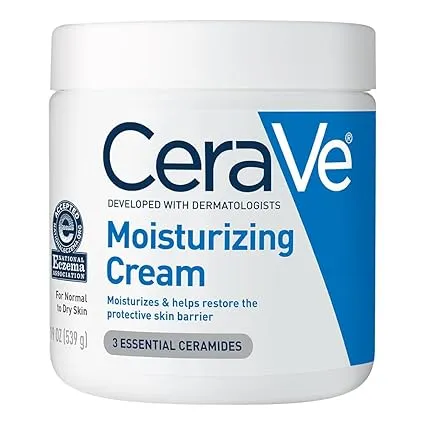
Moisturizing Cream
CeraVe
$19
★★★★½
Nineteen dollars, no fragrance, ceramides doing exactly what they’re supposed to do. This is the product that proves the “tighter budget” trend isn’t actually a downgrade — it’s a correction. For years we were all paying for packaging and a story. In 2027, we think more people quietly swap back to stuff like this and never look back. We’ve got a longer breakdown of it in our full CeraVe Moisturizing Cream review if you want the details.
Where to Actually Spend More
Tighter budgets don’t mean “cheap everything.” It means spending where it counts — sunscreen, a well-formulated retinoid, maybe one genuinely well-studied active — and going basic everywhere else. If you’re not sure where your money is making a difference versus where it’s going to marketing, our minimalist 3-step routine is a decent starting template for 2027 budgets.
Putting It All Together
Here’s where we land, honestly: 2027 skincare is less about chasing a new ingredient and more about demanding proof for the ones already on the shelf. The anti-aging language is finally dying, replaced by a regeneration framing that’s actually more accurate to what good actives do. Biotech ingredients are going mainstream, which is mostly good news, as long as you keep asking for the data behind the claim. Microbiome marketing is about to get a reality check it’s needed for years. And more of us are simply spending smarter, because nobody has the budget to pay a premium for a story anymore.
None of this requires you to overhaul your routine on January first. Keep the actives that work. Keep your sunscreen non-negotiable. Just get a little more skeptical of the words on the label, and a little more comfortable walking past the expensive version of something you can get for less. That’s not a prediction. That’s just where we think good skincare habits are headed, with or without the marketing catching up.