
Ingredients
The Familiar-Ingredient Backlash: Recognizable Botanicals vs Biotech Skincare
As biotech skincare surges, consumers are retreating to pantry-legible botanicals. Here's what's driving the shift — and what it actually means for your routine.
Disclosure — This article may contain affiliate links. We earn a small commission at no extra cost to you when you purchase through our links. This supports our ability to create independent, evidence-based skincare content.
The skincare industry has spent the last five years convincing us that progress lives in a lab. Exosomes, synthetic growth factors, biofermented peptides, next-generation UV filters with names no one can pronounce. The message was clear: nature is quaint. Science is the answer.
Now, heading into the back half of 2026, something is shifting.
Consumers are reading labels differently. They’re not necessarily rejecting science — they’re rejecting opacity. There’s a growing appetite for ingredients that feel legible: things that grew somewhere, have a history, and don’t require a biochemistry degree to contextualize. Rosehip. Turmeric. Bakuchiol. Amla. The kind of word you might actually recognize on a grocery shelf.
This isn’t a rejection of efficacy. It’s a transparency demand. And it’s worth understanding what it means for how we build our routines.
Why Biotech Had Its Moment
To understand the backlash, you have to understand the appeal.
Biotech skincare promised things botanical ingredients couldn’t — or at least, couldn’t prove. Precise concentrations. Stable delivery systems. Clinical trials with measurable endpoints. Ingredients synthesized to exacting standards, free from batch variation, contamination risk, and the supply-chain fragility of plant-based sourcing.
For a while, that story was compelling. Exosomes, synthetic growth factors, and copper peptides attracted serious attention from dermatologists and well-informed consumers alike. Brands invested heavily in the language of biotechnology. Products came with dense explanatory copy, often more scientific abstract than marketing.
But something got lost in translation. For most people, a 14-syllable ingredient name followed by a claim about “cellular signal amplification” doesn’t build confidence. It builds distance. And as transparency became the defining consumer value of 2026 — pushed forward by clean-app scores, ingredient-label TikToks, and an increasingly skeptical post-pandemic relationship with institutions — distance started to feel like a red flag.
Then came the FDA warning letters around exosomes. Suddenly “cutting-edge” looked a lot like “unregulated.” That shook confidence more broadly, not just in exosomes specifically.
The Transparency Wave and What It’s Actually Asking For
The current moment isn’t really about “natural vs. synthetic.” That’s a false binary, and chemophobia has never served anyone well. What’s actually happening is more specific.
People want to understand what they’re putting on their skin. Not in a regulatory sense — they’re not asking for full toxicology reports. They want context. They want to know: where does this come from, what does it do, has anyone used it before me?
Botanical ingredients answer those questions intuitively. Turmeric has a thousand years of topical use across South Asian traditions. Willow bark extract has been linked to salicylic acid in folk medicine since before the FDA existed. Rosehip oil’s beta-carotene content is something most people can connect to broader knowledge they already have.
That familiarity isn’t scientifically rigorous. But it’s not nothing. The accumulated use history of certain plants — particularly those codified in Ayurvedic or traditional Chinese medicine — provides a kind of real-world safety signal that novel biotech actives simply don’t have yet.
The honest version of this: pantry-legible ingredients feel trustworthy because they’re embedded in systems of knowledge most of us can access. Black-box biotech doesn’t offer that, even when the underlying science is solid.
What Botanical Ingredients Actually Deliver
Here’s where we need to be careful. The transparency wave has legitimate grievances, but it can tip into romanticizing nature in ways that aren’t helpful.
Some botanical ingredients have real, well-studied efficacy:
- Bakuchiol has multiple randomized controlled trials showing retinol-comparable results for fine lines and hyperpigmentation, with a gentler irritation profile. We’ve written about it extensively — see Bakuchiol vs Retinol for the full evidence review.
- Centella asiatica has solid data on wound healing and barrier repair. Cica as a category has moved well beyond trend status.
- Amla (Indian gooseberry) carries one of the most compelling vitamin C stories in botanical skincare — the science is more interesting than most people realize.
- Beta-glucan from oat and mushroom sources has legitimate research behind its barrier-supporting and soothing mechanisms. See the complete guide.
Others are more complicated. Rosehip oil’s reputation as a “natural retinol” is based on its trans-retinoic acid content, which is present but low. The evidence is encouraging but not conclusive. And plenty of botanicals on shelves are there because they photograph well and sound compelling, not because there’s any meaningful trial data.
The useful question isn’t “is it natural?” It’s “is there evidence, and is there history?” Those two things together — modern research plus accumulated use — make a much stronger case than either alone.
Where Biotech Still Wins
Let’s not overcorrect.
For certain goals, biotech formulations are genuinely hard to match with plant-based alternatives. Stabilized L-ascorbic acid at clinical concentrations, like SkinCeuticals CE Ferulic, has decades of research and a delivery system that’s been refined over time. Nothing botanical delivers the same predictability.
C E Ferulic
SkinCeuticals
$185
★★★★½
Similarly, tretinoin remains the most evidence-backed topical retinoid available. Bakuchiol is a reasonable alternative for those who can’t tolerate it, but it’s not a clinical equivalent.
And some newer biotech actives — ectoin, certain postbiotics, well-researched peptides — are accumulating evidence that makes them genuinely worth using. The issue was never with the science. It was with the overclaiming, the opacity, and the speed at which unproven ingredients got packaged as breakthrough treatments.
The answer, then, isn’t to abandon biotech. It’s to demand the same standards from biotech that we’re starting to apply to everything else: clear sourcing, honest claims, and some acknowledgment of what we don’t yet know.
The Ayurvedic Angle: More Than an Aesthetic
Ayurvedic skincare sits at an interesting intersection of this debate. It predates “clean beauty” as a marketing category by several thousand years, which means its botanical ingredients come with both traditional use records and, increasingly, modern research interest.
Ingredients like ashwagandha, turmeric, neem, shatavari, and amla have been studied in clinical contexts — not always with large-sample Western trials, but with enough emerging literature to take seriously. We’ve covered several in depth: ashwagandha’s topical effects, gotu kola’s relationship to cica, and the broader case for modern Ayurvedic skincare.
What makes Ayurvedic formulations relevant to the transparency wave specifically is the framework itself. Ayurveda is a named system with a documented philosophy, not a vague gesture toward nature. When a product is genuinely rooted in that tradition, consumers can trace the logic. That’s the kind of legibility people are asking for.
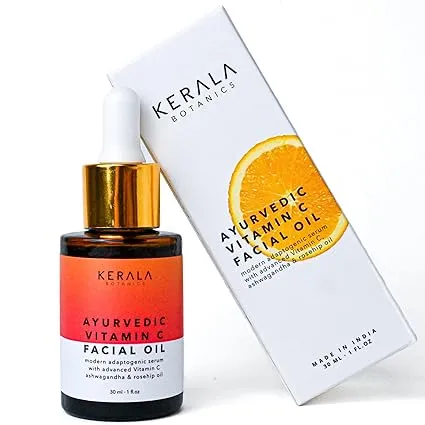
One product that sits clearly in this space is the Kerala Botanics Ayurvedic Vitamin C Face Oil. It uses an advanced form of vitamin C — reportedly more stable and longer-lasting in skin cells than standard L-ascorbic acid — alongside bakuchiol as a retinol alternative, in an oil base that draws on Ayurvedic traditions. The “recognizable ingredient” story is real here: if you know what bakuchiol is, and you know what an Ayurvedic facial oil typically contains, you can parse this product without a glossary.
Honest caveats apply. An oil format isn’t right for everyone — oily or acne-prone skin may find it heavy, and it can feel too rich under makeup for some. The clinical data doesn’t match a product like CE Ferulic. But for people building a simplified routine around ingredients with both traditional history and modern research support, it earns a genuine mention.
Ayurvedic Vitamin C Face Oil
Kerala Botanics
$49
★★★★☆
A More Affordable Middle Ground
Not everyone wants to spend $185 on a vitamin C serum or $49 on a face oil. There’s also a reasonable middle path: well-formulated products that use recognizable, evidence-backed ingredients at honest prices.
Naturium’s Vitamin C Complex Serum is a good example. It’s not a biotech marvel, and it doesn’t need to be. It uses a stabilized vitamin C derivative, keeps the formula straightforward, and comes in at a price where running through a bottle before it oxidizes is actually feasible. It won’t appeal to the strictly natural crowd — it’s clearly a lab-made formulation — but it answers the transparency question in a different way: simple ingredients, honest concentration disclosure, nothing buried.
Vitamin C Complex Serum
Naturium
$26
★★★★½
For anyone weighing options across the vitamin C format spectrum, our guide to vitamin C serums vs. oils lays out the tradeoffs clearly.
How to Actually Use This Tension
The botanicals-vs-biotech framing is more useful as a lens than as a shopping rule. Here’s what’s actually actionable:
Ask “what is this, and why is it here?” For any ingredient you can’t identify, it’s worth a quick search — not to avoid it, but to understand the claim being made. Learning to read ingredient labels takes about twenty minutes and pays off for years.
Weight tradition alongside trials. An ingredient with a hundred years of use across multiple cultures and a handful of modern studies is often more trustworthy than an ingredient with one proprietary trial and a patent filing.
Be skeptical of newness in either direction. A newly isolated biotech active might be brilliant or might be overclaimed. A botanical ingredient might be genuinely effective or might just be legible. Neither category gets an automatic pass.
Simplicity is its own form of transparency. A three-ingredient oil with recognizable botanicals is, in one real sense, easier to evaluate than a 28-ingredient serum with eight branded complexes. If you’ve been feeling overwhelmed, that’s a signal worth listening to.
Putting It Together
The familiar-ingredient backlash isn’t anti-science. It’s a correction to a period when “science” became a branding strategy rather than a standard of evidence, and when complexity got mistaken for sophistication.
Botanicals with documented history and modern research — bakuchiol, centella, amla, beta-glucan — earned their place in this conversation. So did well-formulated biotech actives that come with honest claims and real data. What’s losing ground is everything in between: the ingredient-as-aesthetic, the proprietary complex without a mechanism, the innovation theater.
We’ve been here before with clean beauty’s first wave. The difference now is that consumers are asking better questions. Not “is it natural?” but “is it legible, is it honest, and does it actually work?” That’s a better standard. It’s the one worth building a routine around.