
Routines
The Essential Oils in Kerala Botanics: Who Should Think Twice
Kerala Botanics scents its vitamin C oil with rose, grapefruit and orange. Here's who should patch test, the photosensitivity facts, and who should skip it.
Disclosure — This article may contain affiliate links. We earn a small commission at no extra cost to you when you purchase through our links. This supports our ability to create independent, evidence-based skincare content.
A pleasant scent and a fragrance allergen can be the same molecule. That’s the tension with Kerala Botanics’ vitamin C oil, which is scented with rose, grapefruit and orange oils. Our review praised how it smells, and we stand by that. We’d also tell a friend with reactive skin to be careful with it.
Both statements are true. This guide covers what those oils contain, what the citrus photosensitivity question really looks like, who should patch test first, and who should skip the oil for a fragrance-free vitamin C. For most people, the answer is “probably fine.” For a specific minority, it’s “not worth the gamble.”
What the essential oils are doing in this formula
Essential oils are complex mixtures, often dozens of aromatic compounds each. Rose oil carries citronellol, geraniol, linalool and eugenol. Sweet orange and grapefruit oils are mostly limonene, with smaller amounts of linalool and other terpenes.
Several of those compounds are on the EU’s list of 26 declarable fragrance allergens. They’re on that list because they’re known to sensitize some people. Limonene and linalool are a particular concern because they oxidize on contact with air. The oxidized forms are stronger sensitizers than the fresh ones.
“Natural” doesn’t change any of this. Your immune system reacts to the molecule, not the marketing. A geraniol molecule from a rose petal and one made in a lab look identical to a T cell.
The oils aren’t there by accident, either. In an Ayurvedic-style face oil, aroma is part of the ritual, and there’s some evidence that scent helps people stick with a routine (we covered that in Scent as Skincare). That’s a legitimate reason to include them. It just isn’t a free one.
The label-reading trap
In the US, a product can list individual essential oils by their botanical names and never use the word “fragrance” or “parfum.” So a quick scan for the F-word can leave you thinking an oil is unscented when it’s very much scented. Look for names like Rosa damascena flower oil or Citrus paradisi peel oil. And remember that “unscented” can mean a masking fragrance was added to cancel odors, which is a different thing from fragrance-free.
Individual allergen labeling is coming, slowly. We broke down what the rule will and won’t reveal in The Fragrance Loophole Is Closing.
Holding both facts: the scent is good, and it’s a risk factor
Fragrance is one of the most common causes of allergic contact dermatitis from cosmetics. Most people never develop an allergy. Estimates for the general population run in the low single digits to roughly one in ten, depending on the study and which fragrance markers they use. Among people referred to dermatologists for suspected contact allergy, the numbers are higher.
So for the majority, the scent is a perk. The concern is concentrated in a smaller group. The trouble is that you can’t tell in advance which group you’re in, because sensitization is a one-way door. Once you’re allergic to linalool, you’re allergic to it in everything, including the perfume, the shampoo and the laundry detergent.
We don’t know the exact concentration of each oil in this formula, and a label doesn’t tell you. Oils typically sit low on an ingredient list, which suggests small amounts. “Small” still isn’t “zero,” and a leave-on product you apply daily to your face is about the highest-exposure format there is.
There’s also a point in the brand’s favor. Rose, orange and grapefruit are not among the most notorious sensitizers in the fragrance world. Cinnamal, hydroxycitronellal and oakmoss rank higher. This is a moderate-risk profile, not an alarming one.
The citrus photosensitivity question
This one gets overblown online, so here’s the actual mechanism.
Some citrus oils contain furocoumarins (bergapten is the best known). When these compounds sit on skin and then get hit with UVA light, they can cause a phototoxic reaction: redness, sometimes blistering, then stubborn brown marks. This is a chemical reaction, not an allergy, so anyone can get it with enough exposure. The textbook offender is bergamot oil. Cold-pressed lime is another.
The details matter, though:
- Extraction method matters most. Cold-pressed (expressed) citrus peel oils retain furocoumarins. Steam-distilled citrus oils largely don’t, and some oils are sold “furocoumarin-free” (FCF) after processing.
- Grapefruit is a middle case. Cold-pressed grapefruit oil contains some furocoumarins, enough that the fragrance industry’s safety standards (IFRA) cap how much can go into leave-on products.
- Sweet orange is the lowest-risk of the common citrus oils. Its phototoxic potential is generally considered weak.
- Dose matters. A few drops of oil diluted in a base, or a fraction of a percent in a formula, is a far cry from neat bergamot on a beach day.
What we don’t know is which extraction method Kerala Botanics uses, and we haven’t seen a phototoxicity study on the finished product. Both are questions worth emailing the brand about. Our longer breakdown is in Citrus Essential Oils and Photosensitivity.
What to actually do about it
The risk at typical cosmetic concentrations looks low, but it’s not nothing, and the fix is simple.
- Wear sunscreen every morning. You should be doing this anyway if you use vitamin C for brightening. Broad-spectrum SPF blocks the UVA that triggers the reaction.
- Consider using the oil at night if you’re fair, photosensitized by medication (some antibiotics, retinoids prescribed for acne, certain diuretics), or spending long days in strong sun.
- Don’t apply it before intense UV exposure such as a beach day or a ski trip without sunscreen on top.
- If you notice a patchy, streaky redness in a pattern that matches where you applied the oil after sun exposure, stop using it and see a dermatologist.
One small note in the formula’s favor: the vitamin C itself isn’t phototoxic. If anything, topical vitamin C is used as a modest antioxidant companion to sunscreen, not a replacement for it.
Who should patch test first
Patch testing is worth a few minutes for anyone starting a new scented leave-on product. It’s non-negotiable for the following groups:
- People with a known fragrance allergy, especially a positive fragrance mix or Balsam of Peru patch test from a dermatologist.
- People with a history of contact dermatitis from perfume, cosmetics, or hair products.
- People with eczema, where the barrier is compromised and sensitization happens more easily. If that’s you, start with Adult Facial Eczema: Building a Routine That Doesn’t Sting.
- People with rosacea, perioral dermatitis or seborrheic dermatitis, where fragrance is a common trigger.
- People with currently sensitized skin, such as after over-exfoliating, a peel, or a stretch of too many actives. (See sensitive vs. sensitized skin for the difference.)
- People who’ve reacted to citrus peel, like getting a rash from handling oranges or grapefruit.
The oil also contains bakuchiol. Allergic reactions to it are uncommon, but case reports exist, so it belongs in the same cautious category.
How to do it properly
The quick one-day dab doesn’t work well for allergies. Allergic reactions are delayed and often show up 24 to 96 hours after exposure.
Apply a small amount to the inner forearm or behind the ear twice daily for seven days. Then move to a small patch on the jawline for a few days before using it on your whole face. Itching, redness, small bumps or a dry scaly patch at the test site means stop. The full method is in our patch testing guide.
Oils are also easy to get wrong in other ways: too much, too often, not enough absorption time. Our how-to guide for this oil covers amounts and layering.
Who should skip it and pick a fragrance-free vitamin C
Plainly, skip the oil if any of these apply:
- You have a diagnosed fragrance or essential-oil allergy. Don’t patch test your way into a reaction. Choose something fragrance-free.
- You’re in an active flare of eczema, perioral dermatitis, seborrheic dermatitis or rosacea.
- You’re recovering from a procedure, a damaged barrier, or cancer treatment. Our barrier-first guide explains why simple formulas win here.
- You’ve reacted to this or a similar scented product before. Your skin already told you.
- You want vitamin C and nothing else. If your goal is to isolate one variable, a plain formula is easier to troubleshoot.
Fragrance-free doesn’t mean irritation-free, to be clear. L-ascorbic acid is a common source of stinging at low pH, and that’s a separate problem we cover in why vitamin C burns sensitive skin. If you’re picking an alternative for reactive skin, our gentle vitamin C roundup goes deeper.
Two fragrance-free alternatives
La Roche-Posay’s Pure Vitamin C10 is a lower-strength L-ascorbic acid serum, labeled fragrance-free, and made by a brand that tests on sensitive skin. At 10%, it’s gentler than the 15-20% formulas. The downside is ordinary serum fragility: it will oxidize over time, and the lower strength means subtler results.
Pure Vitamin C10 Serum
La Roche-Posay
$40
★★★★☆
SkinCeuticals C E Ferulic is the benchmark: 15% L-ascorbic acid with vitamin E and ferulic acid, with the deepest clinical record of any vitamin C product. It’s also fragrance-free. The catches are the $185 price and that it can sting on compromised skin. We went through the trade-offs in Is It Worth $185?.
C E Ferulic
SkinCeuticals
$185
★★★★½
Where Kerala Botanics lands
If you’re not in any of the groups above, this oil is a reasonable pick, and the scent is part of why people like it. It folds a vitamin C treatment, bakuchiol and a moisturizing oil into one step. The brand’s claims about its vitamin C form (up to 4x more effective, staying in skin cells up to 80x longer than standard L-ascorbic acid) come from the brand, and we haven’t seen independent data that confirms them. Treat them as promising, not proven.
The honest cons: it has far less clinical backing than C E Ferulic, the oil format won’t suit oily skin, it can feel heavy under makeup, and the fragrance load is a genuine limit for sensitive skin. Pros: a simplified routine, a pleasant sensory experience, and a retinol alternative built in.
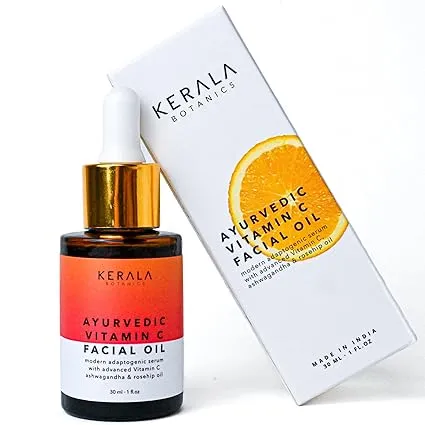
Ayurvedic Vitamin C Face Oil
Kerala Botanics
$49
★★★★☆
Verdict: good for people with resilient skin who like a scented, all-in-one routine. Skip it if fragrance is a known problem for you.
Storage and freshness
One practical point: oxidation drives some of the allergen risk. Limonene and linalool become stronger sensitizers as they age in air. Keep the cap on tight, store the bottle away from heat and sunlight, and don’t use it long past its prime. Our guides on storing skincare and when to throw it out cover the specifics. If the oil smells sharp, off, or different from when you opened it, retire it.
Putting it all together
Here’s the short version.
- The scent is real and it’s deliberate. Rose, grapefruit and orange oils contribute fragrance allergens, even though they’re natural.
- Citrus photosensitivity is a legitimate but low risk at cosmetic concentrations, and it depends on extraction method, which we don’t know here. Use SPF daily and consider nighttime use if you’re photosensitized.
- Patch test for a full week if you have eczema, rosacea, perioral dermatitis, a past fragrance reaction, or currently reactive skin.
- Skip it entirely if you have a diagnosed fragrance allergy or an active flare. Pick a fragrance-free vitamin C.
- Read labels for botanical names, not just the word “fragrance.”
Everyone else can enjoy the smell. Just don’t assume that “from a plant” means “can’t hurt you.”