
Ingredients
Vetiver and Cooling Botanicals: Ayurveda's Answer to Heat-Stressed Skin
Vetiver, sandalwood, and other Ayurvedic cooling botanicals fight heat-stressed skin. Here's what the science says and how to use them.
Disclosure — This article may contain affiliate links. We earn a small commission at no extra cost to you when you purchase through our links. This supports our ability to create independent, evidence-based skincare content.
Heat damage to skin isn’t only about sunburn. We’ve spent decades obsessing over UV, and for good reason — but infrared radiation, ambient heat, and the chronic low-grade inflammation that comes from living in a warming world are doing real work on your collagen too. Ayurveda identified this problem roughly 3,000 years before dermatology had a name for it. The system calls it excess pitta: a state of heat-driven imbalance that manifests as redness, sensitivity, and accelerated aging. And the botanical toolkit it developed to address it — vetiver at the center, flanked by sandalwood, khus, and a handful of others — is increasingly showing up in modern formulas for a reason.
This isn’t a piece about ancient wisdom being magically right about everything. Some of it holds up. Some of it doesn’t. What we’re doing here is looking at which cooling botanicals have genuine mechanistic evidence behind them, and how to actually use them in a 2026 routine.
What “Heat-Stressed Skin” Actually Means
Before getting into ingredients, it’s worth pinning down the problem they’re solving.
Heat aging is distinct from photoaging, though they often arrive together. Infrared radiation (IR-A, specifically) penetrates deeper than UV — past the epidermis and into the dermis where fibroblasts live. It upregulates matrix metalloproteinases (MMPs), the enzymes that break down collagen and elastin. It also generates reactive oxygen species (ROS) independently of UV, which means your SPF does nothing to stop it.
Add ambient heat to the picture — high temperatures slowing wound repair, disrupting the skin’s microbiome, and triggering mast cell activity — and you get a constellation of effects: chronic redness, textural changes, accelerated pigmentation, and a compromised barrier. This is what inflammaging looks like at a thermal level.
Ayurveda’s pitta constitution maps onto a lot of this. Pitta skin in classical texts is described as prone to redness, sensitivity, photosensitivity, and early wrinkling. The prescribed interventions are cooling, anti-inflammatory, and antioxidant-rich. Functionally, that’s not a bad description of what modern dermatology would recommend.
Vetiver: The Root That Does Most of the Work
Vetiver (Chrysopogon zizanioides, also called khus) is a grass native to India. The useful part is the root, which is steam-distilled into an essential oil or processed into an extract for topical use.
In traditional Ayurvedic practice, vetiver is considered one of the most potent pitta-pacifying botanicals. It was used in cooling pastes, in water stored in clay pots during summer, and infused into oils applied after sun exposure. The cooling sensation isn’t just sensory — it’s partly physiological.
What the Research Shows
Vetiver root extract contains zizanal, khusimol, and isovalencenol — sesquiterpene compounds with documented anti-inflammatory activity. Studies have shown inhibition of pro-inflammatory cytokines (specifically IL-6 and TNF-α) in cell models, which is the same pathway that chronic heat stress activates. It also has measurable antioxidant capacity, with free radical scavenging activity comparable to some established botanical antioxidants.
There’s also a cooling mechanism: vetiver interacts with TRPM8 receptors, the same cold-sensing channels that menthol activates, though far more gently. No tingle, no irritation — just a mild vasoconstrictive effect that reduces surface redness.
The honest caveat here is that most vetiver studies are in vitro or on the essential oil rather than finished topical formulas. We don’t have the robust clinical trial data we have for, say, niacinamide or azelaic acid. What we have is solid mechanistic rationale and centuries of use-case evidence — which is more than a lot of trending ingredients can claim.
Practical note
Vetiver essential oil is potent and should be diluted before application — typically in a carrier oil at 1–2%. In ready-made formulas, you’re usually getting it at appropriate concentrations already.
The Supporting Cast
Vetiver rarely shows up alone in Ayurvedic cooling formulations. The traditional combinations are actually smart from a formulation standpoint.
Sandalwood (Santalum album)
Sandalwood’s alpha-santalol content gives it demonstrable anti-inflammatory and skin-soothing properties. It’s been studied more rigorously than vetiver — there’s evidence of UV-induced erythema reduction in human trials, and it’s used clinically for hyperpigmentation in some markets. It also interacts with olfactory receptors in the skin (yes, those exist), triggering a cellular response that slows proliferation and may support wound healing.
Sustainable sourcing is a real issue here. Genuine Santalum album is scarce and expensive. Most mass-market “sandalwood” products use synthetic substitutes or the Australian variety (Santalum spicatum), which has a different chemical profile. Worth checking what you’re actually getting.
Amla (Phyllanthus emblica)
Amla is the Ayurvedic ingredient with arguably the best evidence base of the whole category. It’s one of the richest plant sources of vitamin C, and the ellagic acid content gives it antioxidant activity that holds up in oxidizing conditions better than straight L-ascorbic acid. In the context of heat-stressed skin, it addresses the ROS component directly. If you’re building an Ayurvedic cooling routine, amla is where you’d anchor the antioxidant work.
Neem and Turmeric
Both get included in traditional heat-calming pastes. Neem’s antibacterial and anti-inflammatory properties are legitimate — the limonoids in neem leaf extract have been studied in dermatological contexts, particularly for acne and seborrheic conditions. Turmeric’s curcumin is well-known but poorly absorbed topically without formulation help (it’s notoriously unstable and doesn’t penetrate easily). The evidence for turmeric in topical products is thinner than the cultural footprint suggests.
Bakuchiol
This one isn’t traditionally a “cooling” botanical, but it belongs in this conversation. Bakuchiol is pitta-appropriate in Ayurvedic logic — it’s a retinol-mimicking compound that works without the irritation that heat-stressed skin can’t tolerate. If your skin is already reactive from sun and heat, retinol is often the wrong call. Bakuchiol gives you the collagen-stimulating and retinoid receptor activity with a significantly lower inflammatory load.
Building a Heat-Stress Routine Around These Ingredients
The goal isn’t to build an entirely Ayurvedic routine — it’s to selectively use cooling botanicals where they address specific, mechanistic concerns. Here’s how to actually integrate them.
Step 1: Antioxidant Base
Heat and IR radiation generate ROS. Your antioxidant layer needs to cover this before it cascades into collagen degradation. Vitamin C remains the most evidence-backed option, but format matters in summer — high-acid L-ascorbic serums can irritate already-sensitized skin.
An oil-based vitamin C format sidesteps the pH irritation issue entirely. Kerala Botanics’ Ayurvedic Vitamin C Face Oil uses a more stable form of vitamin C alongside bakuchiol — so you’re getting antioxidant coverage and a retinol alternative in a single step, without the sting. It’s not a replacement for rigorous clinical data, and the oil format won’t suit everyone (particularly oily or acne-prone skin in peak summer humidity), but as a multi-tasking solution for heat-sensitized skin that wants fewer steps, it’s a reasonable option.
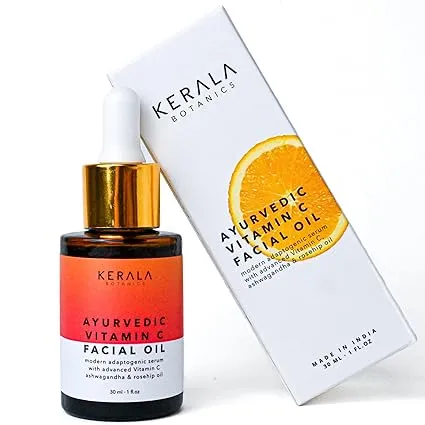
Ayurvedic Vitamin C Face Oil
Kerala Botanics
$49
★★★★☆
Step 2: Anti-Inflammatory Soothing
This is where vetiver, centella asiatica, or heartleaf enter. Centella asiatica has more published clinical data than vetiver, so if you need a safe bet, start there. If you want specifically to explore Ayurvedic cooling actives, look for vetiver in the ingredient list of facial mists, tonics, or light serums — it works well in water-based formats.
Products with sandalwood or amla in an antioxidant serum context are worth seeking out, particularly if you’re dealing with post-heat redness that hasn’t resolved overnight.
Step 3: Barrier, Then SPF
Heat-stressed skin often has a disrupted barrier — the lipid matrix gets disorganized under thermal stress, same as it does under chemical over-exfoliation. Ceramide moisturizers rebuild the structural layer. Then sunscreen. Every morning. No negotiation.
And not just UV protection. If IR-A damage is part of your concern, look for sunscreens with added antioxidants (vitamin E, green tea, or niacinamide) — these address the ROS pathway that SPF alone doesn’t touch. Next-generation UV filters are also more photostable, which matters when you’re in extended sun exposure.
What to Avoid When Skin Is Heat-Stressed
The anti-advice section is sometimes more useful than the recommendations.
Fragrance and essential oils at high concentrations. Counterintuitively, some Ayurvedic products add citrus, camphor, or menthol at concentrations that cause contact sensitization in already-inflamed skin. Vetiver at 1–2% is fine. Lemon peel oil at 3% in a leave-on product is not.
High-strength exfoliants. An AHA at 10% on reactive, heat-sensitized skin is asking for more inflammation. Summer is generally the time to step down acid concentrations — over-exfoliation looks worse in heat.
Heavy occlusive oils in high humidity. If you’re using a face oil and you live somewhere muggy in July, pay attention to how your skin responds. Some people can use oils year-round without issue. Others find them pore-clogging in summer. The oil format question deserves its own honest assessment, which we covered here.
The Heat-Aging Trend, Contextualized
There’s a reason vetiver is showing up in new launches. Heat aging as a distinct skincare category is getting more attention in 2026, driven by a combination of climate awareness and actual research on IR-A damage that’s only a few years old at this point. Brands are responding — sometimes with genuine formulation consideration, sometimes by slapping “cooling” on a label and calling it done.
The tell is the ingredient list. Vetiver, amla, sandalwood, and bakuchiol should appear in the first half of the list if they’re doing real work. If they’re near the bottom — after fragrance, after preservatives — they’re decoration. Reading ingredient labels is the most useful skill you can develop for cutting through this.
The Ayurvedic framework isn’t a perfect fit for evidence-based skincare — some of it maps cleanly to modern biochemistry, some of it doesn’t. But the cooling botanical tradition got a few things right well before we had ROS assays to confirm it. Vetiver is a genuine functional ingredient. Treat it like one.
Putting It All Together
Heat stress is a real, distinct skin concern — not a subtype of sun damage, though it often travels with it. The Ayurvedic cooling botanical tradition, vetiver especially, has meaningful mechanistic overlap with what modern research identifies as useful: anti-inflammatory cytokine inhibition, antioxidant activity, and mild vasoconstrictive effects.
A practical heat-stress routine looks like this:
- Antioxidants in the morning (stable vitamin C, ideally with vitamin E)
- Anti-inflammatory actives with vetiver, centella, or amla in a lightweight serum or tonic
- Barrier support with ceramides before SPF
- Evening repair with bakuchiol rather than retinol if your skin is already sensitized — the evidence for bakuchiol as a gentler alternative is solid enough to make this a reasonable swap for summer
For a deeper look at how Ayurvedic ingredients are showing up in modern formulas — and which ones actually have the evidence to back the tradition — the modern Ayurvedic skincare guide is worth reading alongside this one. And if the simplified routine angle appeals, the three-in-one oil approach covers exactly how multi-functional formats fit into a stripped-back summer regimen.
Vetiver won’t replace your SPF. Nothing replaces your SPF. But as part of a routine designed to address what SPF can’t touch, it’s one of the more interesting ingredients to come out of traditional medicine with its credibility mostly intact.