
Ingredients
I-Beauty: Is Indian Skincare the Next K-Beauty?
Ayurveda meets clinical formulation. We examine whether Indian skincare is building a global moment — and which ingredients actually hold up.
Disclosure — This article may contain affiliate links. We earn a small commission at no extra cost to you when you purchase through our links. This supports our ability to create independent, evidence-based skincare content.
K-beauty didn’t win global shelves because Korean consumers were more sophisticated. It won because the products worked, the marketing was transparent about ingredients, and the routines were genuinely interesting. The question now is whether Indian skincare — a tradition with a 5,000-year head start — can pull off the same move.
The short answer: maybe. And the reasons are more interesting than you’d expect.
Estée Lauder’s acquisition of Forest Essentials and L’Oréal’s investment in Innovist (parent company of Minimalist and Bare Body) aren’t coincidental. Two of the largest cosmetics conglomerates on the planet are betting on I-beauty reaching a global audience. BMI Research forecasts the Indian beauty market growing at a compound annual rate above 10% through 2030, which would put it among the fastest-growing beauty markets worldwide.
That’s a lot of capital flowing toward a category that most Western consumers still associate with turmeric masks and coconut oil. So what’s actually happening, and what should you pay attention to?
What I-Beauty Actually Is
The term “I-beauty” is new. The underlying system isn’t.
Ayurveda — the traditional Indian system of medicine from which most I-beauty ingredients draw — is one of the oldest documented health frameworks in the world. It categorizes the body into three doshas (Vata, Pitta, Kapha) and prescribes herbs, oils, and rituals accordingly. Skincare was always part of that: Kumkumadi tailam, a saffron-based facial oil, appears in classical Ayurvedic texts going back centuries.
What’s new is the formulation layer sitting on top of that tradition.
The brands that are actually gaining traction aren’t just bottling ancient recipes. They’re pairing traditional actives — amla, manjistha, bakuchiol, ashwagandha — with modern delivery systems and clinical testing. That’s the pattern that made K-beauty work. Snail mucin and fermented ingredients weren’t new in Korea; the packaging, the standardized concentrations, and the peer-reviewed evidence were.
I-beauty is following that same arc. Slowly, but it’s following it.
The Ingredients Worth Knowing
Before we get to brands and trends, let’s be specific about the actives. A lot of I-beauty coverage stays vague here, which doesn’t help anyone.
Amla (Phyllanthus emblica)
Amla is an Indian gooseberry with one of the highest natural concentrations of vitamin C of any plant source. It’s been used in Ayurvedic medicine for centuries as an antioxidant and brightening agent. The vitamin C in amla isn’t free L-ascorbic acid — it’s bound to tannins and other polyphenols, which may actually improve its stability compared to isolated ascorbic acid.
Whether that translates to better skin outcomes is still an open question. The ingredient studies are encouraging, but most are in vitro (cell-level) or animal studies. We don’t have large randomized controlled trials on topical amla the way we do on L-ascorbic acid. Promising, not proven. We have a full breakdown of amla’s evidence base and formulation considerations if you want to go deeper.
Bakuchiol
This one has crossed over. Bakuchiol, derived from the seeds of the Psoralea corylifolia plant (known in Ayurveda as babchi), has published clinical data showing it can mimic retinol’s effects on collagen synthesis and cell turnover — without the irritation profile. A 2018 study in the British Journal of Dermatology showed comparable reductions in fine lines and pigmentation versus retinol over 12 weeks, with significantly less peeling and dryness.
It’s not a perfect replacement for tretinoin. But for people who can’t tolerate retinol — or who prefer to avoid it for other reasons — it’s the most evidence-backed plant-based alternative on the market. We’ve compared it directly to retinol here.
Manjistha (Rubia cordifolia)
Manjistha is one of Ayurveda’s primary detoxification herbs. Topically, it’s been used for hyperpigmentation and uneven skin tone. Early studies suggest it inhibits melanin synthesis through tyrosinase inhibition, which is the same mechanism as more familiar brighteners like arbutin and kojic acid. The evidence is thin compared to those ingredients, but it’s at least mechanistically plausible. More on manjistha for dark spots here.
Ashwagandha (Withania somnifera)
Ashwagandha is primarily known as an adaptogen — a compound that modulates stress hormones, including cortisol. Topically, the evidence is early, but there’s enough to suggest it has anti-inflammatory and antioxidant properties that could benefit stressed or reactive skin. It’s not a standalone active the way niacinamide is, but as a supporting ingredient in a formula, it earns its place. We looked at the topical research specifically here.
Turmeric and Curcumin
Turmeric gets complicated. Curcumin, its active compound, has real antioxidant and anti-inflammatory data behind it. The problem is bioavailability: curcumin is notoriously difficult to absorb, both orally and topically. Formulation technology matters a lot here. Liposomal or nanoparticle delivery makes a difference; a straight turmeric extract probably doesn’t penetrate far enough to do much beyond surface-level soothing.
Also: turmeric can stain skin and fabric. Anyone who’s used a DIY turmeric mask knows this. Reputable brands use processed curcumin or tetrahydrocurcumin specifically to avoid the yellow tint.
The Brands Moving the Category
Forest Essentials: The Prestige Anchor
Forest Essentials is effectively the I-beauty brand the Western market has heard of. Estée Lauder’s stake (acquired in 2008, with further investment since) has kept the brand in a kind of slow-burn global expansion. Their products are rooted in classical Ayurvedic formulations — ghee, saffron, rose water, Kumkumadi oil — at prices that would be comfortable in a Parisian apothecary.
The Kumkumadi Miraculous Beauty Fluid is their signature product. It’s a traditional tailam (oil infusion) made with saffron, sandalwood, vetiver, and a dozen other herbs, formulated according to classical Ayurvedic texts. It smells extraordinary. Whether it outperforms a well-formulated vitamin C serum for brightening is genuinely unclear — the evidence for most of its botanicals is centuries of traditional use rather than clinical trials.
That’s honest. And it’s also the same situation as many celebrated beauty oils with long cultural histories and thin clinical data.
Kumkumadi Miraculous Beauty Fluid
Forest Essentials
$72
★★★★☆
Minimalist (Innovist): The Evidence-First Play
On the opposite end is Minimalist, the brand that L’Oréal has bet on through its investment in parent company Innovist. Minimalist is more Deciem than Forest Essentials — stripped-back packaging, clinical ingredient names on the front label, prices that don’t require apology. They’ve built a strong following in India and are expanding globally.
Their formulation philosophy is explicitly evidence-based. They’re working with niacinamide, retinoids, vitamin C derivatives, AHAs, peptides — the standard modern active toolkit. The Ayurvedic connection is loose at best; Minimalist is Indian-owned skincare that happens to include occasional traditional ingredients, not an Ayurveda brand in the Forest Essentials sense.
That’s not a criticism. It’s a distinction worth making.
Mamaearth: Mass-Market Natural
Mamaearth is one of the fastest-growing beauty brands in India — publicly listed, massive distribution, positioned around “toxin-free” natural ingredients. Their vitamin C and turmeric face wash has sold in extraordinary numbers. The formulations are accessible and the prices are very low.
The honest caveat: “natural” and “toxin-free” as marketing categories should always make you read the label more carefully, not less. We’ve written about what clean-app scores actually measure and the limits of “chemical-free” positioning here. Mamaearth makes approachable entry-level products. Some are well-formulated. Some are not. The brand deserves the same critical-ingredient scrutiny as anything else.
Vitamin C + Turmeric Face Wash
Mamaearth
$9
★★★★☆
Kerala Botanics: Ayurvedic Formulation Meets Modern Actives
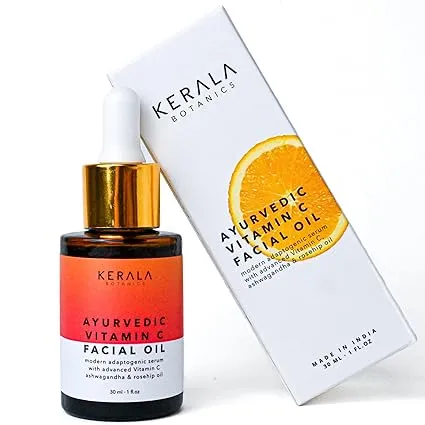
Kerala Botanics sits in an interesting middle zone. Their Ayurvedic Vitamin C Face Oil combines an oil-stable vitamin C derivative with bakuchiol, which means it’s addressing two major categories simultaneously: the stability problem that plagues L-ascorbic acid serums, and the retinol-alternative demand that’s still growing.
The vitamin C form they use is an advanced derivative that stays active in skin cells significantly longer than standard L-ascorbic acid — a real formulation advantage, given how quickly ascorbic acid degrades once oxidized. (You can read more about why vitamin C oxidizes and what to do about it.) The bakuchiol addition makes sense alongside the vitamin C — both are working on brightening and collagen support, and the oil format means they’re genuinely compatible in a way they might not be in a water-based formula.
Cons worth naming: the oil format isn’t ideal for everyone. Oily or acne-prone skin may find it too heavy, especially layered under a separate moisturizer. It may not sit well under heavy makeup for some people. And the clinical data, while promising at the ingredient level, doesn’t match the decades of peer-reviewed research behind SkinCeuticals C E Ferulic.
At $49, it’s priced as a genuine skincare product — not a drugstore pick, not a luxury spend. The combination of Ayurvedic heritage, modern active delivery, and all-in-one format (it replaces a serum, facial oil, and part of your moisturizer step) gives it a real identity rather than just category-filling.
Ayurvedic Vitamin C Face Oil
Kerala Botanics
$49
★★★★☆
What I-Beauty Gets Right That K-Beauty Didn’t At First
K-beauty’s initial Western wave was heavy on aesthetics and light on ingredient education. Glass skin as a concept, sheet masks as a ritual, the 10-step routine as aspiration — it was lifestyle marketing first, chemistry second. The deeper ingredient story (centella asiatica, fermented actives, galactomyces) came later, as consumers started reading labels.
I-beauty’s strength, ironically, is that its ingredient story is already rich. Amla, turmeric, bakuchiol, ashwagandha — these have enough cultural context and emerging science behind them to support genuine ingredient conversations. The Gotu Kola situation is instructive: that ingredient became a K-beauty staple (marketed as “cica”) before most Western consumers learned it was rooted in Ayurvedic and Southeast Asian traditional medicine. We covered that here.
The brands that figure out how to present that complexity clearly — without retreating into vague “ancient wisdom” claims or overclaiming clinical results — are the ones that will earn lasting credibility.
The Honest Limitations
A few things worth keeping in mind before you overhaul your routine around I-beauty.
The evidence gap is real. Ayurvedic ingredients have centuries of empirical use behind them. That matters. But it’s not the same as randomized controlled trials. Ingredients like bakuchiol are closing that gap. Many others haven’t started. Treat claims accordingly.
“Ayurvedic” isn’t a regulated term. Anyone can put it on a label. It doesn’t guarantee traditional sourcing, authentic formulation, or any specific ingredient concentration. Read past the positioning and look at the actual INCI list.
Oil-based formats require honest assessment. There’s a real trend toward traditional Ayurvedic oils and tailams. They can be excellent. They can also be too heavy, pore-clogging for some skin types, or poorly suited to humid climates. Face oils have their place — we’ve covered how to use them properly here — but format fit matters.
The market is enormous and uneven. India’s domestic beauty market is vast, and quality varies dramatically across price points. The brands getting Western attention have generally done the formulation work. That doesn’t mean every I-beauty brand has.
Putting It All Together
I-beauty is not the next K-beauty. It’s something structurally different: a tradition with deeper roots, a domestic market that’s growing faster, and an ingredient library that western skincare has been quietly borrowing from for years without full attribution.
The more honest frame is that I-beauty is graduating from a niche wellness category into a formulation-first one. That shift is what K-beauty made a decade ago. Estée Lauder and L’Oréal seeing it early is not nothing — those companies are slow on trends and fast on revenue signals.
The ingredients to watch are the ones where the mechanism is clear and the evidence is building: bakuchiol (now well-documented), amla-derived vitamin C (promising), ashwagandha topicals (early but plausible), and turmeric derivatives when the delivery system is actually designed for penetration.
For your routine specifically: you don’t need to overhaul anything. But if you’re already interested in simplified routines, retinol alternatives, or oil-based vitamin C formats, the I-beauty category has products that deserve consideration on their actual merits. The cultural context is interesting. The chemistry is what should drive your purchase.
Read the label. Check the evidence. The ancient wisdom and the modern formulation data can coexist — but only one of them goes on your INCI list.